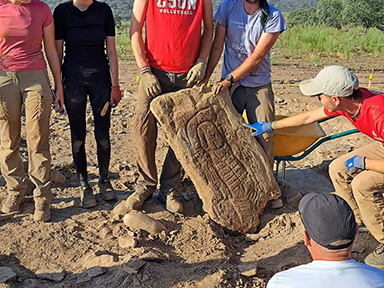
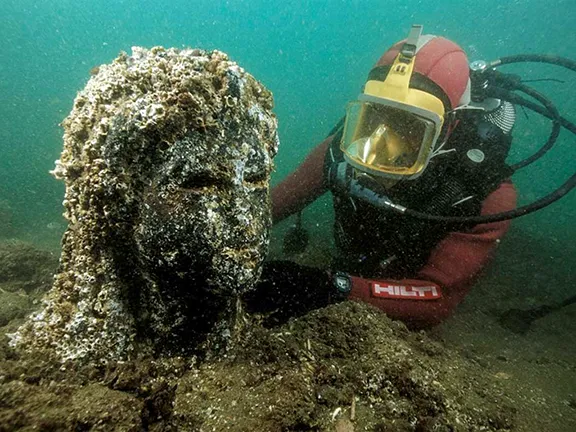
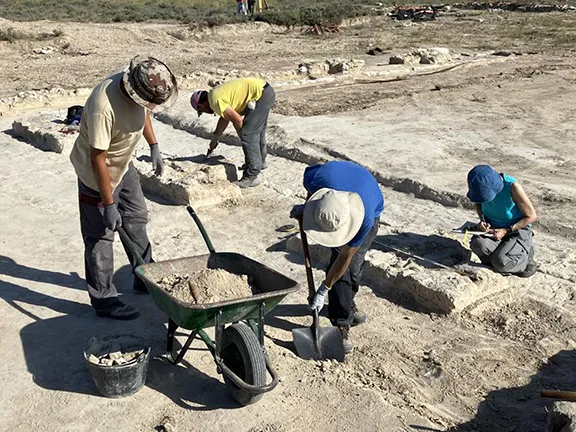
The shipyard, which dates back to the Iron Age (1200-800 BC), was discovered in 2015, but its full extent was only recently realized after years of underwater surveys and excavations. The shipyard contains nearly 294 slipways, which are inclined ramps where ships were built and launched. This means that nearly 300 ships could have been simultaneously built at the shipyard, making it the largest and most productive shipyard in the ancient world.
Contents
Discovering the shipyard
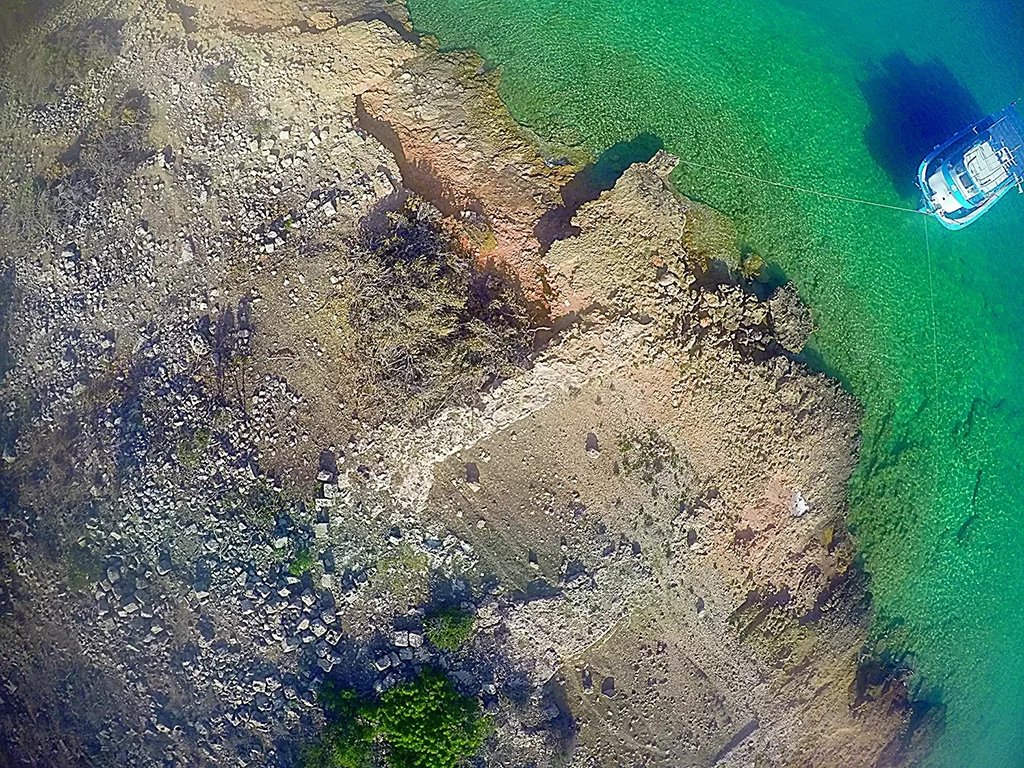
A team of underwater archaeologists from Selcuk University in Turkey has discovered the world's largest and oldest ancient shipyard on Dana Island, located off the coast of Mersin province in the Mediterranean region.
Ancient shipbuilding
"This is a groundbreaking discovery that will revolutionize our understanding of ancient shipbuilding and maritime trade," said Associate Professor Dr. Hakan Oniz, the head of Selkuk University's Underwater Archaeology Department. "The shipyard on Dana Island is evidence of the advanced shipbuilding capabilities of the people of the Iron Age and their sophisticated maritime networks."
The Greek Dark Ages
The discovery of the shipyard on Dana Island is also significant because it sheds light on a period of Mediterranean history that is often referred to as the "Greek Dark Ages." During this period, there is relatively little archaeological evidence available, making it difficult to reconstruct the history of the region. However, the shipyard on Dana Island provides clear evidence that the Mediterranean region remained a centre of maritime trade and shipbuilding even during this period of political and social upheaval.
Island of the Denyen
Just very occasionally, a modern archaeological discovery can be tied to ancient accounts and texts. I will let Dr. Oniz tell the story:
Stating that the Dana Island most probably was known as the island of the Denyen, named the 'Sea People' in the 12th century, Oniz said the Denyens were first mentioned by the Hittite King Telipinu around 1,500 B.C. The Adania region, which King Telipinu mentioned, is the region of Adana and Mersin today, he added. "The reason why this era is called the 'Dark Age' is that we have limited archaeological information about a period of around 300-400 years. Most probably a big drought, earthquakes or epidemic disease occurred in the 13th century B.C.
We can deduce this from the fact that Egyptian Pharaoh Ramses II had to send ships full of grain from the Alexandria region, which is usually productive and suitable for agriculture. Ancient sources suggest there was a famine around this era," Oniz said.
"Probably the Denyens, together with other groups suffering from the famine, attacked Egypt in order to get grain. Ramses III said the Egyptians defeated the Denyens and he sent the captured Denyens and others to remote regions as soldiers. He pursued the other Denyens to their island in the north and destroyed them there," he added.
"But this story is not limited to the Deneyns and the Hittites. We know of the existence of the late Hittite kingdoms in the Cilicia region in the Iron Age. We know that they resisted against the New Babylon Kingdom that wanted their iron and grain. The name of the island became Pitusu in the Iron Age. The King of Babylon Neriglissar described Pitusu as a 'mountain in the middle of the sea.' He said he attacked it and 6,000 soldiers on this small island resisted against him. The existence of those 6,000 people reveals that the island continued serving as a shipyard in the Iron Age too," Oniz said.
First iron ram
Oniz added that they had determined the existence of archaeological wreckages in the region. "But the most exciting for us was an iron spur that we found at a depth of 35 meters and that was used as the weapon of warships in ancient ages. Such an iron spur has been found for the first time in the world," Oniz said.
Ongoing Research
The archaeologists are continuing to excavate and study the shipyard on Dana Island. They hope that their research will shed even more light on the shipbuilding techniques and technologies used in the Iron Age, as well as the maritime networks that connected the Mediterranean region to the rest of the world.