Books by Nick Nutter FREE to read on Kindle
Nick and his wife, Julie, have spent over a quarter of a century travelling around the Mediterranean, from Anatolia in the east to Portugal in the west.
"My passion is history. Over the years I have written countless articles for newspapers and magazines, innumerable blog posts and a few books. The books are mostly orientated round history. I believe the only way to understand any history of an area is to walk the land, breathe the air and appreciate the geography and geology. Failing that, read a book whose author has done just that. All my books are fully illustrated in colour and available as FREE to read on Kindle, as downloadable Ebooks and paperback from Amazon. Enjoy."
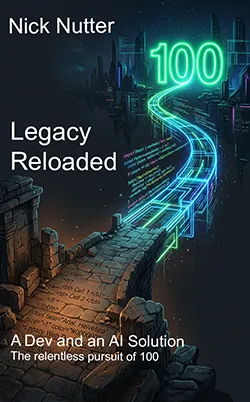
Legacy Reloaded: A dev, an AI, and the relentless pursuit of 100.
Trapped under decades of technical debt?
You don’t have to burn your website down to build it right?
If you built websites in the early 2000s, you remember the golden age of HTML tables, font tags, and rigid pixel widths. We built massive, database-driven empires line by line. It was tedious, but it worked.
But the rules of the internet have changed.
Today, Google’s crawlers and modern screen readers demand semantic HTML, lightning-fast mobile responsiveness, and flawless accessibility. A website built with the best practices of 2006 is practically invisible to the search engines of today. For veteran webmasters, self-taught coders, and developers managing legacy PHP, this is a nightmare. The thought of manually rewriting thousands of files, retrofitting Bootstrap grids, and unpicking decades of inline CSS is enough to make anyone want to abandon their project entirely.
But what if you didn't have to do it alone?
Legacy Reloaded: A dev, an AI, and the relentless pursuit of 100 is the ultimate survival guide for modernising vintage web architecture. It chronicles the real-world journey of a veteran developer who partnered with an Artificial Intelligence pair-programmer to drag a sprawling, twenty-year-old digital empire kicking and screaming into the modern era.
This isn’t a theoretical textbook; it is a battle-tested manual for bridging the gap between the programming grit you already possess and the modern syntax you have yet to master.
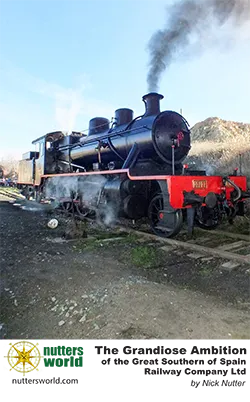
The Grandiose Ambition of the Great Southern of Spain Railway Company Ltd
The founders of the Great Southern of Spain Railway Company Ltd. (GSSR) had a magnificent, grand scheme – to engineer a railway line through some of the most inhospitable landscapes in Spain, from Granada to Murcia.
But was the project doomed to failure? Was that failure part of the original plan? Did the GSSR always scheme to construct and retain control of the only section of line that was likely to be profitable, from Baza to Aguilas?
The Great Southern of Spain Railway Company Ltd. was a British company set up in December 1885 to build a railway line between the city of Granada and the city of Murcia, via Guadix and Baza, down the Almanzora river valley in the province of Almería and over to Lorca and thence to Murcia, with a branch line to Águilas.
The line would mean that Almería would be connected with the north of Spain and have easier access to a Mediterranean port as well as inland markets for a surprising list of commodities including marble, talcum, esparto grass, cereals, flour, oil, wine and fruit and vegetables. The railway line would also stimulate the mining industry particularly the relatively unexploited Sierra Filabres and Sierra Bacarese areas and the GSSR planned to capitalise on the transport of metallic ores, mainly iron ore.
From the first day the Great Southern of Spain Railway Company Ltd encountered problems. The Spanish bureaucracy was, if anything, worse than it is today.
The roads were poor and sometimes impassable, and this made the movement of construction materials difficult. The water available to cool the steam engines was hard and this resulted in the boilers of the engines becoming calcined and sometimes even exploding, and the Spanish supplied coal would not burn at a high enough temperature.
All that before they even began to build a railway line through unforgiving terrain, mountains, badlands, and across deep ravines.
Some of these problems had been anticipated, many had not.
With the same confidence that helped build an Empire, not to mention railway lines throughout the Empire, the Great Southern of Spain Railway Company Ltd. persuaded its first investors that building a line in Spain would be easy. The Great Southern of Spain Railway Company raised an initial capital of £1,250,000 in October 1885 for the railway's construction. This figure was later increased to £1,684,357.
This is primarily the story of the railway line built by the Great Southern of Spain Railway Company Ltd. between Baza and Lorca with a branch line to Águilas where the line ends at the magnificent El Hornillo ore loading dock.
The original project to connect the cities of Granada and Murcia was an unattainable dream. This book continues beyond the dream and finishes what the GSSR started.
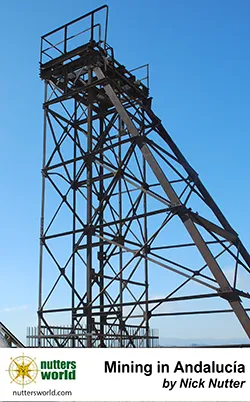
Mining in Andalucia: Emphasising the involvement of British Companies in the 19th and 20th centuries
‘Mining in Andalucia’ looks at the exploitation of the rich mineral deposits found in Andalucia, southern Spain.
During the 19th century, foreign investors arrived from the industrialised nations, France, Germany, Belgium, the Netherlands and Great Britain. The competition to profit from the valuable resources was fierce as mining mania swept through southern Spain. Larger than life characters emerged to dominate the mining industry. Their ambitions were boundless, their pursuit of wealth relentless, their ingenuity remarkable.
Mining companies were registered by the score. Britain led the field with over two hundred companies registered in Andalucia by the end of the 19th century. Many of those companies failed. Only the few would grow and prosper. Those companies that did survive left an indelible imprint on the societies they encountered and on the landscape.
‘Mining in Andalucia’ is the story of the men and women who powered the crusade, who mobilised a workforce numbering thousands, who reaped the rewards and who, a mere hundred years later, relinquished the mines whose visible, crumbling reminders, are slowly being recaptured by nature.
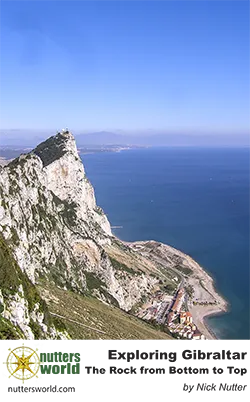
Exploring Gibraltar: The Rock from Bottom to Top
'The Rock from Bottom to Top' is the story of Gibraltar written for the visitor who wants to know a little more than is gleaned from a standard travel guide. It explains how Gibraltar came to be, “Probably the most fought over and most densely fortified place in Europe, and probably, therefore, in the world.” (Field Marshal Sir John Chapple (Governor of Gibraltar 1993 – 1995)).
First published in 2016, The Rock from Bottom to Top was due for an overhaul. We are pleased to publish a second edition on the 320th anniversary of Britain's capture of Gibraltar in 1704.
Completely updated with new images, stories, and anecdotes, Exploring Gibraltar is like no other travelogue or guidebook.
The Rock from Bottom to Top is for anybody interested in the history, attractions, and culture of Gibraltar. You may even decide to visit.
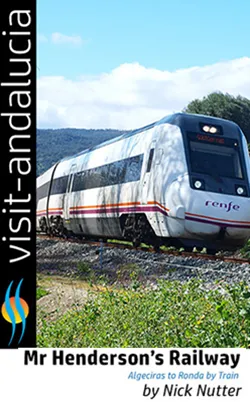
Algeciras to Ronda by Train: Mr Henderson's Railway
'Mr Henderson's Railway' is the story of a remarkable enterprise undertaken at the end of the 19th century by the British in Spain. The railway connects Algeciras with Bobadilla through some of the most difficult terrain in the world. The stretch from Algeciras to Ronda is famous as much for its majestic scenery as for the engineering proficiency of the men who built the line. Once completed villages previously all but cut off from the outside world found new life and markets. The line and complimentary passenger ferry from Gibraltar to Algeciras also connected Gibraltar with the rest of Europe for the first time in 200 years an objective welcomed by the British but not always by the Spanish.
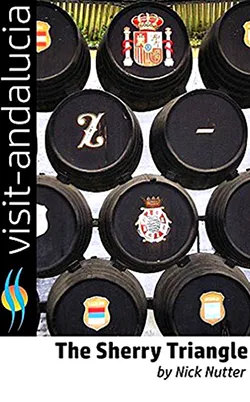
The Sherry Triangle
The fortified wine known as Sherry can only be produced within an area known as the 'Sherry Triangle'. The triangle is bound by the three towns of Jerez de la Frontera, Sanlucar de Barrameda and El Puerto de Santa Maria, all in Cadiz province in Spain. A triangle formed by lines drawn between those towns encompasses an area of approximately 140 square kilometres. The history of Sherry is intimately entwined in the history of those towns and the area between them. It is a history that can be traced back to 1100 BC. The towns themselves are fascinating places in their own right, each with its own attractions and yet with a common denominator, the sherry industry. This book takes you through the history of Sherry overlaid on the history of the towns. Today the sherry industry is not just a commercial venture, it has a prominent part to play within the tourist industry, drawing people from all over the world to the 'Sherry Triangle'. The separate attractions and places to visit in the towns that form the triangle are as much a part of the story as the wine itself.