Contents
When did the Bronze Age Collapse in the Middle East begin?
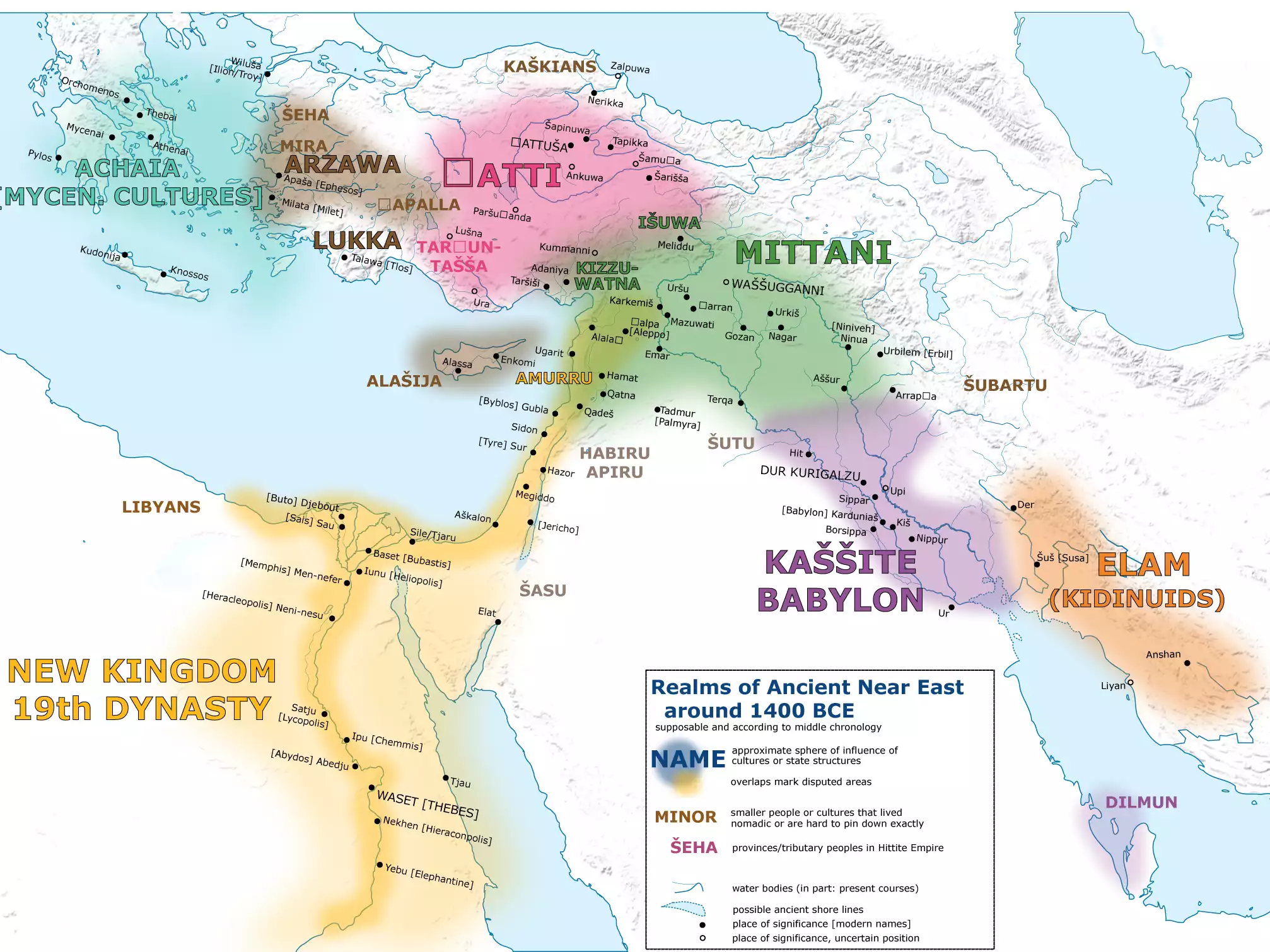
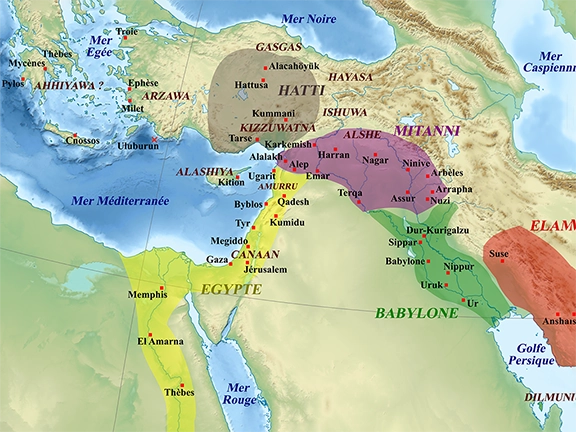
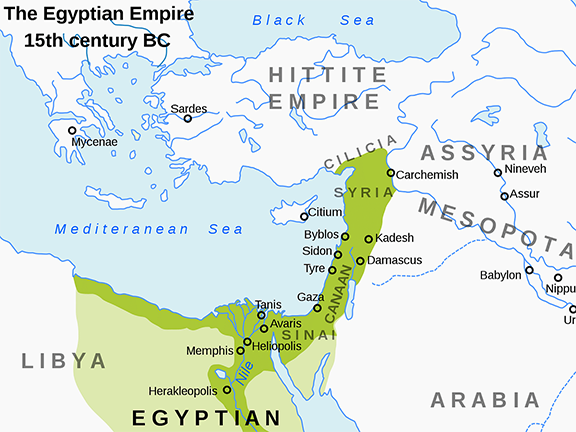
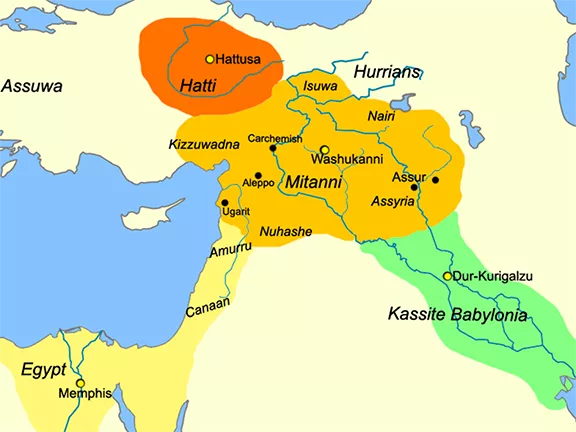
The Great Powers in 1400 BC
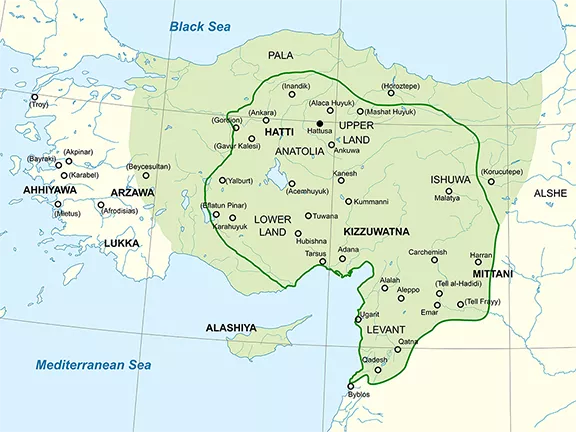
The Hittites
In a fragment of a tablet found at Hattusa, we read of a treaty between Thutmose III or Amenhotep II of Egypt, and Tudhaliya II. It is known as the Kurustama Treaty and dealt with the relocation of some of the population of Kurustama from Hittite into Egyptian territory, in other words, forced labour. We can deduce that, at the beginning of the 14th century BC, relations between the Hittites and Egypt were at least cordial.
The Kingdom of Mitanni
Egyptian New Kingdom
Kassite Babylonians
The Aspiring Great Powers in 1400 BC
Mycenaean Civilisation
They, and their predecessors, the Minoans, had long had a fruitful trading relationship with Egypt. By the end of the Hyksos period in Egypt, about 1530 BC, there was a flourishing Minoan colony at Tell el-Dab'a in the Nile delta. By the time of Thutmose III, about 1425 BC, the city had decorated palace structures in the Mycenaean style and Mycenaean stirrup jars from this time have been found as far south as Thebes and at Tell el Amarna, later famous for the Amarna letters. In Thebes, amongst the painted scenes of daily life found in the tombs of nobles, we find depictions of envoys from Mycenae bringing tributes and gifts to Egypt.
The Mycenaean civilisation reached its peak about 1350 BC, by which time its territory consisted of palatial states on mainland Greece, Crete, parts of western Anatolia and the Aegean islands as far as Rhodes. The palatial states boasted a complex administrative system. Work was divided among specialized departments, each handling specific trades and tasks. At the head of this society was the king, known as wanax.
Elam
1400 BC ushered in the Ighalkid Dynasty that was to last two hundred years. Elam had forged a profitable trade network that extended down the Persian Gulf and east as far as the Indus Valley civilisation which made it an attractive target for the adjoining power, the Kassite Babylonians. In 1400 BC, Elam was ruled by the first of the Igihalkid dynasty, Igi-halki, who probably usurped the throne. Most of the references to the Kingdom of Elam come from texts from neighbouring powers, very few native texts have so far been found. The regnal dates during the Igihalkid dynasty are very tentative, those of the succeeding Shutrukid dynasty from c 1200 BC are more accurate.
Assyria
Arzawa
During the reign of Thutmose III (1479 BC to 1425 BC), Arzawa is mentioned for the first time in Egyptian texts. In an inscription at the Temple of Karnak, Thutmose boasts of his conquest of over one hundred territories, including Arzawa from where he took 175 prisoners.
In the diaries from the royal shipyard at Perunefer, we are informed that Arzawans are employed as shipbuilders during the same period. One such worker is simply called 'the Arzawan' who is also named in a papyrus in the British Museum where his position is given as 'chief craftsman', or 'head carpenter'.
Kings in 1400 BC
HittitesTudhaliya II
Kassite Babylon Kadashman-Harbe I
Mitanni Artatama I
Assyria Ashur-nadin-ahhe II
c 1400 BC Kurigalzu I becomes King of Babylon (until c 1375 BC)
c 1400 BC Thutmose IV becomes Pharoah of Egypt (until c 1390 BC)
Little is known about the ten year reign of Thutmose IV apart from his continued efforts to maintain friendly relations with Mitanni by marrying a Mitannian princess, and we only know that from one of the Armana letters written decades later by the Mitannian king Tushratta in a letter to Pharoah Akhenaten.
'When [Menkheperure], the father of Nimmureya (i.e.,Amenhotep III) wrote to Artatama, my grandfather, he asked for the daughter of my grandfather, the sister of my father. He wrote 5, 6 times, but he did not give her. When he wrote my grandfather 7 times, then only under such pressure, did he give her.
The letter implies that Thutmose IV had to request a bride from Artatama I of Mitanni no less than seven times before Artatama agreed to the union.
Thutmose IV had inherited a religious problem from his father, Thutmose III. Of the many gods worshipped by the Egyptians, Amun was one of the most powerful and the Priests of Amun were the dominant priesthood. Thutmose III donated riches and land to the Priests of Amun to such an extent that their power rivalled that of the pharaoh himself. To curb their power, Thutmose IV promoted the solar deity, Aten and pronounced himself the sun god Ra, the creator of life. This religious conflict was to have dire consequences when his grandson, Amenhotep IV came to the throne.
c 1390 BC Pahir-ishshan I becomes King of Elam (until c 1380)
c 1390 BC Arnuwanda I becomes King of the Hittites
The Assuwa Rebellion
'But when I turned back to Hattusa, then against me these lands declared war: [...]lugga, Kispuwa, Unaliya, [-], Dura, Halluwa, Huwallusiya, Karakisa, Dunda, Adadura, Parista, [ ], [-]waa, Warsiya, Kuruppiya, [-]luissa, Alatra, Mount Pahurina, Pasuhalta, [-], Wilusiya, Taruisa. [These lands] with their warriors assembled themselves ......... and drew up their army opposite me.'
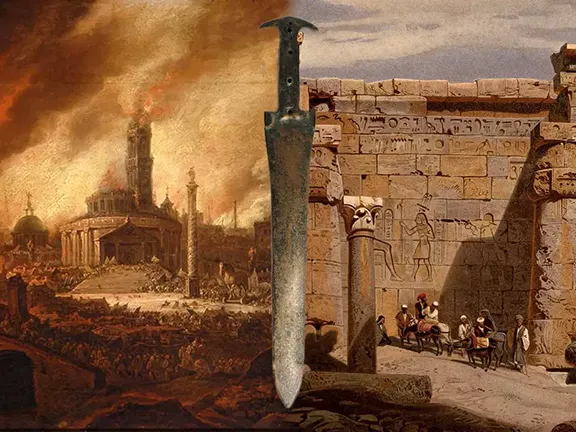
The Assuwa confederation may have been supported by the Ahhiyawans (Mycenaean Greeks), a supposition based on the finding of a Mycenaean style sword found at Hattusa that bore an inscription suggesting that is was taken from an Assuwan soldier and then given as an offering to the Hittite storm god and, as we shall see below, a short reference to Ahhiyawa in a Hittite text.
In any case, we know of at least two campaigns against Arzawa when the two kings defeated Kupanta-Kurunta of Arzawa and it is during the second of those campaigns that the irrepressible warlord Madduwatta makes an appearance. He is known solely from a Hittite text called 'The Indictment of Madduwatta', the text of which is biased towards the Hittite view but gives an idea of the upheavals and political shenanigans occurring in Anatolia in the first quarter of the 14th century BC. It also gives an insight into the problems the Bronze Age kings had when dealing with unruly, ambitious and duplicitous vassals.
The Rebel Madduwatta
Soon after the appointment of Arnuwanda as joint ruler of the Hittite Empire, Madduwatta embarked on a disastrous campaign against Kupanta-Kurunta. The Hittites had to send an army to rescue Madduwatta (probably the second Hittite campaign against Arzawa).
Returned to Zippasia, Madduwatta chose to turn a blind eye towards an incursion by his old foe, Attarissiya and again the Hittites had to send an army to bail him out. There is a suggestion that Madduwatta gave away the position of the Hittite troops to Attarissiya resulting in their defeat.
Undeterred Madduwatta turned his attention to Hittite vassal states in southwestern Anatolia, with rather more success, carving out for himself a small kingdom. He subjugated Hapalla and a number of unidentified territories, Iiyalanti, Zumarri and Wallarimma that were probably part of the neighbouring state of Lukka.
Madduwatta claimed that he was only acting in good faith because Hapalla was intending to rebel against Hittite overlordship.
Arnuwanda, who by now had had enough of his uncontrollable servant, demanded Madduwatta's extradition that was, predictably, ignored. Madduwatta went on the incite anti-Hittite rebellions in other Hittite vassal states.
The indictment recalls,
'Then because Madduwatta did not go to Dalauwa for battle, but in fact wrote away to the people of Dalauwa (saying): '[The troops] of Hatti have just gone to Hinduwa for battle. Block the road before them and attack them!'... 'They proceeded to block the way [of our] troops and routed them. They killed Kisnapili and Partahulla. But [Madduwatta] laughed out loud about them.'
Having established himself through military means, Madduwatta decided to use diplomacy to entrench his position and came to an agreement with his two long time enemies, Kupanta-Kurunta and Attarissiya, after all, they were all now on the same side.
Madduwatta offered to send his daughter to Kupanta-Kurunta to be his wife. Whether the offer was accepted is not known.
More seriously, Madduwatta then allied himself with Attarissiya and set sail for Alashya (Cyprus), an island considered by the Hittites to be their own. Having apparently taken the island, Madduwatta tried to distance himself from the affair, claiming he did not know the island belonged to the Hittite king.
'Madduwatta said thus: ...the father of his Majesty [had never informed] me, [nor] had his Majesty ever informed [me] (thus): ?The land of Alasiya is mine, recognize it as such!?'
What became of Madduwatta is not recorded.