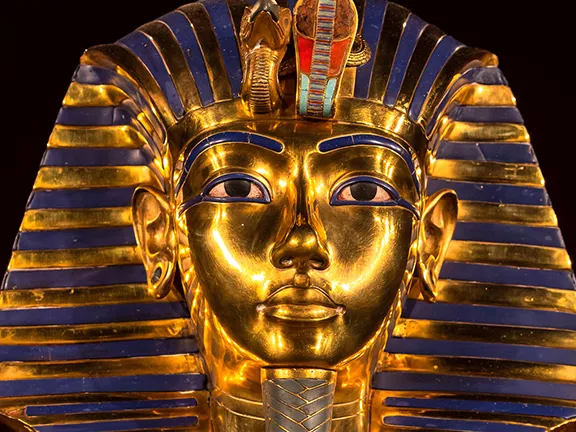
Egypt Pharoah Thutmose IV
Hittites Tudhaliya II co ruling with Arnuwanda I
Kassite Babylon - Kadashman-Harbe I
Mitanni Artatama I
Assyria Ashur-nadin-ahhe II
Contents
Kings in 1387 BC
c 1387 BC Amenhotep III becomes Pharoah of Egypt (until c 1348 BC)
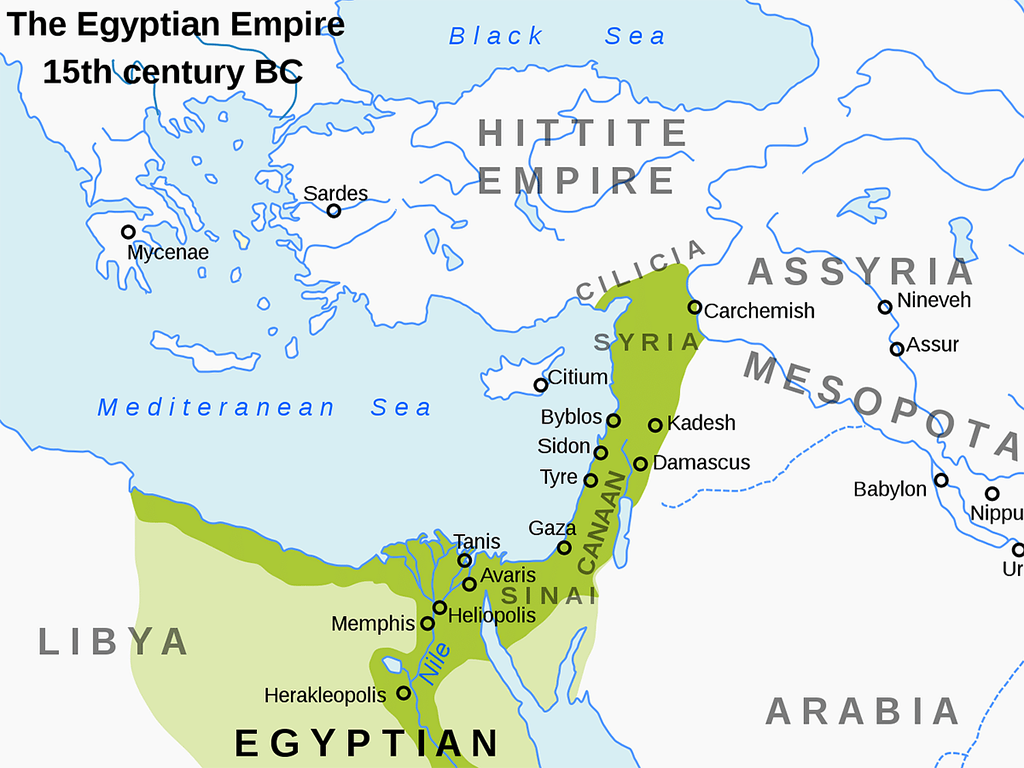
Amenhotep III inherited a vast empire from his father, Thutmose IV, when he inherited the throne at the age of 11 or 12 years of age. Egypt was the undisputed great power in the Middle East that others tried to emulate. We know about this period from the tablets discovered in the 'Office of the Pharaoh's correspondence' in Armana, and they show an empire more interested in trade than war and illustrate the relationships between the various powers in the Middle East and the eastern Mediterranean.
To solidity friendships between the Great Powers, during his reign, Amenhotep married two Mitanni princesses, Gilu-Hepa and Tadukhipa, and maintained alliances with Kassite Babylon. He also married three of his daughters, including his first-born daughter Sat-Amun, who became a Great Royal Wife about 1358 BC on the occasion of Amenhotep's First Jubilee.
During the first years of his reign, there was a Regency Council dominated by Mutemuia, Amenhotep's mother and secondary wife of his predecessor, Thutmose IV. About 1360 BC, his son, Amenhotep IV, who would become pharaoh Akhenaten, was appointed co-regent.
The jealousy between the Priests of Amun and the pharaonic court rumbled on into the reign of Amenhotep III. He appears to have come away from his father's idea of personifying the sun god Ra. His inscriptions and memorials up until the co-regency period associate Amenhotep with a number of gods in the Egyptian pantheon. To further distance himself, Amenhotep moved away from Thebes, building new palaces at Malkata and El Fayum.
c 1385 BC Amenhotep III marries Tiy
Although the marriage between the daughter of a Syrian chariot chief, who was probably Mutemuia's brother, and Amenhotep, was arranged by Mutemuia, and the fact that Tiy was two years younger than her cousin, Amenhotep, the two immediately bonded in a strong marriage that lasted for the entire life of the pharaoh. Tiy became Amenhotep's first Great Royal Wife. She also became the power behind the throne.
Pharaohs since Hatshepsut, over one hundred years previously, had kept their wives firmly out of the way in the harem to curb their influence in court. Amenhotep broke with this tradition and Tiy became a true shadow ruler and appeared in frescoes and statuary alongside her husband.
c 1380 BC Shuttarna II becomes King of Mitanni (until c 1360 BC)
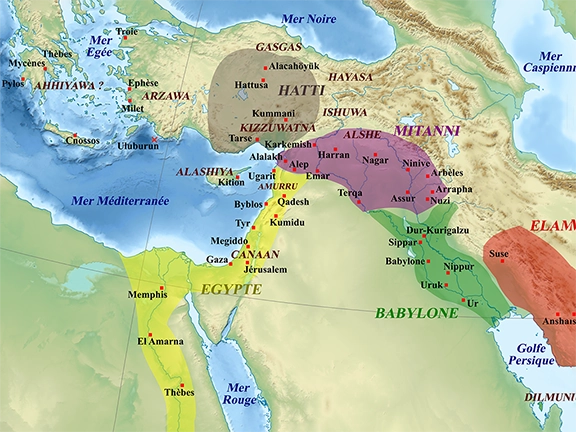
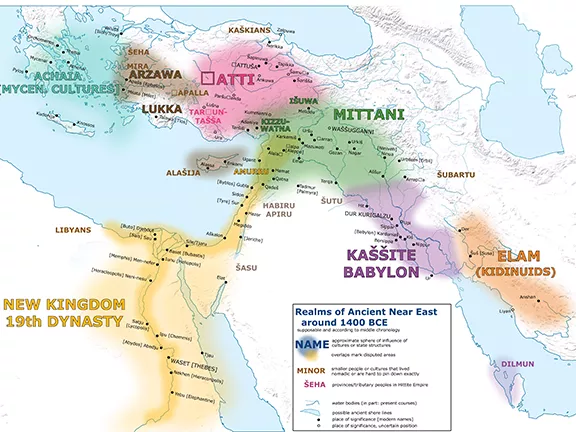
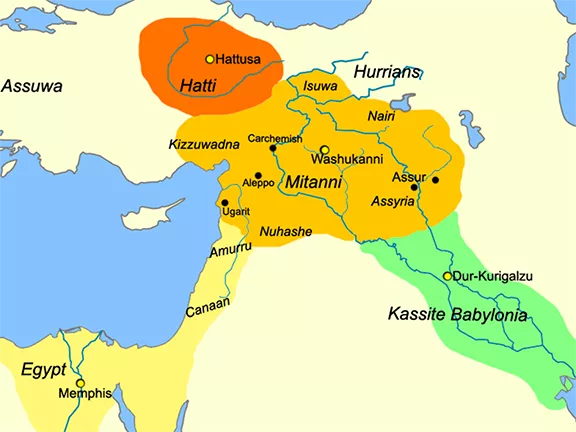
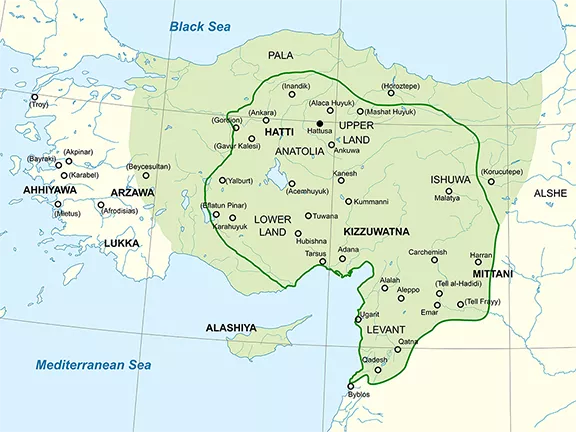
The Mitanni Kingdom, under the rule of Shuttarna II, experienced its zenith of power and prosperity. Its territory extended from Alalakh in the west to the vicinity of the Orontes River, bordering Egypt in northern Syria. Archaeological evidence supports Mitanni's influence; two tablets sealed by Shuttarna were unearthed at Tall Bazi along the Euphrates River. Additionally, his seals have been discovered at Alalakh, Tell Brak, Nuzi, and Umm el-Marra. The Khabur River valley served as the kingdom's core, housing the capital Wassukanni. Both Assyria and Arrapha in the east were vassal states to Mitanni.
A Strategic Marriage Between Mitanni and Egypt
In approximately 1380 BC, a strategic alliance was solidified between Mitanni and Egypt through the marriage of Mitanni King Shuttarna's daughter, Gilu-Hepa, to Egyptian Pharaoh Amenhotep III. To commemorate this union, Amenhotep commissioned a special series of scarabs, documenting the princess's arrival accompanied by 317 ladies-in-waiting. He recorded that:
'the princess was escorted by 317 ladies-in-waiting, women from the Mitanni king's royal palace.'
Gilu-Hepa assumed the title of "Secondary King's Wife," a position subordinate to Amenhotep III's primary consort, Queen Tiye.
Safeguarded by this alliance, Egypt enjoyed an unprecedented era of peace, stability, and prosperity under Amenhotep III's reign. This idyllic period contrasted starkly with the turmoil experienced by the Hittite Empire, which faced invasions from multiple fronts, bringing it to the brink of collapse. Recognizing Hatti's weakened state, Amenhotep sought to establish an alliance with the rising power of Arzawa in western Anatolia. However, the Hittites defied expectations, recovering their strength, and engaging in a protracted conflict with Mitanni. Despite this regional instability, Egypt maintained cordial relations with both powers, opting for neutrality as its thriving economy, robust administration, and opulent treasury ensured domestic tranquillity and enabled the construction of monumental architectural structures.
c 1380 Eriba-Adad I becomes King of Assyria (until c 1353 BC)
Eriba-Adad I succeeded his nephew, Ashur-nadin-ahhe II as King of Assur. At this time Assur was to all intents, a vasal state of the powerful Mitanni Empire and would remain so until the middle of the century.
c 1380 Attar-kittah becomes King of Elam (until c 1370)
Attar-kittah was probably the son of the founder of the Igihalkid dynasty, Igi-Halki. He is mentioned as such on two mace heads found in Chogha Zanbil, one of only a few ziggurats found outside Mesopotamia, situated about thirty kilometres southeast of the Elam capital of Susa. Details of his rule are not known.
c 1380 BC - Kaska Tribes Threaten Hatti
We now return to the Hittite Empire where Arnuwanda I has become sole ruler of the Hittite Empire. As if his problems with the rebel Madduwatta were not enough (see previous article), Arnuwanda I also had to contend with problems on the northern frontier of his empire.
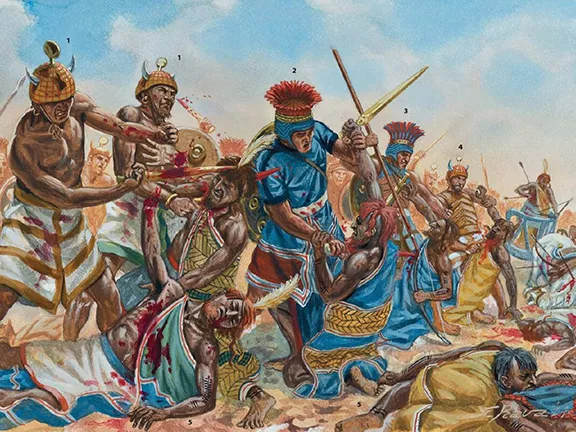
The Kaska were a tribe that lived in the mountains between the core Hittite region in eastern Anatolia and the Black Sea. They first appear in written records about 1450 BC and posed a perennial threat to the Hittites being, at times, able to raise an army of 9,000 warriors and eight hundred chariots. When not engaged in raiding or offering themselves as mercenaries, they raised pigs and wove linen.
The Kaska people are first mentioned in Hittite prayer inscriptions dating back to the reign of Hantili II (circa 1450 BC), which reference their encroachment into the ruins of the sacred city of Nerik. During the reign of Hantili's son, Tudhaliya II (about 1430 BC), Hittite records indicate that Tudhaliya's third military campaign was directed against the Kaska tribes. Tudhaliya's successor, Arnuwanda I, composed prayers seeking divine intervention to return Nerik to Hittite control. He also named Kammama and Zalpuwa as cities that he claimed had once been part of the Hittite empire but were now under Kaska dominion. Arnuwanda attempted to appease some of the Kaska tribes by offering them tribute.
c 1374 BC Kadashman-Enlil I becomes King of Kassite Babylonia (until c 1360 BC)
Kadashman-Enlil succeeded Kungalzu I who was either his father or his brother. His fourteen-year reign is remarkable for the apparent stability during that time. Kadashman-Enlil had no ambition to widen his empire, and he was not beset by any foes wanting part of his. In fact, he is primarily known through five Armana letters between himself and Pharaoh Amenhotep III attempting to arrange marriages between the two empires.
c 1370 BC Humban-numena I becomes King of Elam
Son of his predecessor, Attar-kittah, Humban-numena I married a daughter of the Babylonian king Kurigalzu I through whom they had a son, Untash-Napirisha. He therefore managed to stay on peaceful terms with Kassite Babylon who were, in turn, on friendly terms with Egypt.
c 1360 BC Artashumara becomes king of Mitanni
Approximately 1360 BC, Artashumara inherited the Mitanni throne from his father, Shuttarna II. Soon after taking the throne, according to one of the Armana letters, he was murdered by an individual called Tuhi. His brother, Tushratta, took the crown.
Whilst assassinating a sitting monarch may seem extreme, it was not an uncommon occurrence during the bronze age. Kings were expected to be superior warriors. Their fitness to govern was measured by how successful they were in battle, how much territory they could acquire and how much loot they could obtain. Kings that failed to live up to expectations could expect to lose their crown and the head on which it was placed.
c 1360 BC Tudhaliya III becomes King of the Hittites (until c 1350 BC)
The reign of Hittite King Tudhaliya III marked a catastrophic period for the Hittite Empire. The heartland of tkingdom he was overrun by invaders.
The Sacking of Hattusa
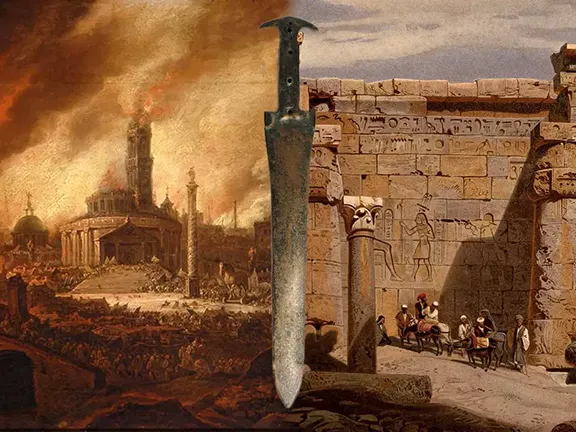
Letters found during excavations at Masat Hoyuk reveal that locust swarms devastated the Kaska people's grain supply sometime during the early years of Tudhaliya's reign. Faced with starvation, the Kaska allied with their eastern neighbours, the Hayasa-Azzi a confederation of two kingdoms from the Armenian Highlands and Isuwa. Together they successfully sacked and burned Hattusa, the Hittite capital, forcing the king into exile at Samuha, a remote eastern outpost.
The sacking of the Hittite capital signified a near-fatal blow to the empire and the relocation of the royal court to Samuha only a temporary reprieve as this city was taken by Hayasa-Azzi soon afterwards and Tudhaliya was obliged to relocate to the secondary capital of Sapinuwa. It is likely that the Kaska alliance also destroyed Sapinuwa.
Even Pharoah Amenhotep III thought this may be the end for the Hittites, writing to Tarhundaradu, king of Arzawa;
"I have heard that everything is finished and that the country of Hattusa is paralysed"
and asks Tar hundaradu to send him some of the Kaska people of whom he had heard.
Despite the failure of the Assuwa rebellion only thirty years previously, Arzawa was still a power to be reckoned with and an obvious one to fill a void left by a collapsing Hittite Empire.
An Alliance between Arzawa and Egypt
In the same letter, Amenhotep asks Tarhundaradu if he might have one of the Arzawan princesses as a bride. In this portion of the letter, Amenhotep addresses Tarhundaradu as 'brother', implying an equality between the two, the closest Arzawa ever came to being considered one of the 'Great Powers'.
It is worth looking at the correspondence in more detail. The first Armana letter, EA 32, is in a museum in Berlin. The first letter seems to refer to a verbal request for a bride that Tarhundaradu did not trust and is a written response back to Amenhotep.
'See, this message which Kalbaya spoke to me' (saying): 'Let us make ourselves a marriage-alliance, [now] I do not trust Kalbaya. He spoke it verbally, but on a tablet it was not set down. Now if truly my daughter you are seeking, will I not indeed give (her) to you? (Of course) I will give (her) to you! Now dispatch Kalbaya back to me with my envoy in haste, and write back this matter to me by tablet.
The scribe who reads this tablet may Nabu king of wisdom and the Sun-God of the Gatehouse duly protect him,
and may they duly hold (their) hands around you! You, Scribe, duly write to me, also put your own name after. The tablets which they will bring, always write in Hittite.'
The second, CG 4741, is in the Egyptian museum in Cairo.
'Thus says Nimuwaria (the scribe), Great King, King of the land of Egypt, to Tarhundaradu, King of the land of Arzawa, speak. With me (it is) well, my houses, my wives, my sons, the nobles, my army, my horse, anything of mine within my lands all (is) well. With you may all be well, your houses, your wives, your sons, the nobles, your army, your horse, anything of yours
See, I have sent you Irrappa, my envoy. Let us see the daughter whom they will bring to My Majesty for marriage. For her (he will?) pour oil on her head. See I have sent you one nice gold (zu)halaliya. The works for which you wrote to me (saying): Send them to me, I will send them to you afterwards. Dispatch back to me your envoy and my envoy at once and let them come, and they will come and bring you the bride-price for your daughter my envoy, but the envoy who came (as) yours, he has died (?). Bring me people of the Gasga-land. I have heard that everything is finished and that the country of Hattusa is paralysed. Now see, I have sent you a consignment duly by the hand of Irrappa my envoy.'
There follows a lengthy list of gifts.
For Tarhundaradu this offer of marriage must have been a great coup. It would enhance his reputation and prestige and, economically, it could only benefit Arzuwa. From the tone of the letters, Amenhotep is well aware of the fragility of the Hittite Empire and wants an alliance with the new power on the block.
Hattusa Restored
The ambitions of a resurgent Arzuwa and the fears of a pessimistic Amenhotep were not to be realised. Within a short time of Hattusa being taken, Tudhaliya III and the man who would succeed him, Suppiluliuma I, who is variously described by scholars as Tudhaliya's son or son in law, established their base of operations in Samuha and launched an offensive against the Azzi-Hayasa confederation. The Kaska people intervened, but Suppiluliuma successfully repelled their attack. After securing the region, the Hittites turned their attention to Hayasa, ultimately overcoming their resistance, despite facing challenging guerrilla tactics.
Subsequently, twelve Kaska tribes united under the leadership of Piyapili, a Kaskan noble who governed Nerik. But his forces were no match for Suppiluliuma's military prowess. Through their combined efforts, Tudhaliya and Suppiluliuma successfully restored Hattusa to Hittite control. Both Hayasu and Azzi were forced into becoming Hittite vassal states. Some of the Kaska warriors were enlisted in the Hittite army as mercenaries.
One of the new kings of Hayasu, Hakkani, married a Hittite princess and, after Suppiluliuma succeeded his father on the Hittite throne about 1350 BC, went on to also marry Suppiluliuma's sister.
Despite their defeat, the Kaska remained a persistent threat, both internally and externally, posing a constant challenge to Hittite security.