Contents
Canopus: A Submerged Jewel of Ancient Egypt
Foundation and Strategic Location
Canopus was not an isolated outpost but rather part of a dynamic maritime landscape. It lay in close proximity to Thonis-Heracleion, often considered its sister city. Ancient accounts, notably by Strabo, describe Heracleion as lying "straight to the east" of Canopus, whilst Frank Goddio, a lead archaeologist on the current excavation project, states that Thonis-Heracleion was approximately 3 kilometres to the east of Canopus. This close relationship meant the two cities functioned as complementary ports, facilitating extensive trade between Egypt and the Greek world before the foundation of Alexandria by Alexander the Great in 331 BC. Their proximity is further highlighted by a yearly religious procession of the god Osiris, which journeyed from Thonis-Heracleion to a sanctuary in Canopus, illustrating their intertwined spiritual and civic lives.
Purpose and Prosperity of Canopus
Furthermore, Canopus was a significant religious centre. It housed important sanctuaries dedicated to Egyptian deities such as Osiris, and later, the Greco-Egyptian god Serapis. These temples became sites of pilgrimage, where individuals sought spiritual solace and miraculous healing, cementing Canopus's reputation as a sacred destination. The city's cultural allure was so profound that the Roman Emperor Hadrian, captivated by its charm, famously commissioned a replica of a part of Canopus for his opulent villa in Tivoli, Italy.
Architectural Grandeur and Submerged Finds
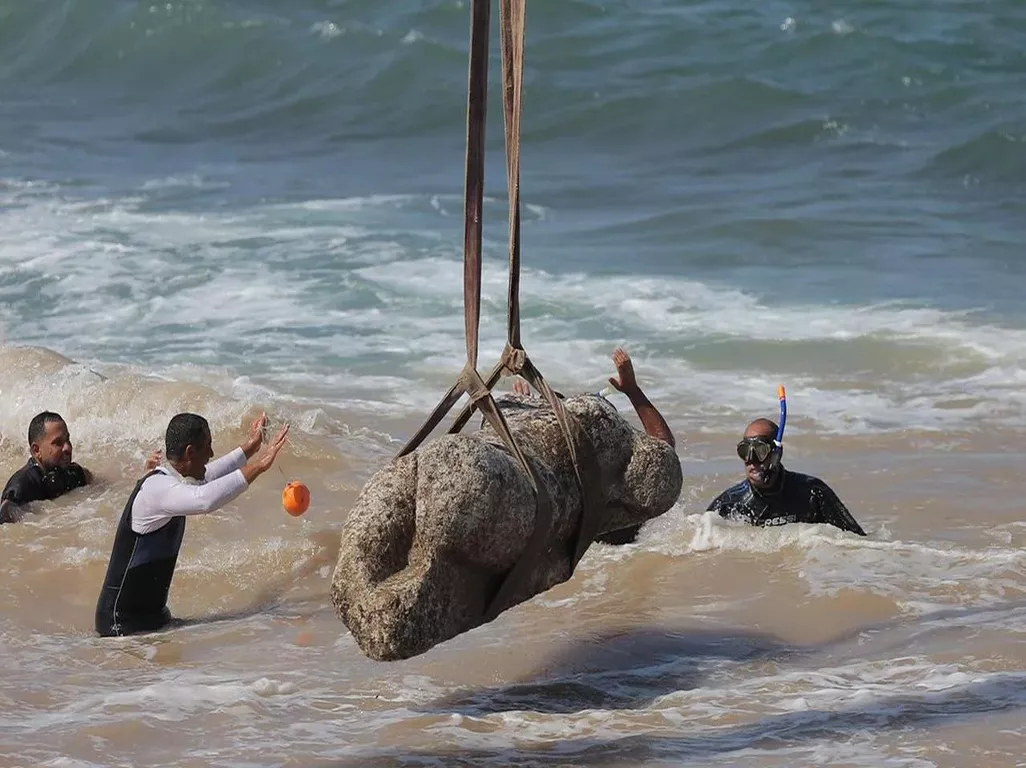
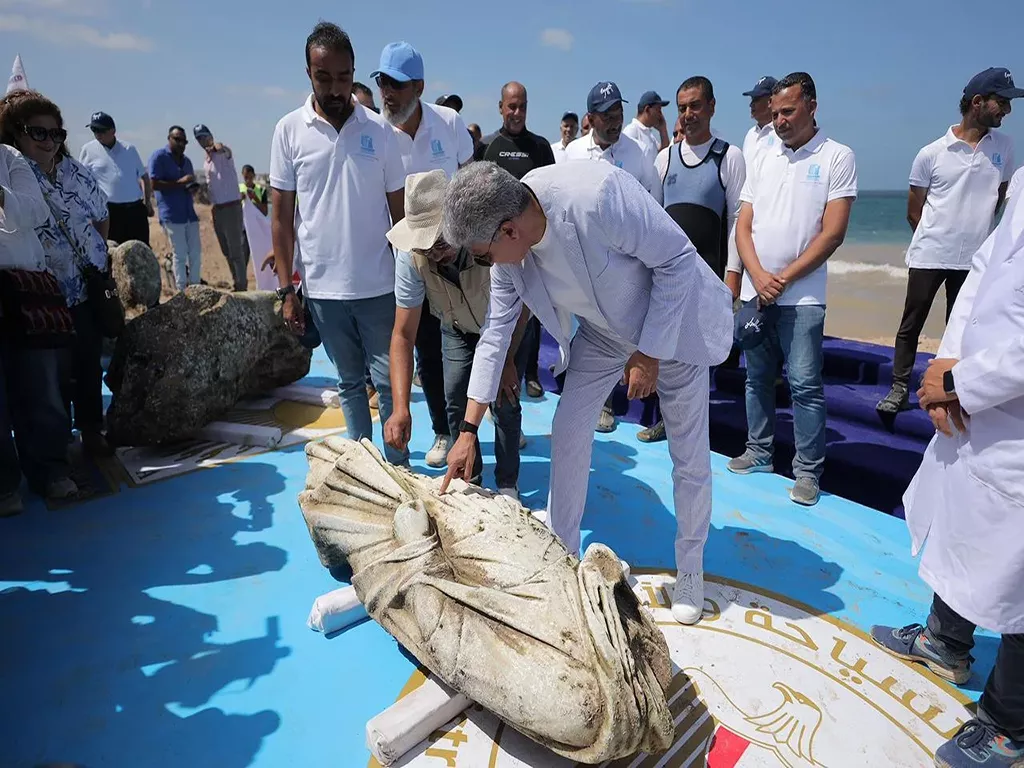
Over decades, the efforts of organizations like the European Institute for Underwater Archaeology (IEASM) and the Egyptian Ministry of Tourism and Antiquities have brought forth a remarkable collection of artifacts. Recovery operations in August 2025 have yielded particularly impressive finds:
Colossal Statuary: Among the most awe-inspiring discoveries are several large statues recovered in . These include a magnificent quartz sphinx bearing the cartouche of Pharaoh Ramses II, a symbol of Egypt's ancient dynastic heritage. Also recovered are a headless granite statue of an unknown Ptolemaic figure and the lower half of a white marble sculpture depicting a Roman nobleman, attesting to the city's longevity and its importance across different historical periods.
Maritime Evidence: The city's role as a port is illustrated by the discovery of fragments of a merchant ship and stone anchors. A substantial 125-meter-long dock further confirms its capacity to handle significant maritime traffic, primarily from smaller vessels.
The merchant ship was laden with walnuts and almonds, a sign of Canopus’s role as a thriving port, as well as Olynthian millstones, a non-rotary grinding stone uncommon in Egypt, which shed light on technological and cultural exchanges during the Greek and Roman eras.
Everyday Life Artifacts: Beyond the monumental, countless smaller artifacts offer glimpses into daily life. Pottery, coins, and even a copper measuring scale have been recovered, providing context to the economic activities and social customs of ancient Canopus.
Ushabtis (funerary figurines) and stone anchors further underline the city’s funerary traditions.
Perhaps most telling are the everyday objects such as amphora handles stamped with merchant seals, coins from the Ptolemaic and Roman periods, along with a Byzantine coin, and even Islamic era finds such as a clay pipe and part of a balance weight found at the site.
These artifacts, after careful conservation, are gradually being presented to the public, with some already featured in exhibitions like "Secrets of the Sunken City" at the Alexandria National Museum.
The Decline of Canopus
Conclusion
“The evidence suggests that this newly uncovered area may represent an extension of the ancient city of Canopus, a major centre during the Ptolemaic Dynasty which ruled Egypt for nearly 300 years and later under the Roman Empire which governed for some 600 years. Alternatively, it could be the remains of a smaller town known as Taposiris-Parva, which was gradually destroyed over time,” said Mohamed Abdel-Meguid, a senior archaeologist at the Underwater Antiquities Department of the Supreme Council of Antiquities (SCA).
Taposiris Parva is mentioned by the ancient Greek geographer Strabo in his account of the road between Alexandria and Canopus. Strabo wrote that the young people of Alexandria would celebrate feasts in the neighbourhood of the city, and it is also known for its association with the god Osiris as it had a large temple dedicated to him that was destroyed during the fifth century during the Christian period.