By Nick Nutter |
Published: 2024-04-24 |
Updated: 2025-05-20
Visited 5,841 times
The Modi island shipwreck contained ceramics from Mycenae and dates to the late bronze age.
Contents
Where was the Modi Island wreck found?
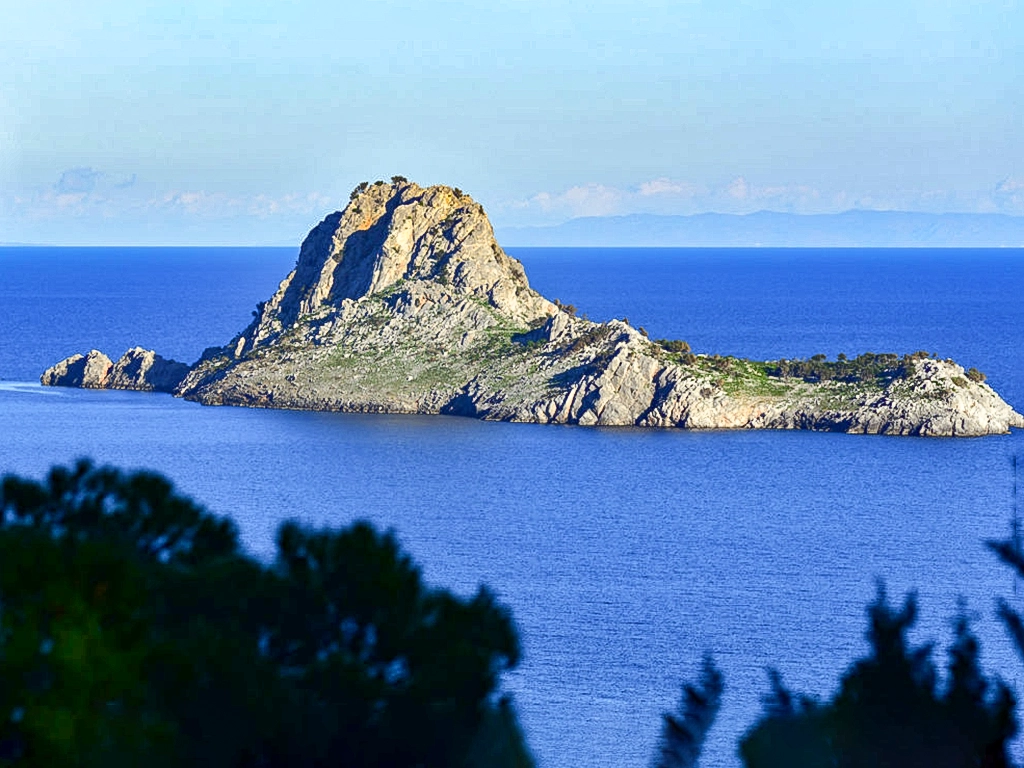
Modi Island
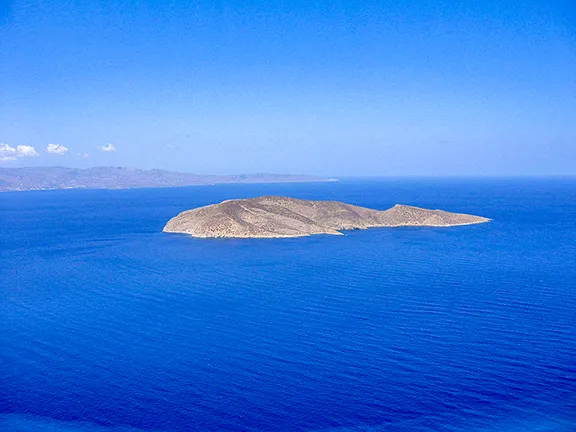
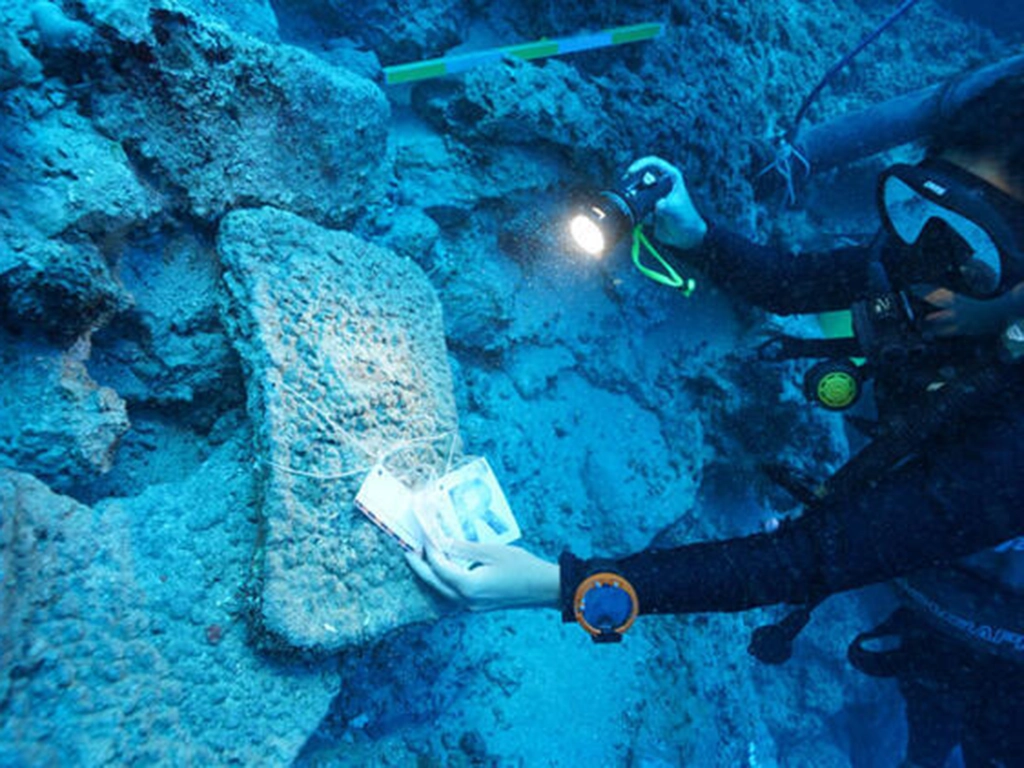
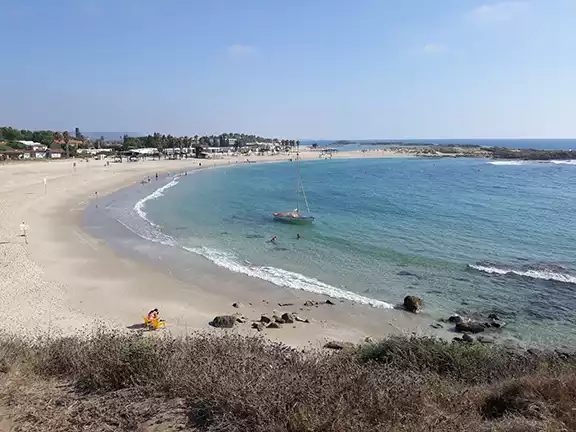
Modi is situated at the southwest end of the Saronic Gulf, at a distance of less than 1.8 kilometres southeast from the nearest coast of Poros (known in ancient times as Kalavreia). The shipwreck is located on the northern, steep, rocky bottom, of the island at a depth of 24 to 37 m.
About the Modi Island wreck site
The rocky, uninhabited islet reaches a height of 102 m above sea-level and extends about half a mile from southwest to northeast. Its steep coastline offers limited access to a safe anchorage. Modi's remarkable shape, like a seated lion, explains its second name Liontari (lion, in Greek) and makes it an important landmark on one of the most frequent sea routes in the Aegean throughout the centuries.
The seabed is extremely rugged. The site is covered with rocks, which have rolled down from higher levels of the underwater site as well as from the land.
Excavations carried out on Modi island, under the direction of Dr Eleni Konsolaki, Ephorate of Piraeus, provided evidence for the existence of a well-planned, prosperous settlement, established between 1320 BC and 1200 BC, which would have flourished for a few hundred years. The site had been occupied for its geographical advantages as an important port of call on the maritime trade routes extending through the Argo-Saronic region and beyond.
Who excavated the Modi island shipwreck?
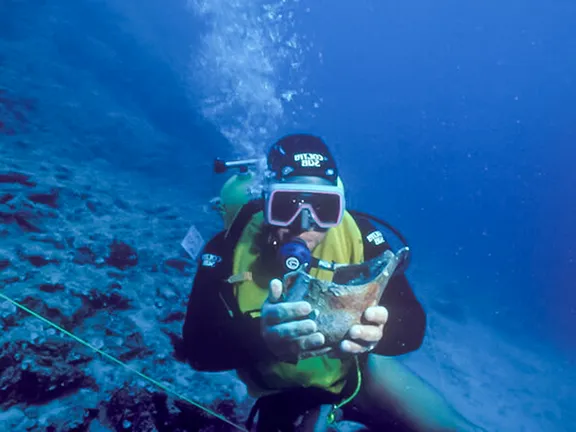
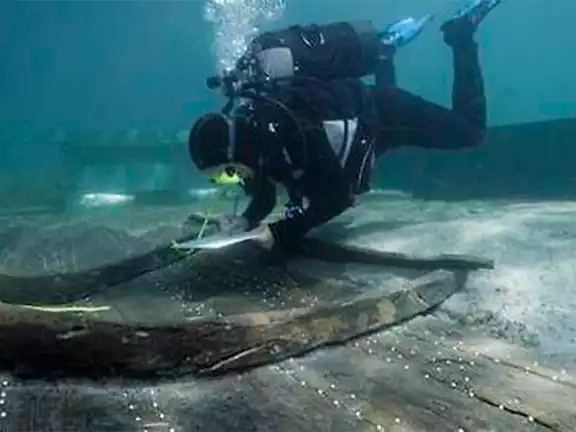
The Modi shipwreck was discovered during a systematic underwater archaeological survey in selected areas of the Argo-Saronic Gulf carried out since 2003 by the Hellenic Institute of Marine Archaeology (HIMA), under the direction of Christos S. Agouridis. A marine geophysical survey was carried out in collaboration with the Laboratory of Marine Geology and Physical Oceanography, University of Patras (LMGPO), under the coordination of George Papatheodorou, with Maria Geraga supervising the data processing and analysis. Excavations are still underway each year.
When did the Modi island wreck sink?
The style of the ceramic pithoi and hydria recovered indicate a sinking date of between 1300 and 1200 BC.
How was the Modi island ship built and what were its dimensions?
None of the Modi island wreck hull remains so an estimate of the vessel's size is obtained by looking at the scatter pattern of the cargo. It is likely that the Modi shipwreck was larger than the Point Iria shipwreck, probably about the same size as the Gelidonya shipwreck, about 7 metres with a crew of two or three.
What was the Modi Island ship's cargo?
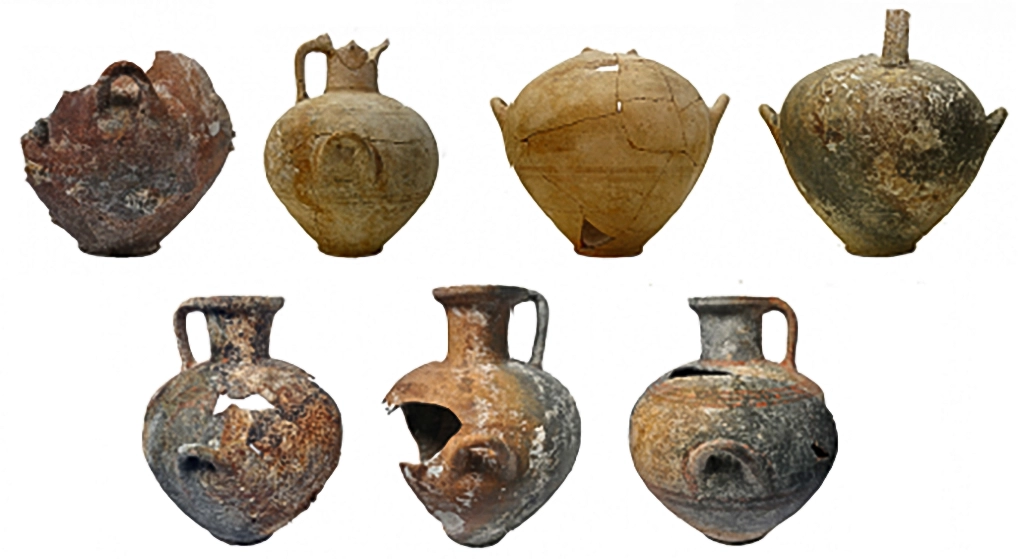
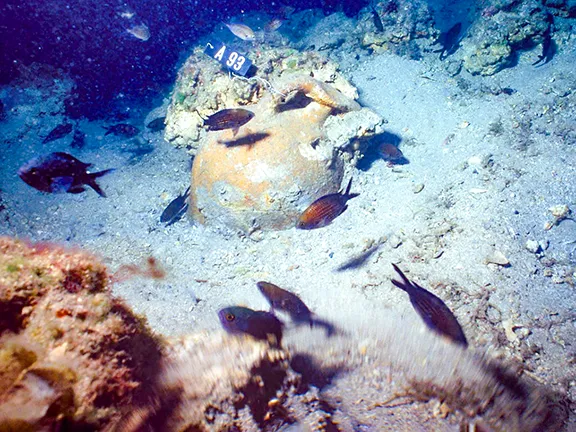
Hydria from the Modi island shipwreck
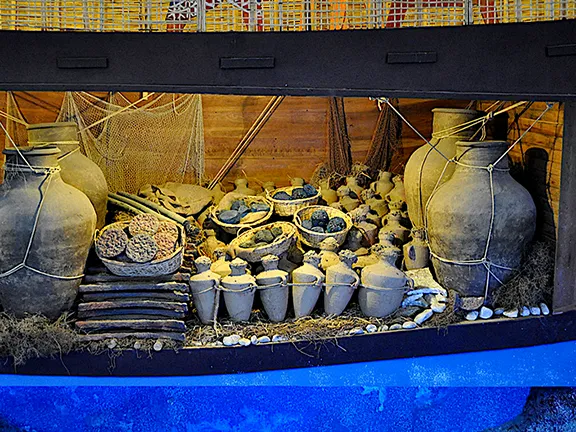
The ceramic cargo of the wreck is dated to the Late Helladic III period (13th to 12th century BC) and comprises an assemblage of large transport vessels (pithoi, jars, and hydrias), some of them surviving intact and most of them in fragmentary condition. Many of the recovered ceramics are decorated with either painted, incised, or relief decoration.
One jar fragment proved to have a Liner B symbol 'T' incised in it. This symbol represents a dry measure unit (weight or volume) used for wheat and barley.
To date thirty six hydria have been recovered along with eleven undecorated, two handled jars and a number of decorated jars.
In addition, a bronze knife with a curved blade was found near two partially preserved terracotta figurines that closely resemble Mycenaean figures dating to the 13th to 12th centuries BC. Other goods, probably for the use of the crew includes, an amphora, a small stirrup jar, half an alabastron (used in ancient times as a perfume bottle), four bowls and a krater.
Where did the Modi Island wreck cargo come from?
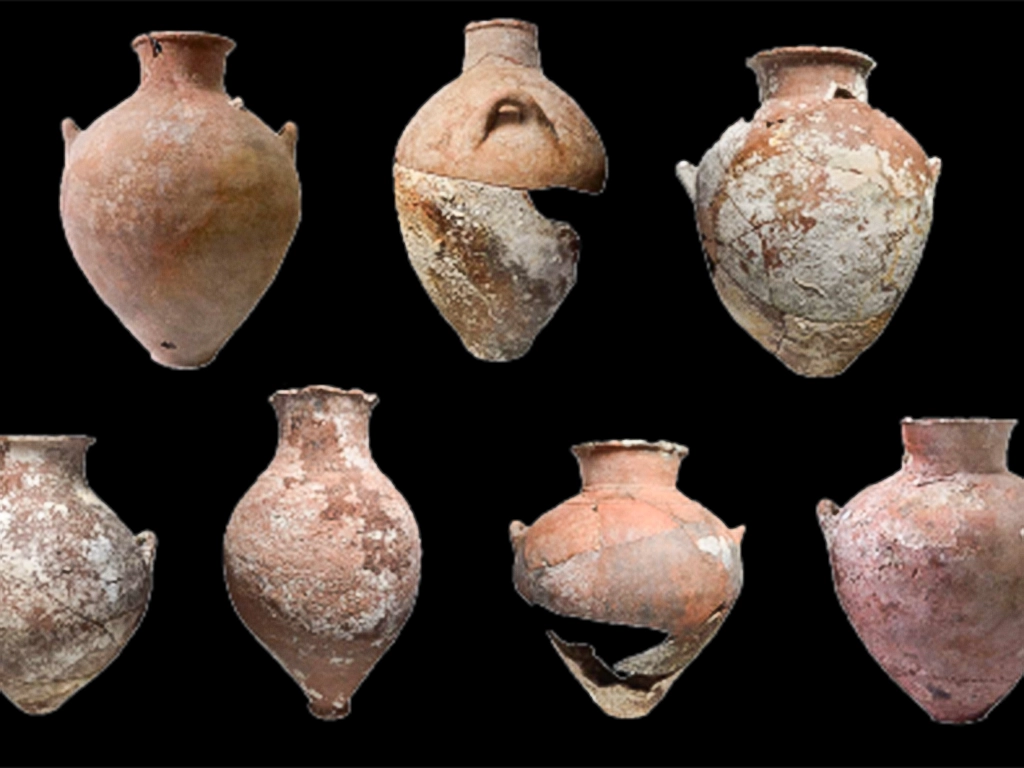
Transport jars from the Modi island shipwreck
At present, we cannot determine whether the ship was en-route to another port or if Modi was its intended destination, where its cargo would have been transferred onto smaller vessels to be further distributed via coastal trading (cabotage). The ship's cargo was mainly contained in large transport vessels, such as pithoi and hydriae of significant volume
Eleven undecorated two-handled jars have so far been recovered. Two survived almost intact, while the rest were preserved in a fragmentary condition. They belong to the same type, with some variation in size and shape. They have a piriform, ovoid, or ovoid-conical body with two handles, a flat base and a collar neck. Their capacity averages 130-165 litres. Their closest parallels are from the Point Iria wreck and LH III B/C settlement sites in the Peloponnese, such as Prosymna and the Palace of Nestor at Pylos in western Messenia.
The decoration and general shape of the hydriae resemble Phylakopi II examples, dated to LH III B, but are more closely paralleled by hydriae from Mycenae.
As well as the pithoid jars and hydriae, three jugs, were found almost intact and parallel in form to vessels found at Prosymna and Mycenae.
Where did the Modi island ship ship come from and where was it going?
Modi was and still is on the route taken by ships sailing from the Saronic Gulf, the Euboean Gulf, Attica, and the Peloponnese to the Argolic Gulf, the Cyclades, Dodecanese, and Crete, or vice versa. All would have passed close to its rocky slopes.
Why did the Modi island shipwreck sink?
The ship was most probably trapped as it tried to avoid the strong winds, which kept pushing it against the rocky coast until it broke apart and wrecked lying in a southwest-northeast direction.
Political situation at the time
The ancient ship that wrecked and sank off Modi islet was making its voyage during a critical period in the late bronze age when the Mycenaean palaces and their centralized economies had collapsed. At the close of the 13th century BC, the Mycenaean world was radically changing. The large-scale movement of people to somewhat more remote regions, fleeing from administrative power centres that had been destroyed by natural hazards or invasions, marked the beginning of an era of restructuring at the dawn of the 12th century BC.
Ongoing Research
Research is still underway through residue analyses to determine the contents of the vessels found and through petrographic analyses the place those vessels were manufactured.
Where is the Modi Island shipwreck now?
Some of the recovered ceramics from the Modi Island shipwreck can be seen at the Archaeological Museum of Poros.
References
Under the Mediterranean I: Studies in Maritime Archaeology (2021) Published by Sidestone Press, Leiden.
Agouridis, C., 2011, The Late Bronze Age shipwreck off the islet of Modi (Poros). Skyllis 11.2, Zeitschrift fur Underwasserarcheologie, 25-34.
Agouridis, C., 2012, Underwater Archaeological Research in the Argolic Gulf, 2006-2007. Enalia XI, 70-85. Athens.
Blegen, C.W., 1937, Prosymna: The Helladic Settlement Preceding the Argive Heraeum. Cambridge University Press.
Konsolaki-Yannopoulou, E., 2003, ?. Mycenaean establishment on the islet of Modi in Trizinia, in N.Kyparissi-Apostolika and M. Papakonstantinou (eds), The Region of the Mycenaean World. B' International Interdisciplinary Symposium, 26-30 September 1999, Lamia 1999, 417-432. Athens.
Lolos, Y., 1999, The cargo of pottery from the Point Iria wreck: Character and implications, in W. Phelps, Y. Lolos, and Y. Vichos (eds), The Point Iria Wreck: Interconnections in the Mediterranean ca.1200 BC. Proceedings of the International Conference, Island of Spetses, September 1998, 43-58. Athens.
Mountjoy, P.A., 1998, Mycenaean Written Pottery: Identification Guide, Kardamitsa Publications (after D. G. Godika). Athens.
Mountjoy, P.A., 1999, Regional Mycenaean Decorated Pottery, vol. I. Rahden/Westf.
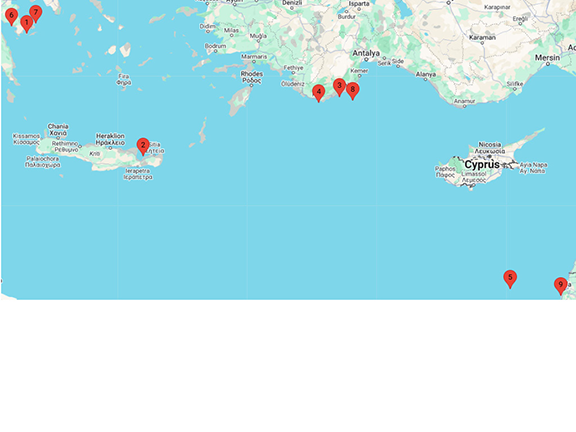
Location Map
Enjoying this clean, uncluttered read?
You are currently browsing the result of a massive technical overhaul. My new book, Legacy Reloaded: A dev, an AI, and the relentless pursuit of 100, chronicles the journey of transforming an aging legacy website into a modern, lightning-fast platform that hits the perfect 90+, 100, 100, 100, 3/3 Lighthouse metrics. It’s a story of collaboration between developer and AI, and the stubborn pursuit of technical perfection.