The severing of trade links with the Argolid prompted a notable local response. Deprived of the imported ceramics that had previously reached the island, Rhodian potters began producing highly decorated Mycenaean-style fine wares of their own. Rather than turning inward, Rhodes maintained maritime links with surviving centres in Cyprus, such as Enkomi, and along the Levantine coast, helping to sustain eastern Aegean exchange while much of mainland Greece entered the so-called ‘Dark Age’ (Dickinson, 2006).
Iron Age Shipyards, Harbours and Emporia in the Mediterranean
Rhodes during the Iron Age
Whilst other ports and harbours were being destroyed at the end of the Bronze Age and even the Great Empires collapsed or were severely weakened, Rhodes not only rode the storm with barely a pause for breath, but prospered.
By Nick Nutter | Published: 2026-05-23 | Updated: 2026-05-23
Visited 5 times
The Late Helladic IIIC Boom (1200 to 1050 BC)

The Early Iron Age and the Dorian Arrival
It was during this period of reorganisation that Rhodes underwent a decisive demographic shift: the arrival of the Dorians.
The Foundation of the Three Poleis

Ialysos: Situated in the north, commanding the fertile plains and the traditional maritime approaches.
Kamiros: Located on the western coast, focusing heavily on agriculture and local Aegean trade.
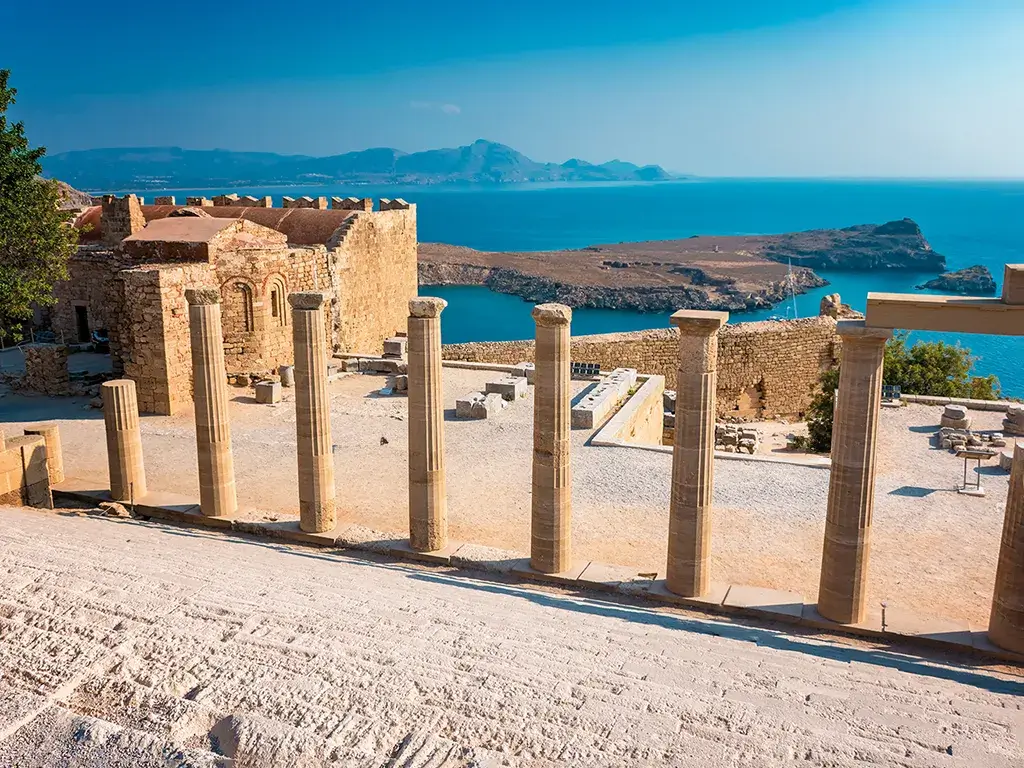
Lindos: Located on the eastern coast, with a formidable, easily defensible acropolis and twin natural harbours well positioned for eastern voyages.
These three Dorian cities formed the political backbone of Rhodes for centuries. They operated independently and at times competitively, yet recognised a shared heritage. Together with Kos and the Anatolian cities of Halicarnassus and Cnidus, they formed the Doric Hexapolis, a significant political and religious alliance in the eastern Aegean (Mac Sweeney, 2013).
The Iron Age Bridge
By dispersing maritime power across three harbours, the Dorians of Rhodes secured key eastern Aegean shipping lanes. The resulting distribution of wealth, expertise, and strategic capacity created the conditions for the political unification of Ialysos, Kamiros, and Lindos in 408 BC, when the island’s maritime strengths were concentrated in the new city of Rhodes.
Synoecism and the Creation of a Super-Port
The new city was ideally placed across several natural bays, which were enhanced with long moles and protected by substantial fortifications. As a result, Rhodes transformed its coastline into a single, large-scale harbour complex designed to support both defence and commerce (Nakas, 2022).
The Hellenistic Harbour Complex and Shipsheds

In comparative terms, this made Rhodes larger and more systematically organised than important contemporary centres such as Delos and Miletus (Nakas, 2022).
Rhodes was not only a commercial centre but also an independent naval power. To support its war fleet, the city maintained a military harbour equipped with extensive shipsheds. These fortified and carefully organised structures, characteristic of elite military harbours in the Classical and Hellenistic Mediterranean, were constructed in the mid-3rd century BC. They were renovated in the mid-2nd century BC and then abandoned by the end of that century, reflecting the political changes brought about by expanding Roman dominance (Blackman et al., 2013).
The Colossus and the Symbolism of the Super-Port
The Siege and the Celebration
The Colossus enters the historical record in the early 3rd century BC, after one of the defining moments in Rhodian history. In 305 BC, Demetrius Poliorcetes, a Macedonian general and successor to Alexander the Great, laid siege to the newly unified city of Rhodes. The island’s fortifications and maritime strength enabled it to repel the year-long assault.When Demetrius withdrew, he left behind a large cache of siege equipment. The Rhodians sold this abandoned material for a substantial sum, reported as 300 talents, and used the proceeds to commission a victory monument dedicated to their patron god, Helios (Haynes, 1992). Designed by the local sculptor Chares of Lindos, the statue was begun in 292 BC and took twelve years to complete.
Evidence of Existence
The Colossus is well attested in independent ancient and near-contemporary sources. Writing centuries later, Pliny the Elder noted that even in ruin the statue remained a marvel: "few men can clasp the thumb in their arms, and its fingers are larger than most statues" (Pliny the Elder, 1938, 34.18). Philo of Byzantium also described its construction, indicating that it was built in tiers around an iron and stone framework clad in cast bronze plates, rather than cast as a single solid form (Higgins, 1988).
The Myth of the Straddling Giant
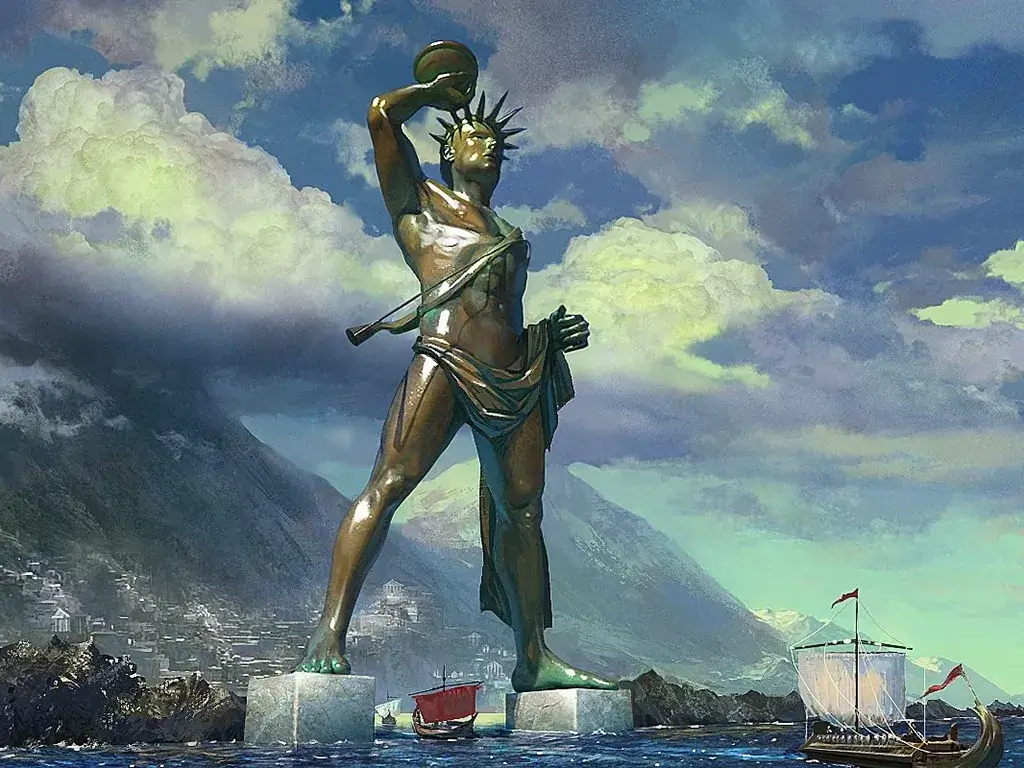
While the statue was real, its most famous depiction is a medieval fiction. The familiar image of the Colossus straddling the entrance to Mandraki Harbour is an engineering impossibility. A bronze statue of that height, approximately 33 metres, could not have spanned a harbour mouth hundreds of feet wide without collapsing under its own weight. Construction at such a location would also have blocked the city’s main commercial arteries for more than a decade.
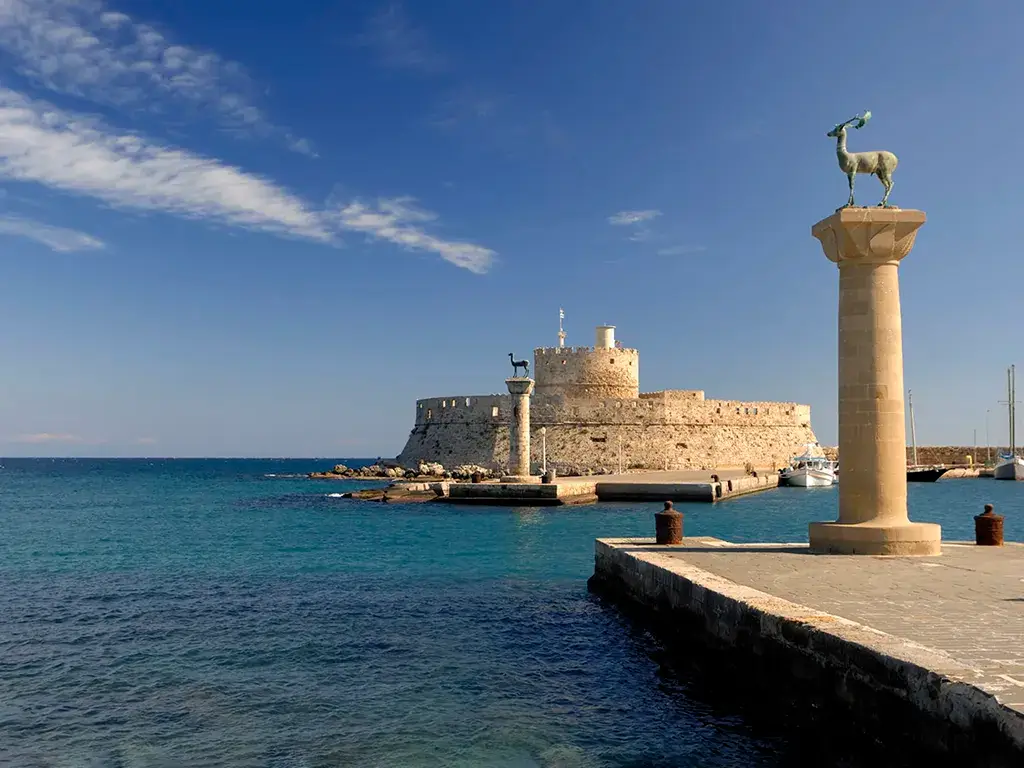
Modern scholars continue to debate its location. The most plausible suggestions place it either on the eastern promontory of Mandraki Harbour, near the site of the present Fort of St Nicholas, or further inland on the city’s acropolis, from which it could overlook the maritime traffic it symbolically protected (Vedder, 2015).
Despite the immense effort required to construct it, the Colossus stood for only fifty-four years. In 226 BC, a major earthquake struck Rhodes, severely damaging the city and breaking the statue at its knees (Haynes, 1992).
The statue was never rebuilt. Ancient authors report that its fallen remains continued to attract visitors for centuries, even as Rhodes restored its harbour economy and remained one of the eastern Mediterranean’s most recognisable maritime centres (Vedder, 2015). The Colossus thus formed part of the same monumental programme that made the Rhodian waterfront both a functioning port and a stage for political display.
Commercial Use and the Monumental Maritime Façade
What is clear, however, is the visual impact of the harbour on approaching ships. Like a small number of prominent eastern Aegean ports, Rhodes developed a monumental maritime façade that projected wealth and authority.
The waterfront included: porticoes, temples, arches and grand gateways, and the tetrapylon of Rhodes, which served as a major landmark.
These buildings were not merely functional. They linked the busy harbour front to the wealthy urban centre behind it and projected Rhodian power to merchants and sailors entering the bay (Nakas, 2022).
References
Enjoying the fast, clean reading experience?
Discover how I partnered with an AI to rescue this outdated site from technical debt and hit perfect 100/100 Lighthouse scores. Legacy Reloaded is the ultimate guide to modernising old code without losing your mind.
Location Map
You have finished reading chapter 3
More articles in the Iron Age Shipyards, Harbours and Emporia in the Mediterranean series: