How and Why Tiryns Survived the Bronze Age Collapse
The ancient city of Tiryns presents a fascinating historical paradox. Around 1200 BCE, a massive disaster of fire and earthquake destroyed its great palace. Yet, unlike nearby Pylos, which people abandoned entirely, Tiryns survived. Instead of disappearing into obscurity, the city underwent a dramatic transformation. While its central government collapsed, the town below the fortress actually grew. It absorbed refugees and reorganized its economy to become one of the largest thriving urban centres of its era.
Geographic Setting and Pre-Collapse Role in the Argolid
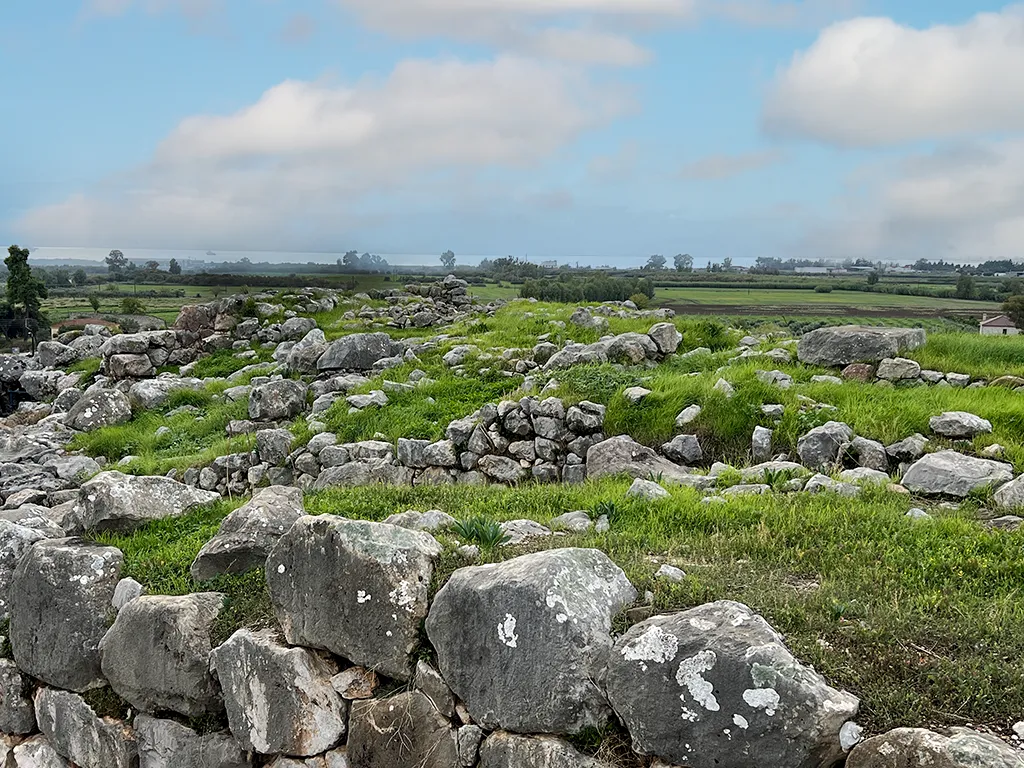
Understanding why Tiryns survived requires examining its location and regional political role. Sitting on a low limestone ridge in the northeastern Peloponnese, the fortress rose 18 metres above the Argive Plain (Hope Simpson, 1981). Today, the site lies inland near Nafplio. In the Late Bronze Age, however, Tiryns was a true coastal settlement. Before three millennia of river silting pushed the coastline seaward, the Argolic Gulf reached the marshlands surrounding the rock (Zangger, 1991).
During the Late Helladic IIIB period (c. 1300–1190 BCE), Tiryns formed part of a strategic triad of fortified citadels:
- Mycenae (The Northern Pass): Controlled overland trade routes through the northern mountains toward the Isthmus of Corinth (Hope Simpson, 1981).
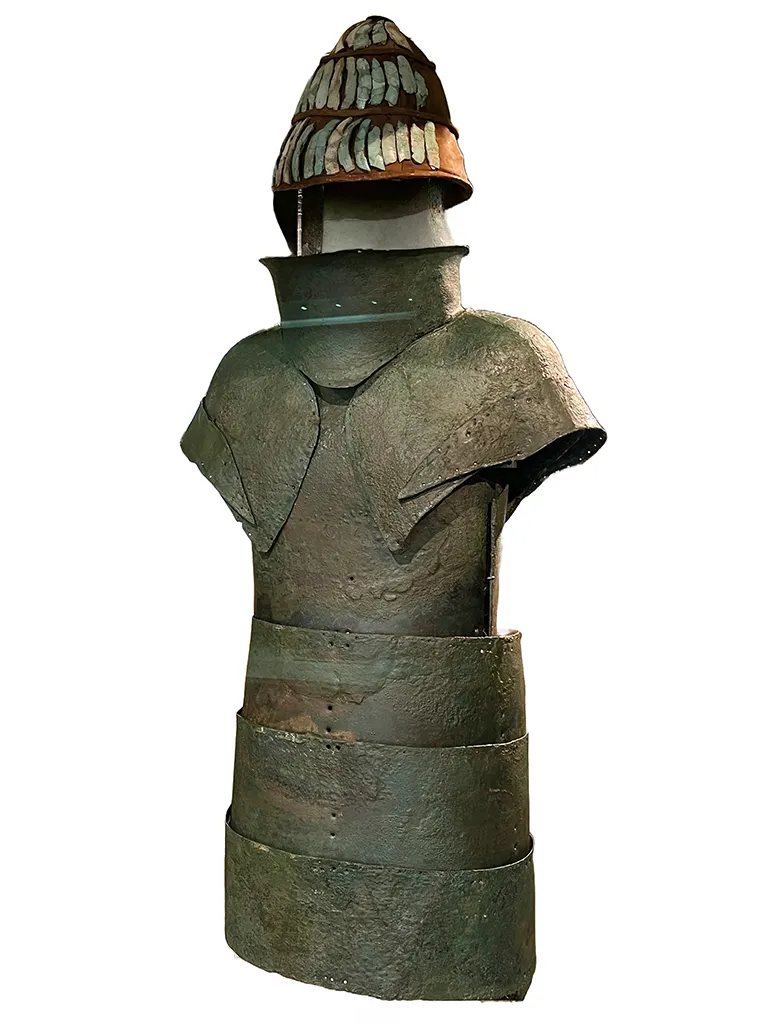
- Midea (The Eastern Sentinel): Perched 270 metres high, Midea guarded overland routes across the peninsula to Epidaurus and overseen the interior agricultural plain (Demakopoulou et al., 1996). Its elite buried their dead at nearby Dendra, famous for its complete bronze armour.
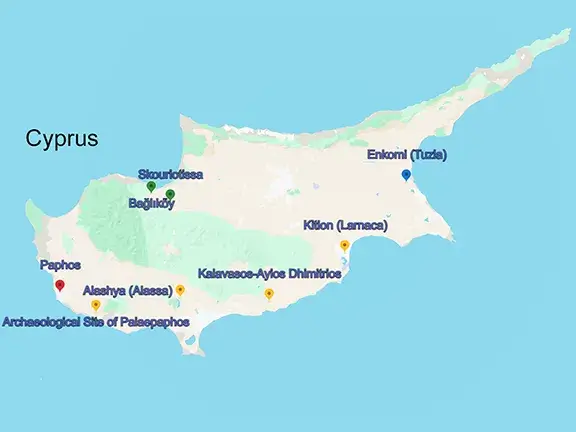
- Tiryns (The Maritime Gateway): Located on the coast, Tiryns functioned as the naval fortress and trade port for the entire region. Foreign luxuries, Levantine copper ingots, Baltic amber, and Cypriot bronzework, entered the Argolid through its harbour (Cline, 1994; Maran, 2004).
Tiryns was an administrative power in its own right. Its Upper Citadel housed a grand frescoed Megaron, court offices, archives, and massive stone walls with vaulted galleries capable of storing massive agricultural reserves (Iakovidis, 1983). Its position along eastern sea lanes linked the Peloponnese directly to the Cyclades, Crete, and the Near East (Dickinson, 2006).
The LH IIIB2 Crisis: Destruction Without Abandonment
Around 1200 BCE, severe fires destroyed the major citadels of the Argive Plain. At Mycenae and Midea, collapsed walls and crushed skeletons led early excavators to propose a regional "earthquake storm" (Nur and Cline, 2000). Heavy burn deposits and calcined stones also swept across Tiryns.
However, recent archaeoseismological studies suggest seismic activity was only a catalyst for a deeper socio-political collapse (Hinzen et al., 2018):
- Targeted Palatial Destruction: Destruction was concentrated on the Upper Citadel, the Great Megaron and administrative core of the wanax (king). This pattern points to civil unrest or popular revolt triggered by severe drought and failing food distribution (Middleton, 2010).
- Absence of Desertion: Unlike sites destroyed by foreign conquest, the local population did not flee. Residents cleared the rubble and immediately reoccupied the lower terraces.
- Rapid Rebuilding: During early LH IIIC, workers built new houses and workshops directly over the destruction debris on the lower terraces and surrounding plain (Maran, 2002).
- Continuity of Cult: Religious practice endured, modified to suit the new reality. Community leaders reorganised cult activities inside specialised shrines built into the defensive walls of the Lower Citadel (Kilian, 1981).
Urban Expansion and Demographic Influx
While the administrative power of the wanax vanished, the physical population of Tiryns grew to its historical peak. As a severe megadrought crippled agriculture across the Aegean, unfortified inland hamlets became unsustainable (Drake, 2012). Deprived of state grain reserves, rural families migrated to Tiryns for physical security, coastal resources, and freshwater infrastructure.
- Sprawling Lower Town: The lower settlement expanded to 20–25 hectares during LH IIIC, making the post-palatial town far larger than its palatial predecessor (Maran, 2010). Applying standard survey benchmarks (100–200 people per hectare), the population swelled to between 2,500 and 4,000 residents.
- High-Density Housing: Excavations revealed closely packed, multi-room mudbrick homes built along gravel roads, equipped with domestic hearths, storage pits, and drainage channels (Mühlenbruch, 2009).
Macro-Engineering: The Tiryns Dam
Environmental catastrophe posed a severe threat to the expanding town. The LH IIIB2 earthquake altered local hydrology, causing the Manessi stream to breach its banks and threaten the Lower Town with flash floods.
To neutralise this hazard, the community undertook a massive hydraulic project at Kourtaki, four kilometres east of the citadel (Zangger, 1994):
- Earthwork and Masonry: Engineers built a 10-metre-high, 300-metre-long dam made of hard packed soil and faced with massive stone blocks.
- River Diversion: Workers dug a 1.5-kilometre canal that permanently diverted the stream southward into the Karachali riverbed.
Without this dam, regular flash flooding would have rendered the post-palatial Lower Town uninhabitable. Executing such a project during LH IIIC shows that post-palatial society at Tiryns retained advanced engineering skills and strong social cohesion without a central monarch.
Political Adaptation: From Wanax Palace to Chieftain's Hall
Tiryns adapted its political structure to match its new reality. On the Upper Citadel, workers did not rebuild the grand Megaron. Instead, they erected a simpler, narrower hall known as Building VI inside the ruins of the old palace (Maran, 2001).
- Scaled-Down Governance: Building VI incorporated a surviving palace wall, using an open hearth and a single row of roof supports.
- Rise of the Basileus: This shift marks the transition from a divine wanax to a local warlord or chieftain (basileus). Leaders maintained authority through public feasting, gift exchange, and military prowess rather than written tax records (Maran, 2006).
- Communal Feasting: Concentrations of drinking vessels, deep bowls, and animal bones around Building VI point to elite-sponsored feasts designed to unite the growing town.
This transition illustrates political de-complexification (Tainter, 1988). The pre-collapse palatial state was a high-overhead machine requiring massive crop surpluses. When drought destroyed those surpluses, shedding the expensive state superstructure was a rational survival strategy. Rather than total civilisational decay, this reversion acted as a societal reset. Returning to decentralised households (oikoi) provided the flexibility needed to survive climatic instability, unintentionally laying the groundwork for the future Greek polis (Deger-Jalkotzy, 2008).
Maritime Economy and Infrastructure
In the Late Bronze Age, Aegean ports relied on natural coastal features rather than built masonry quays (Frost, 1989; Tartaron, 2013). Ships anchored in shallow, sheltered bays or ran aground on sandy beaches.
The transition from LH IIIB to LH IIIC changed the management of trade rather than ship logistics:
- Pre-Collapse (LH IIIB): The palace-controlled landing zones and maintained guarded storehouses to tax incoming goods under a royal monopoly (Cline, 1994).
- Post-Collapse (LH IIIC): Palatial customs vanished. Independent sailors, Levantine traders, and local elite families used the beachhead freely (Maran, 2004).
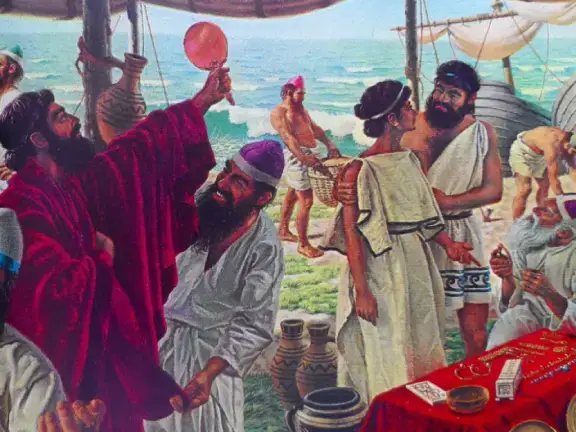
Following the collapse, trade shifted from royal monopolies to decentralised merchant networks. Finds of Canaanite storage jars show that Tiryns imported luxury items like resinated wine, olive oil, and honey from Cyprus and the Levant to support communal feasting (Knapp and Demesticha, 2016). For staple foods, plant remains show the town relied on local crops like barley, wheat, lentils, and bitter vetch (Kroll, 1982). Meanwhile, marine shells and fish bones in refuse pits reveal that residents supplemented their diet with coastal fishing and inshore scavenging (von den Driesch and Boessneck, 1990).
Industrial Production and Metallurgy
The Lower Citadel transformed into an active manufacturing quarter for textile dyeing, bone-working, and metalworking (Rahmstorf, 2008). Potters produced expressive regional styles, exporting pictorial kraters and stirrup jars across the Aegean (Mühlenbruch, 2009).
The breakdown of long-distance trade severed imports of raw tin from Central Asia and Anatolia. Because Greece lacks natural tin deposits, smiths could no longer produce fresh bronze. Metalworkers in the Lower Citadel responded by establishing scrap-recycling workshops inside former storage galleries, melting down broken tools and weapons (Rahmstorf, 2008). The smiths discovered that repeated remelting burns off tin, steadily weakening the alloy.
This tin shortage ultimately triggered the transition into the Iron Age:
- Simultaneous Innovation: Functional iron tools found at Tiryns and Perati (c. 1190 BCE) disprove older theories that iron technology spread slowly from Cyprus and the Levant. Aegean smiths experimented with iron working simultaneously as a substitute for bronze (Waldbaum, 1999).
- Two-Stage Evolution: Early 12th-century iron items were soft, uncarburised wrought iron used as temporary stopgaps. True steelmaking, involving carburisation, quenching, and tempering, developed later across the Mediterranean (Snodgrass, 1980).
- Democratisation of Metallurgy: High-status graves from LH IIIC contain iron Naue II slashing swords and spearheads (Kilian-Dirlmeier, 2002). Metal weaponry was no longer restricted to a narrow chariot elite, reflecting a broader class of armed warriors supporting local chieftains.
Why Tiryns Survived
Tiryns survived the Bronze Age collapse through a combination of physical and organisational advantages:
- Coastal Access: Maritime connections enabled short-range coastal trade to exchange manufactured goods for food surpluses while supplementing diets with marine resources.
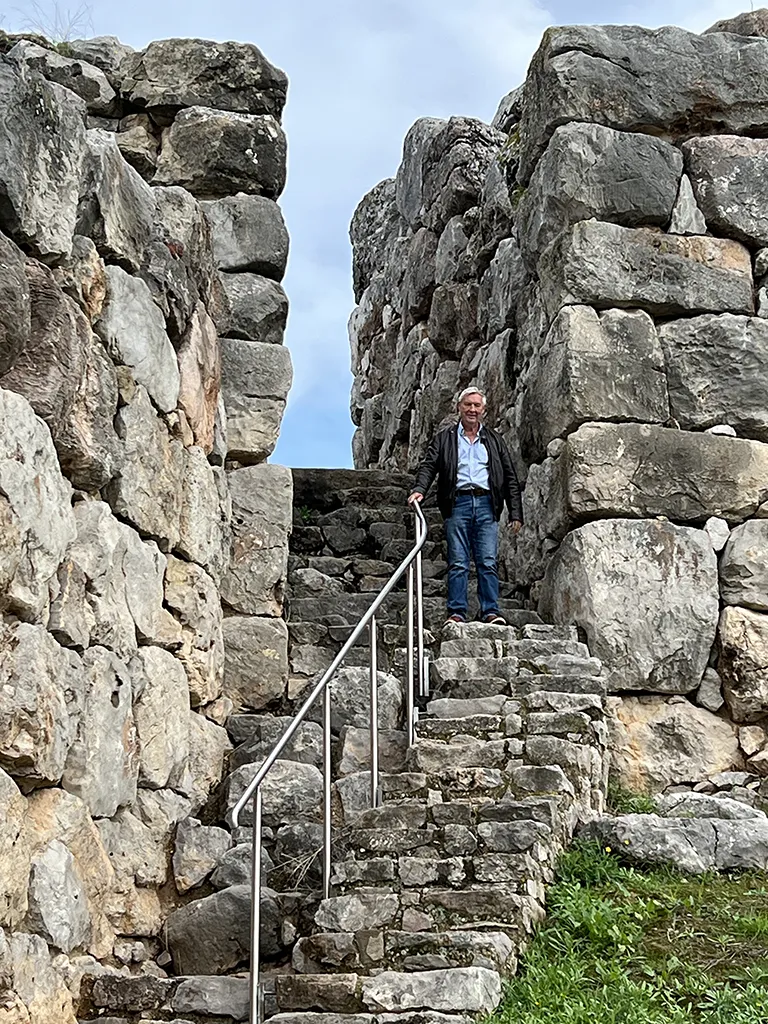
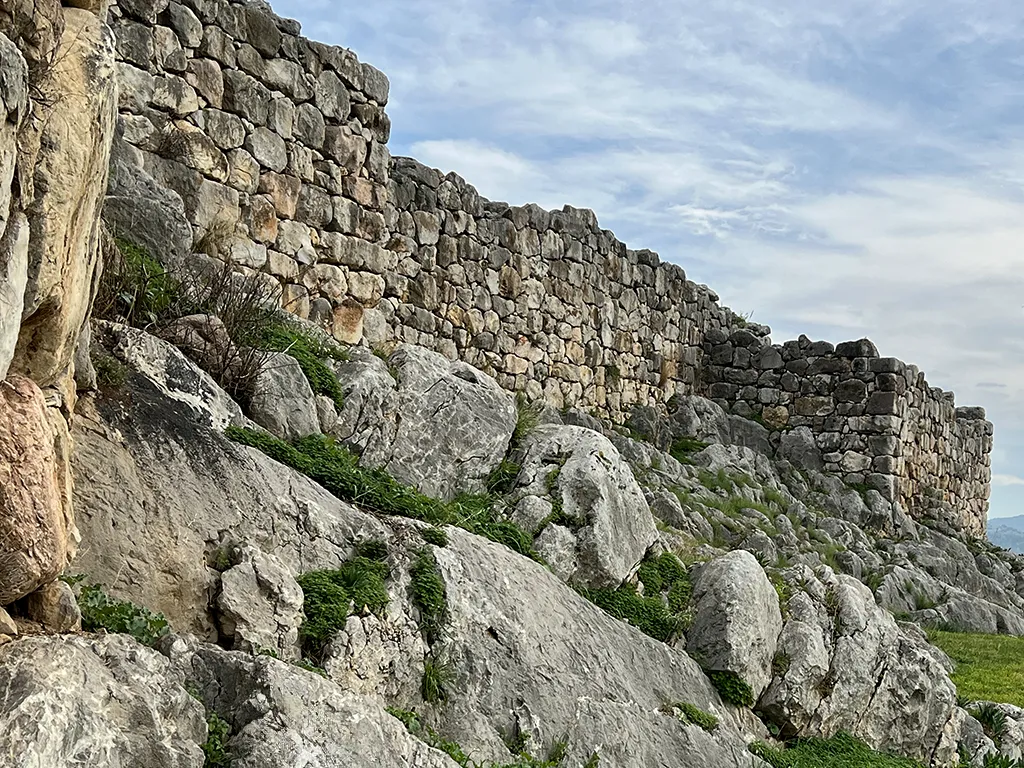
- Fortification Security: Massive Cyclopean walls provided physical safety, attracting surrounding populations.
- Civic Engineering: Constructing the Tiryns Dam prevented flood destruction, proving that civic organisation survived the palace.
- Flexible Leadership: Replacing the bureaucratic wanax with local chieftains (basileis) allowed rapid social adaptation.
- Metallurgical Innovation: Active trade links allowed local smiths to adopt iron technology quickly as bronze supplies failed.
Far from being a static ruin, 12th-century BCE Tiryns was a vibrant, sprawling town that successfully navigated the collapse of the Mycenaean world, bridging the gap into the Early Iron Age.