The Geography of Iron Age Epidaurus
The nature of the polis that emerged during the Iron Age at Epidaurus, and other poleis in the Argolid and the rest of the Peloponnese, was determined by its geography.
Coastal Topography and the Harbour System
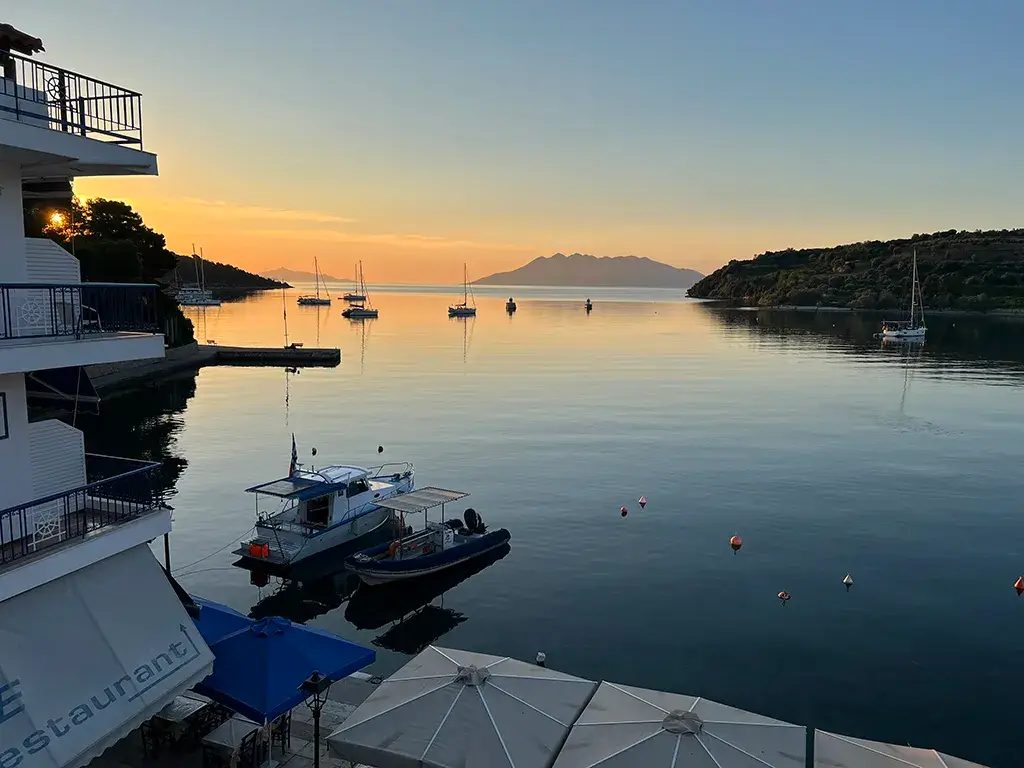
The maritime centre of ancient Epidaurus lay in the northern bay, close to the modern marina of Palaia Epidavros (37°38′N 23°09′E) on the eastern coast of the Peloponnese. In the Late Bronze Age, this inlet functioned as a protected natural anchorage. Its position on the Acte peninsula (northeastern Peloponnese) sheltered shallow-draft vessels from prevailing Aegean winds, allowing them to be drawn directly onto the beach without the need for substantial harbour works (Tartaron, 2013).
After c. 1200 BCE, as palatial exchange systems contracted, the same coastal geography became the basis for a more active maritime orientation. By the Iron Age and Classical periods, the northern bay had developed into a formal harbour with breakwaters and quays. Severe tectonic subsidence along the eastern Peloponnese has left parts of this harbour infrastructure submerged near the Nisi peninsula (a small promontory extending into the Saronic Gulf) (Flemming, 1968).
Civic Space: The Nisi Peninsula and the 4th Century BCE Little Theatre
The Nisi peninsula separated the northern harbour from the southern bay and formed the acropolis and civic nucleus of the coastal polis. Classical defensive walls protected the headland, the harbour, and the adjacent agora; surviving polygonal masonry on the slopes preserves traces of this fortified civic landscape (Tomlinson, 1983).
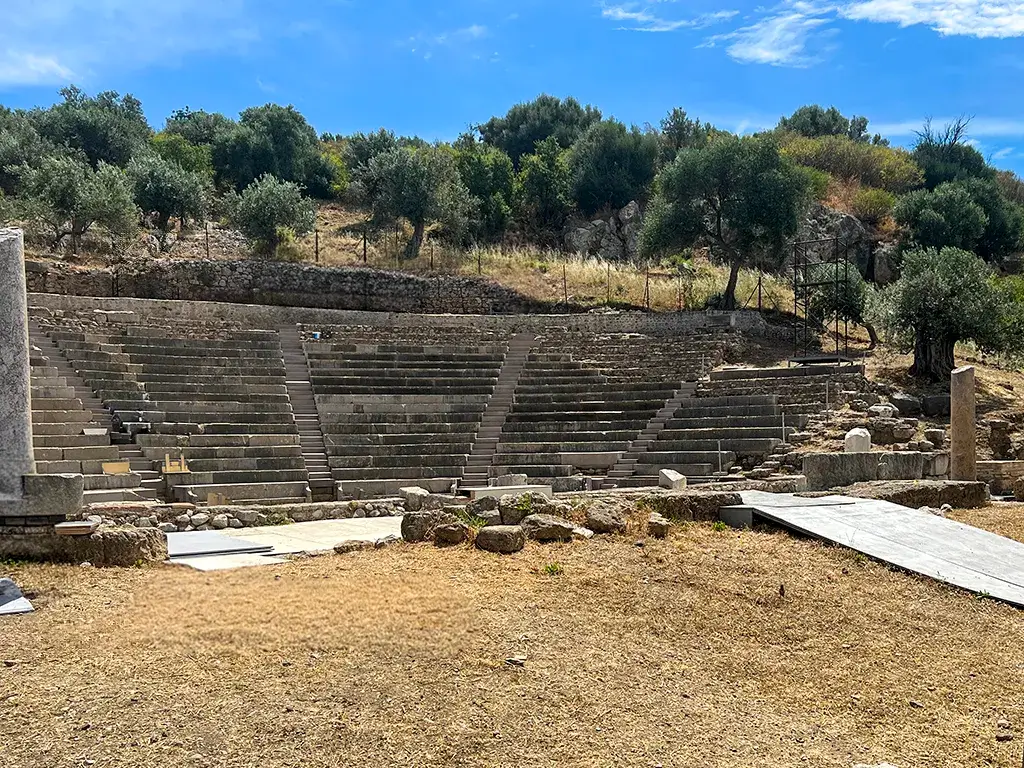
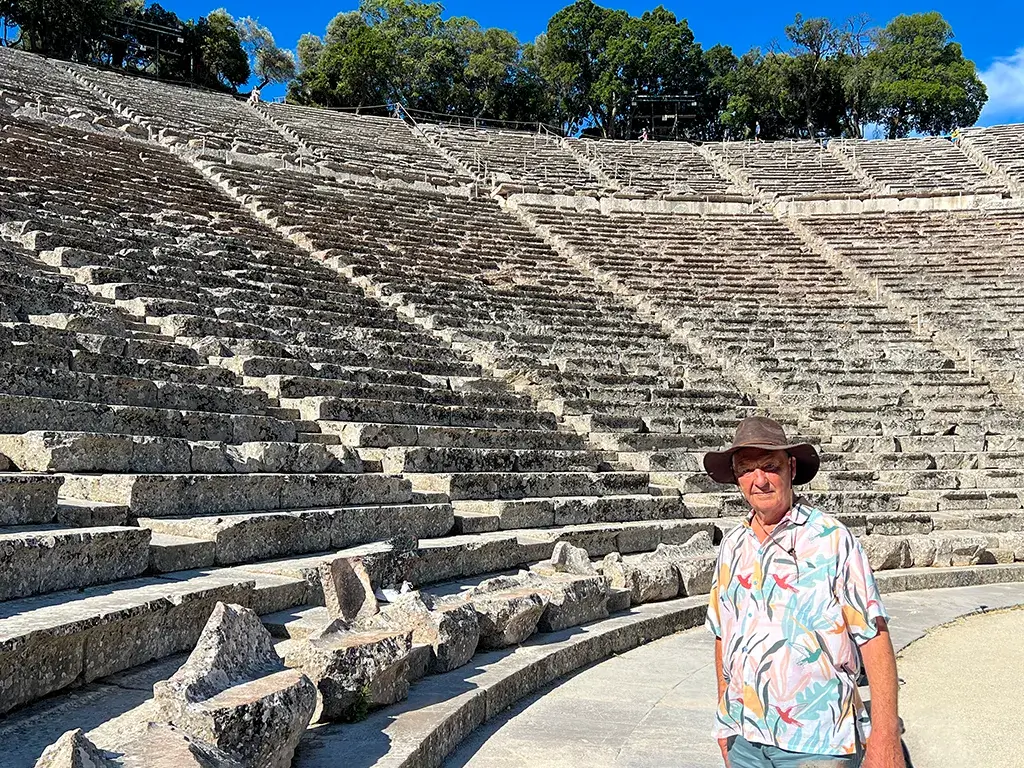
The Little Theatre of Ancient Epidaurus, built into the western slope of the headland, was originally constructed in the fourth century BCE, although it was later modified in the Roman period. Unlike the better-known theatre at the inland Sanctuary of Asclepius (37°35′N 23°04′E), this coastal theatre served the civic community of the harbour town and was dedicated to Dionysus rather than Asclepius (Tomlinson, 1983).
Its westward orientation is significant. The theatre faced inland towards the agora, placing civic performance within the inhabited and administrative space of the port. The arrangement emphasises that, by the 4th century BCE, the harbour was not merely an economic facility but an integrated civic environment.
Debunking the “Sunken City”: The 2nd Century CE Roman Villa at Agios Vlasios
South of the Nisi headland, in the Bay of Agios Vlasios (south of the modern port) near modern Kalymnios and Gliati beaches, lie shallow submerged remains frequently promoted by tourism boards as the “Sunken City” of ancient Epidaurus. However, as my recent underwater fieldwork and direct observation of the site confirm, this label is highly misleading. The visible remains submerged in two metres of water are strictly the foundations of a 2nd-century CE Roman villa maritima, built nearly a millennium after the Iron Age harbour.
The structures date principally to the Roman period, when improved security under the Pax Romana encouraged elite settlement directly on the coast. The paved floors, domestic foundations, and massive pithoi (storage vessels) visible today are consistent with a sprawling agricultural estate dedicated to production and export, rather than the earlier civic harbour of the Greek polis (Kritzas, 1971; Whittlesey, 1970). The heavy ashlar blocks of the true ancient Greek harbour lie further north, submerged beneath modern maritime activity and tectonic subsidence.
The Inland Sanctuary and Cult Continuity
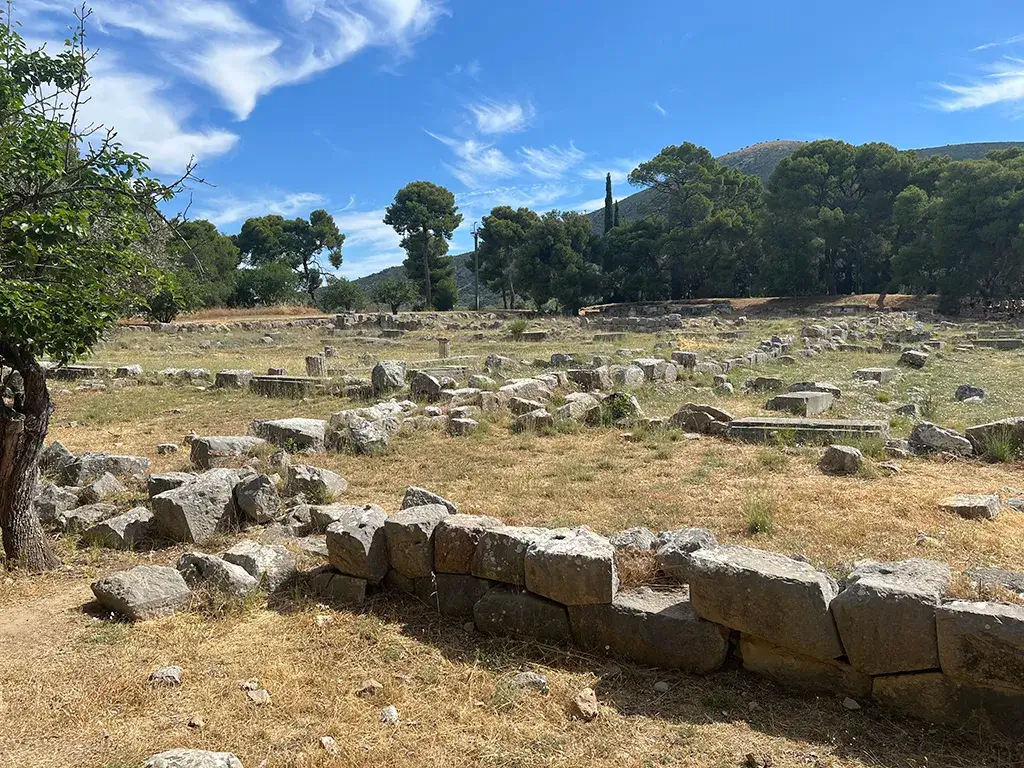
The Sanctuary of Asclepius lay roughly 15 kilometres inland from the harbour, in a fertile valley framed by Mount Kynortion and Mount Titthion (elevation approx. 400m). Its location separated the community’s principal religious centre from the exposed maritime zone, while still allowing it to remain connected to coastal wealth and pilgrimage.
This inland setting gave Epidaurus an ideological anchor. Whereas the harbour was open to exchange, risk, and innovation, the sanctuary was embedded in the agricultural hinterland and shielded by mountainous terrain. Such spatial separation helped distribute risk across the territory of the polis (de Polignac, 1995).
The sanctuary’s importance also lay in its cultic continuity. Religious activity did not begin suddenly with the Classical cult of Asclepius. Earlier ritual practice centred on Mount Kynortion, where excavations have revealed an open-air ash altar associated with Apollo Maleatas and earlier cult traditions. Stratified deposits of ash and votive material indicate continuity from the Late Bronze Age through the Early Iron Age and into the Archaic period (Lambrinoudakis, 1981).
This evidence complicates any simple model of cultural rupture after the collapse of the palaces. While nearby palatial centres declined or were destroyed, local communities continued to mark sacred space, make offerings, and reproduce collective identity through ritual. From the sixth century BCE onwards, the cult expanded into the valley and became increasingly associated with Asclepius, eventually producing the monumental healing sanctuary of the Classical period (Tomlinson, 1983).
The Sacred Way: The 15-Kilometre Artery Connecting Port and Sanctuary
The relationship between the coastal harbour and the inland sanctuary was materialised in a 15-kilometre processional road conventionally known as the Sacred Way. Walking the modern, rugged terrain between Palaia Epidavros and the sanctuary valley today, the strategic genius of this spatial separation becomes obvious. This physical artery linked the harbour town with the inland sanctuary, enabling the movement of pilgrims, offerings, and prestige goods across the territory of the polis.
Although much of the original route has been obscured by later agriculture and erosion, its existence is supported by textual, architectural, and topographical evidence. The most definitive textual proof comes from the 2nd-century CE geographer Pausanias. In his Description of Greece (Book 2.26), he explicitly records his journey from the coastal city of Epidaurus inland to the sanctuary, noting specific landmarks such as the precinct of Asclepius and statues along the route.
At the Sanctuary of Asclepius itself, archaeologists excavated the monumental Propylaia (gateway), constructed in the late 4th or early 3rd century BCE. This grand entrance is located on the northern edge of the sanctuary and is oriented outwards to receive the processional road arriving through the mountain passes from the coastal port (Tomlinson, 1983). Finally, field surveys navigating the ravines between the coast and Mount Kynortion have identified fragmentary remnants of the ancient road network. These include deep wheel-ruts cut into the bedrock in the steeper mountain passes, as well as segments of ancient retaining walls designed to support the road (Bintliff, 2012).