Although primitive by modern standards, the progress being made by these small family concerns had to be funded somehow. The surplus crops they were producing were mainly sold in a fairly local area as we have seen with some filtering out through Spain and a little into the rest of Europe. The infrastructure to transport the still grown traditional crops such as grapes, and the first of the introduced crops, tomatoes, water melons, cucumbers and courgettes, was only just beginning to be improved.
Contents
Greenhouses to the Horizon
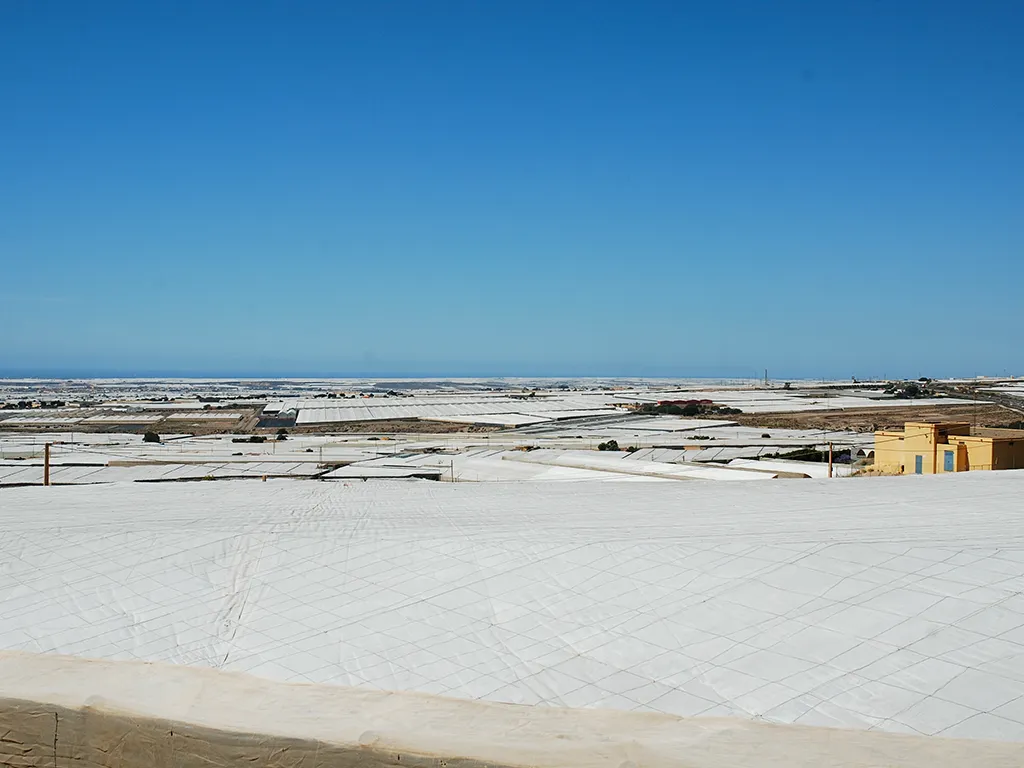
The use of plastic greenhouses spread from the original municipalities of the Campo de Dalias (Dalias, Felix, Vicar and Roquetas de Mar) to the municipalities of El Ejido and La Mojonera and then to Adra and Berja, up to El Alquian, La Canada de San Urbano and into Nijar. Currently the province of Almeria has the largest area of greenhouses in the world.
The 'Almeria' Model
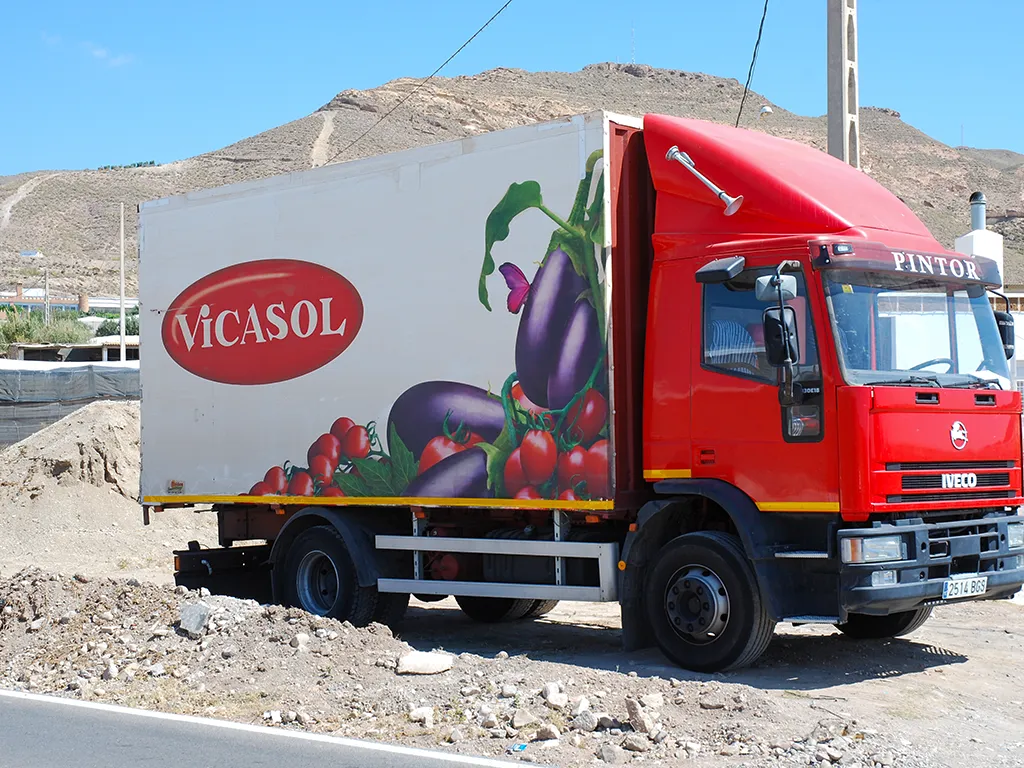
Even today most of the produce from this area is transported by road. After 1963, the banks were able to offer loans to entrepreneurial growers, at a price. Interest rates could be as high as 23% and, prior to Spain's entry into the EU in 1986, the tariffs charged on any produce destined for Europe were prohibitively high.
Not surprisingly, many families went bankrupt. A steady stream of ex growers moved to the coastal cities, towns and villages where they hoped to find work in an expanding tourist industry. The survivors joined together in the co-operatives and where feasible, the co-operatives bought back the land. Today, most of the producers are small family-owned greenhouse operations and have low capital investments, generally producing on a site of 1-1.4 hectares in size. The traditional crops gradually disappeared from the menu in favour of the higher value fruit and vegetables.
This combination of support by bank and cooperatives to help advance the technology and marketing of agricultural produce while maintaining its core element of small producers is unique and has been called the 'Almeria Model'.
Meals on Wheels
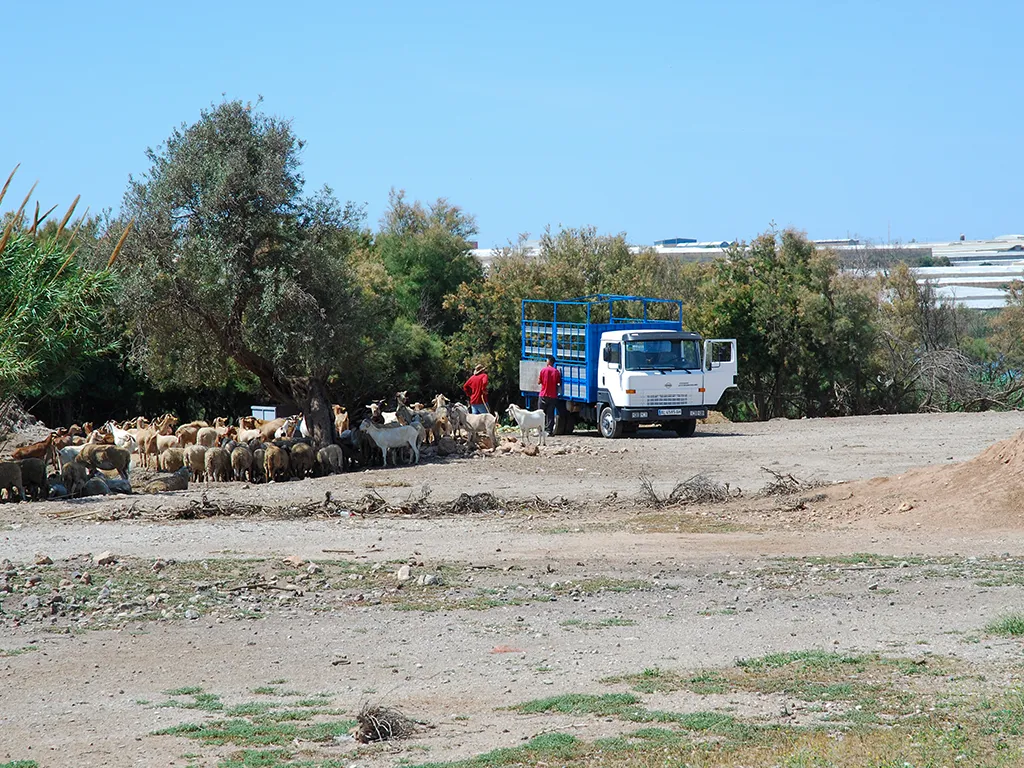
Before moving on, last May I was heartened to come across this scene. I like goats and I could become depressed thinking about all those goats that have lost their grazing lands in favour of the plastic greenhouses. Early this year I was surprised to see that at least one local goatherder has managed to adapt, well his goats have. Instead of eating grass and vegetation, their meals arrive by lorry. Their diet now consists of surplus or unsaleable vegetables from the greenhouses that surround them.
Hybrid Seeds

In 1975, the first hybrid seeds were introduced to the growers in Almeria. Hybrid seeds, also known as F1 hybrids, are produced by cross-pollinating two genetically different parent plants. These parent plants are carefully selected for their desirable traits, such as disease resistance, higher yield, or better flavour. The resulting hybrid seeds are then grown into plants that exhibit a combination of the desirable traits from both parents.
Hybrid fruit and vegetable seeds rapidly became popular with the growers because they can produce plants that are more vigorous and disease-resistant than their non-hybrid counterparts. They can also be bred to have specific characteristics, such as larger or sweeter fruit, that consumers find more appealing. Under the plastic sea the growers concentrated on uniformity and size, flavour took a back seat. By 1991, Long Life varieties, plants with a longer fruiting period, were also being grown.
Examples of Hybrid Seeds
Some examples of hybrid fruit and vegetable seeds grown under the plastic include:
F1 Hybrid Peppers: These peppers are bred to be disease-resistant and to have a high yield. They also come in a variety of colours, shapes, and sizes. Seedless watermelon: This is a hybrid fruit that has been bred to produce fruit without seeds. It is often preferred by consumers because it is easier to eat and has a sweeter flavour.
F1 Hybrid Eggplant: These eggplants are bred for disease resistance and to produce fruit that is uniform in size and shape. They come in a variety of colours. Beefsteak tomatoes: These are large, juicy tomatoes that are often used for slicing and sandwiches. They are a hybrid variety that has been bred to produce larger fruit with a meatier texture.
F1 Hybrid Peppers: These peppers are bred to be disease-resistant and to have a high yield. They also come in a variety of colours, shapes, and sizes. Seedless watermelon: This is a hybrid fruit that has been bred to produce fruit without seeds. It is often preferred by consumers because it is easier to eat and has a sweeter flavour.
F1 Hybrid Eggplant: These eggplants are bred for disease resistance and to produce fruit that is uniform in size and shape. They come in a variety of colours. Beefsteak tomatoes: These are large, juicy tomatoes that are often used for slicing and sandwiches. They are a hybrid variety that has been bred to produce larger fruit with a meatier texture.
Producing hybrid seeds is an industry in itself. Seeds saved from plants grown from hybrid seeds do not reproduce the parent plant. The practice of saving seeds from one year's crop to the next disappeared and was replaced by specialist growers who solely produced the hybrid seeds. This also created another export market, for hybrid seeds increasingly in demand by gardeners in northern Europe.
In Line Drip Irrigation
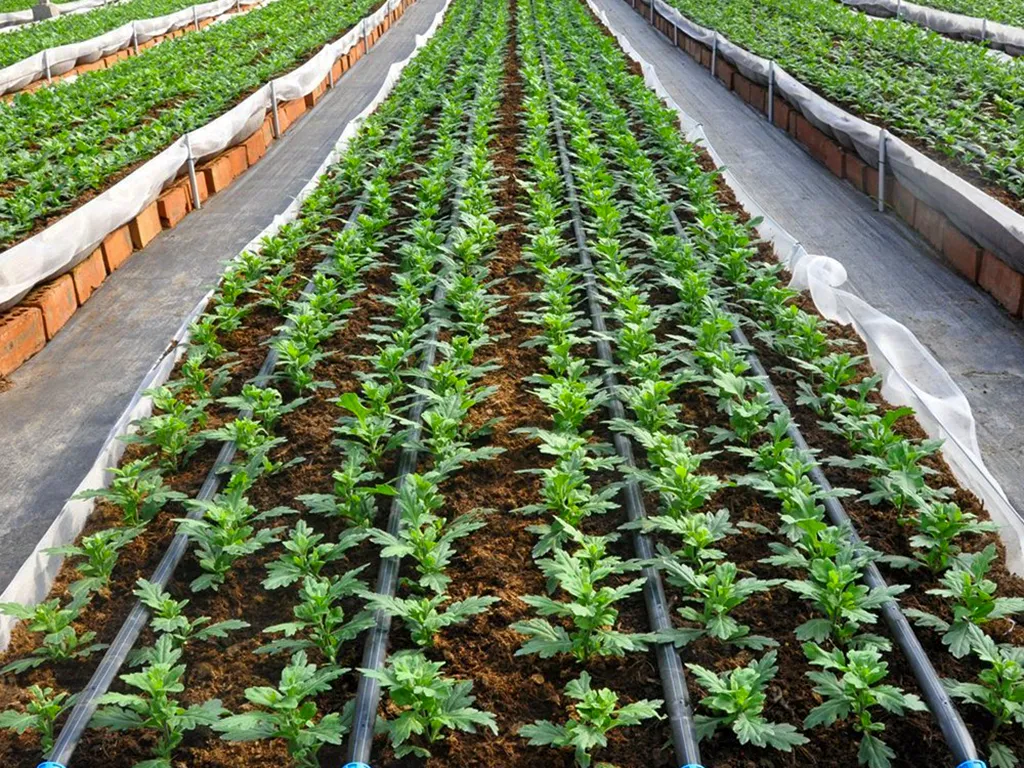
By 1977, depletion of the water supply from the aquifers was becoming a concern and growers started to turn to drip irrigation to conserve water despite the increased cost of the piping. Drip irrigation was not new.
Drip irrigation was first conceived in the 1860s by a German botanist named Julius von Sachs, who discovered that plants could absorb water through their roots. However, it wasn't until the 1960s that modern drip irrigation systems were developed and commercialized.
The development of drip irrigation is often credited to Israeli engineer Simcha Blass, who was working on a project in the 1930s to deliver water to remote areas of the desert. Blass observed that water dripping from a punctured pipe provided water to nearby plants, and he realized that this method could be used to deliver water more efficiently than traditional flood irrigation methods. He went on to develop a prototype drip irrigation system, which he patented in 1959.
Drip irrigation involves using a network of pipes, tubing, and emitters to deliver water directly to the roots of plants. Drip irrigation is often preferred over traditional sprinkler systems in greenhouses because it can reduce water usage and prevent water from evaporating into the air, which can lead to high humidity levels and disease problems.
Overall, drip irrigation is a highly effective method of irrigating plants in greenhouses. It can save water, reduce labour costs, improve plant growth, and reduce disease risk, making it an ideal choice for many greenhouse operations. The cost of the piping is largely offset by the saving in water bills.
Another industry became established alongside the greenhouses, plastic piping and drip irrigation manufacturers.
Thermal Plastics
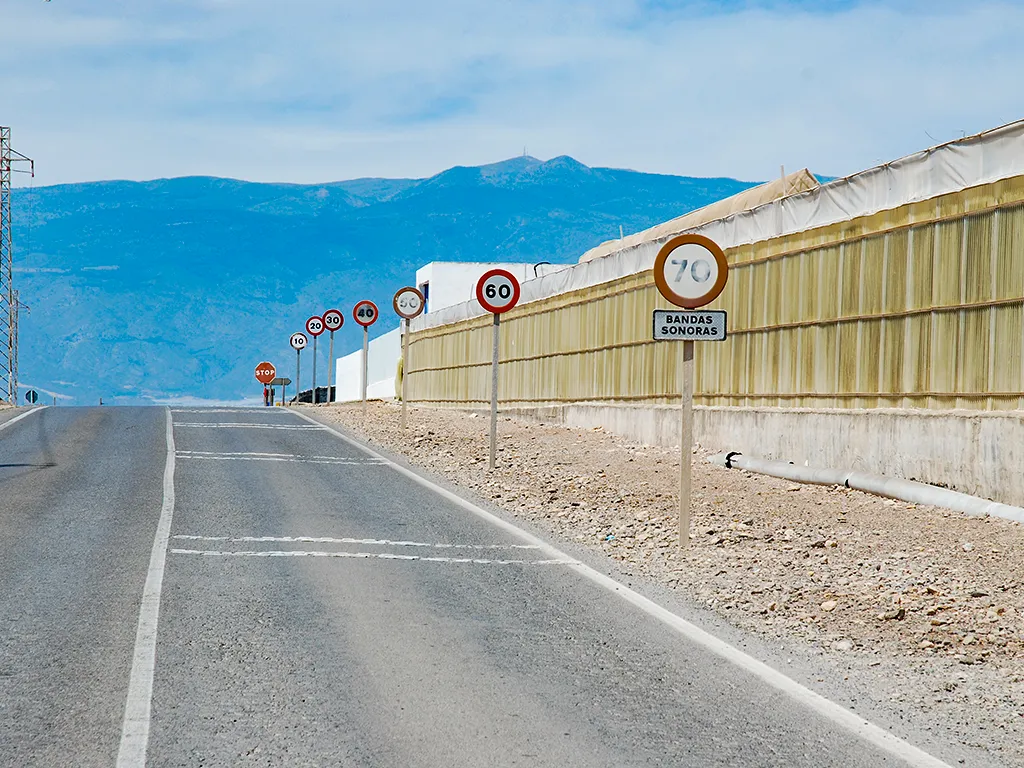
During the 1970s, the plastics industry discovered thermal plastics typically made from polycarbonate or acrylic materials, which have excellent insulation properties and can withstand high temperatures and UV radiation, ideal for greenhouses. One of the main benefits of using thermal plastics in greenhouses is their ability to trap heat inside the structure, reducing the need for artificial heating during colder months. This can significantly lower energy costs and make greenhouse cultivation more sustainable.
In 1981 the plastic sheet manufacturers in Almeria turned over to manufacturing thermal plastics and the new material started to appear on more rigid, aluminium structures. The new plastic also had a longer shelf life than the traditional plastic sheeting. Even so, somewhere in the region of 33,500 tons of plastic waste is generated each year in the greenhouse complex of Almeria.
Throughout the 1980s, watering systems evolved with the introduction of interline drippers, a system of pipes laid out in a grid fashion that allows greater control of the water supply to individual plants. Greenhouse structures improved. Large box like greenhouses with increasingly sophisticated ventilation systems started to replace the poly tunnels.
Let's hear it for the Bees
Then 1990 saw a real innovation.
I do not know if anybody has noticed, but the whole of the sea of plastic has been denuded of its wildlife both flora and fauna. There are no native plants to encourage insects, no birds to feed off native seeds and insects, no herbivores to eat the native plants and no carnivores or raptors to prey on them. It is almost eerie to stand in the midst of the greenhouses and just listen. Tune out the sounds of traffic and all you are left with is the whisper of wind over plastic, no bird song, no buzzing of insects, apart from the inevitable pesky flies.
but only the Bumble Bee
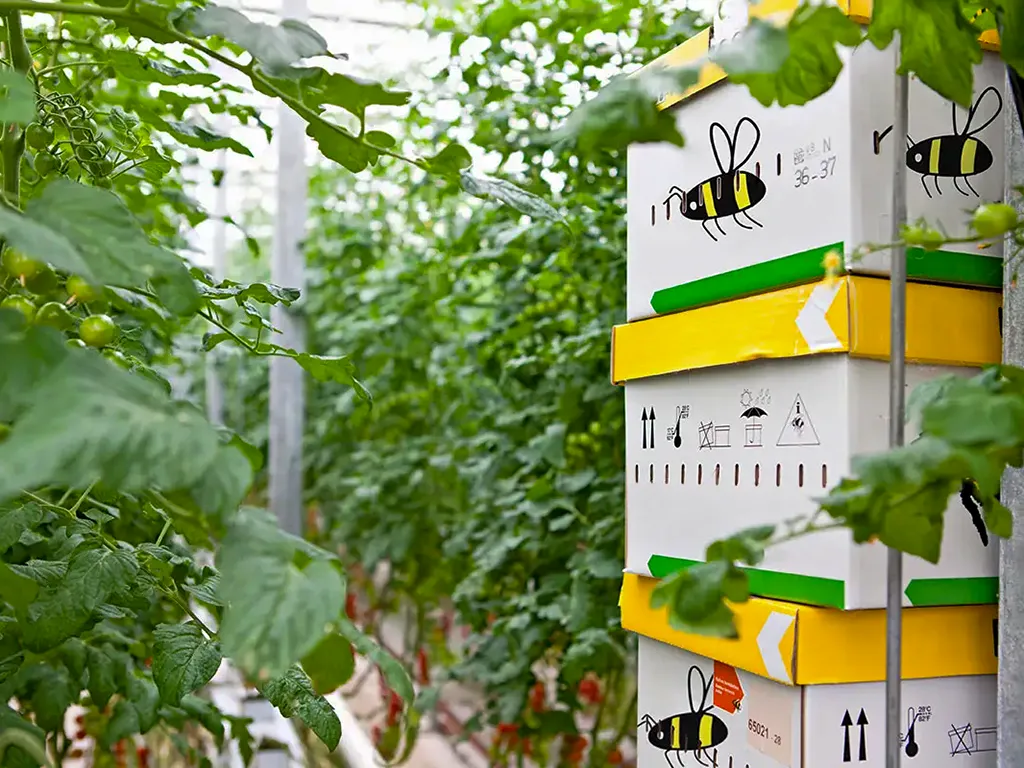
It is well known that fruiting plants need insects to pollinate them. No insects, no fruit, unless you adopt the labour intensive practice of hand pollinating. In 1990, the Almeria growers started introducing bumble bees to their greenhouses. Hive bees won't pollinate tomatoes as there is no nectar in the flowers; once the first few bees from a hive visit the field, they'll pass on information to the rest of their hive that there's no nectar in that location. But bumblebees don't communicate in this way, so each bee will merrily visit any tomato flower it encounters. Additionally, bumblebees don't store food, so they will leave the colony box to find flowers every day.
The company Agrobio have made an industry from breeding bumble bees as well as a wide range of insects for biological pest control.
At least within the greenhouses you can now hear the reassuring buzz of the bumble bee.
Biological Pest Control
Once farmers switch to using bees for pollination, they usually switch to biological pest control too; chemical pesticides often cause bees to die, not to mention the potential problems caused by residues of chemicals that remain in the produce. To make matters worse, pests develop resistance to widely used chemicals over time, meaning that farmers must use ever increasing amounts to protect their crops from the same pests.
Indeed, Almeriais farming community suffered a catastrophic blow in 2006, when Greenpeace published a report about its discovery (in German supermarkets) of unacceptably high levels of pesticide residues in produce from the region, including pesticides not permitted to be used in the EU. The supermarkets in question quickly switched to non-Spanish producers, but the scandal grew as more European vendors tested for and detected the same residues and stopped buying from Almeria. Brussels placed the offending chemical on its blacklist and with that, Almeria could no longer sell affected produce within the EU. The blow to the economy was severe and resulted in unusually rapid and wholesale changes to the industry; in 2005 just 300 hectares in the region used biological pest control, now 27,000 hectares in the region do so. The use of chemicals dropped drastically; Almeria has become a global showcase for farming with minimal use of chemicals.
Metagenomics
In 2013, the word metagenomics as applied to plants, began to be heard in Almeria linked with the inaccurate term 'organic growth'. Simply put metagenomics is a study of the microbiome of the plants and soil in which those plants are grown. The microbiome are all the microbes and bacteria in the plants and soil that co-exist. Research showed that 'tweaking' the microbiome could benefit plants by making them more resistant to disease, hardier in extremes of temperature and less prone to fungal infections during periods of drought. Experiments to artificially introduce a microbiome into a sterile growing medium are producing interesting results.
Supermarket Sales Take Off
Spain joined the EU on the 1st January 1986 and immediately found the tariffs on agricultural produce lifted, making the fruit and vegetables grown in Almeria much more competitive.
The growers hit their stride just as the customers in northern European supermarkets were demanding more out of season fruit and vegetables and a more varied diet with lower-impact plant-based ingredients.
Agricultural Production 1970 - 2022
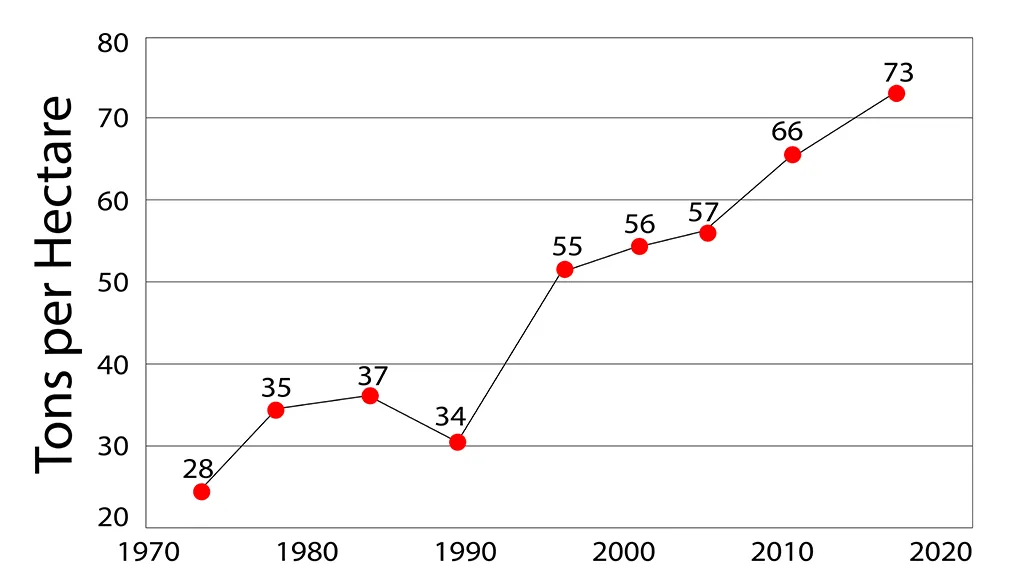
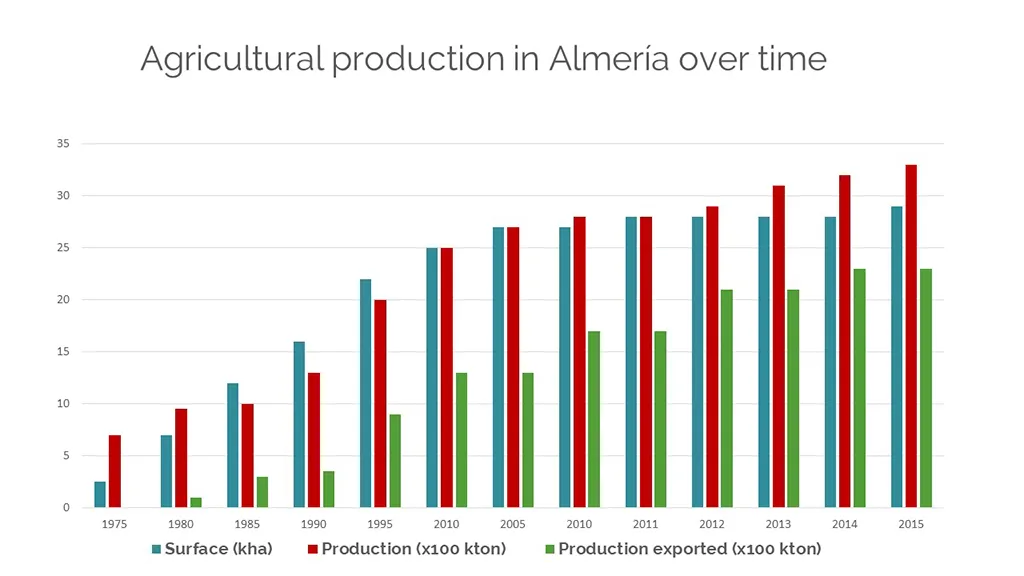
The growth figures are staggering:
In 1990, 16,000 hectares of land produced 1,200,000 tons of produce, of which 400,000 tons were exported.
In 1995, 23,000 hectares of land produced almost 2,000,000 tons of produce of which 900,000 tons were exported.
In 2022, Andalucia sold a total of 4 million tons of fresh fruits and vegetables abroad, for a value of 6,567 million euros.
Of the eight Andalucian provinces, Almeria exports the most horticultural products. The province accounts for a 28.1% share of Andalusia's fruit and vegetable exports and 6% of the Spanish total.
It generated a trade surplus of 3.16 billion Euros, according to data from Extenda, Andalucia's trade promotion agency.
98.1% of the horticultural products that Almeria exports end up on the European market.
80.5% is for EU countries and 17.6% for European countries that are not part of the European Union, including the United Kingdom. 0.7% goes to Africa and 0.6% each time to America and Asia.
In 1990, 16,000 hectares of land produced 1,200,000 tons of produce, of which 400,000 tons were exported.
In 1995, 23,000 hectares of land produced almost 2,000,000 tons of produce of which 900,000 tons were exported.
In 2022, Andalucia sold a total of 4 million tons of fresh fruits and vegetables abroad, for a value of 6,567 million euros.
Of the eight Andalucian provinces, Almeria exports the most horticultural products. The province accounts for a 28.1% share of Andalusia's fruit and vegetable exports and 6% of the Spanish total.
It generated a trade surplus of 3.16 billion Euros, according to data from Extenda, Andalucia's trade promotion agency.
98.1% of the horticultural products that Almeria exports end up on the European market.
80.5% is for EU countries and 17.6% for European countries that are not part of the European Union, including the United Kingdom. 0.7% goes to Africa and 0.6% each time to America and Asia.
Top Three Purchasers in 2022
Germany, Almeria's main destination for horticultural products, purchased 1.059 billion Euros, which was 30.4% of the total.
The United Kingdom purchased 531.5 million Euros which was 15.3% of the total.
France purchased 497.7 million Euros which was 14.3% of the total.
The United Kingdom purchased 531.5 million Euros which was 15.3% of the total.
France purchased 497.7 million Euros which was 14.3% of the total.
References
Agronomy (2021). 'The Role of Technology in Greenhouse Agriculture: Towards a Sustainable Intensification in Campo de Dalias (Almeria, Spain)'
La Vanguardia (2014). 'En el mar de plastico, en Espana, los insectos reemplazan a los insecticidas'.
New Biotechnology (2018). 'An efficient agro-industrial complex in Almeria (Spain): Towards an integrated and sustainable bioeconomy model.'
Resources, Conservation and Recycling (2021). 'Towards delivering on the sustainable development goals in greenhouse production systems.'
Small Business International Review (2020) Volume: 4; Issue: 2; Pages: 18-29. Almeria's fruit and vegetable competitive advantage and the growth of GDP per capita. Sustainability (2017). 'Integral Management of Irrigation Water in Intensive Horticultural Systems of Almeria'.
La Vanguardia (2014). 'En el mar de plastico, en Espana, los insectos reemplazan a los insecticidas'.
New Biotechnology (2018). 'An efficient agro-industrial complex in Almeria (Spain): Towards an integrated and sustainable bioeconomy model.'
Resources, Conservation and Recycling (2021). 'Towards delivering on the sustainable development goals in greenhouse production systems.'
Small Business International Review (2020) Volume: 4; Issue: 2; Pages: 18-29. Almeria's fruit and vegetable competitive advantage and the growth of GDP per capita. Sustainability (2017). 'Integral Management of Irrigation Water in Intensive Horticultural Systems of Almeria'.