Changing Landscapes

Shattering the Divine Contract: State Evasion and Ideological Rupture in the Late Bronze Age Collapse

The Late Bronze Age collapse (c. 1250–1150 BC) in the Eastern Mediterranean was more than a climate or military catastrophe; it was a deliberate ideological rupture. Rather than a passive system failure, I argue that marginalised populations, including the Habiru and displaced palatial subjects, actively exploited the crisis to evade the extractive systems of divine kingship. By retreating to the highlands and constructing resilient coastal networks, these emerging Iron Age societies systematically adopted decentralised technologies, implemented alphabetic writing, and codified transcendent religious frameworks specifically designed to make a return to autocratic palatial servitude impossible.

By Nick Nutter | Published: 2026-06-4 | Updated: 2026-06-4

Visited 120 times

The Collapse as Crisis—and as Political Rupture

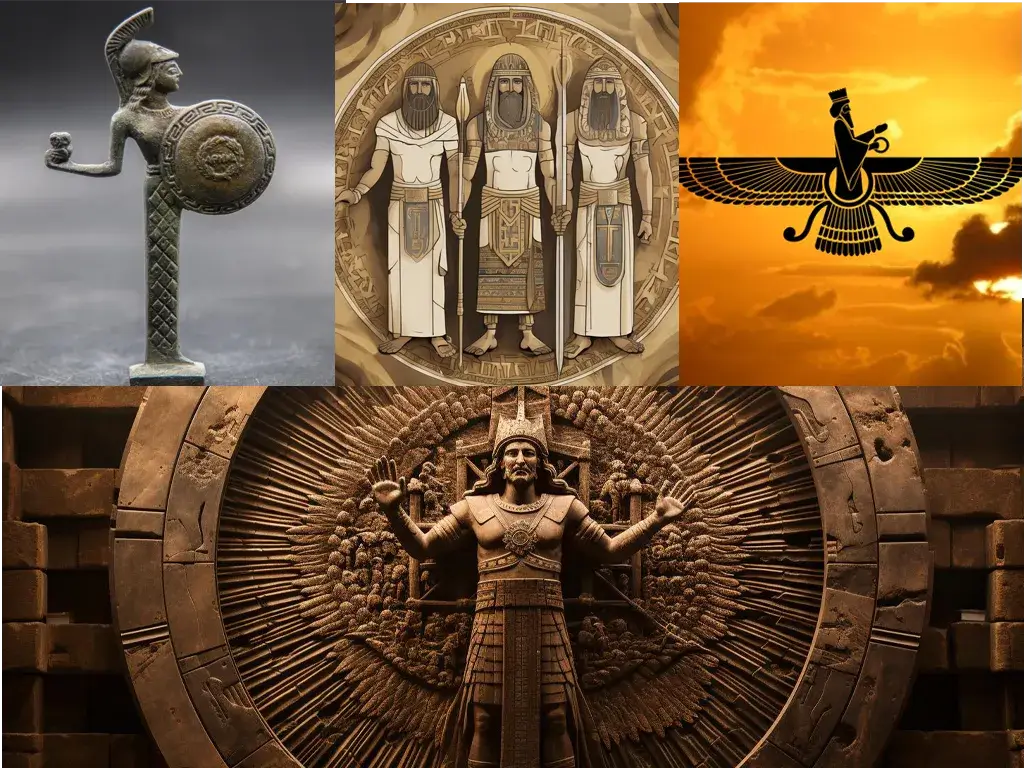
Shattering the Divine Contract: State Evasion and Ideological Rupture in the Late Bronze Age Collapse - Top: Athena (Greek), Yahwism, Zoroastrianism. Bottom: Ashur
Top: Athena (Greek), Yahwism, Zoroastrianism. Bottom: Ashur
The Late Bronze Age collapse, conventionally dated to c. 1250 – 1150 BC, is usually framed as one of the ancient world’s great catastrophes. In the standard account, a combination of prolonged drought, earthquakes and the incursions of the Sea Peoples destabilised the interconnected palatial economies of the Eastern Mediterranean and Near East, producing a wider systems collapse and ushering in a period of fragmentation and reduced literacy (Cline, 2014; Knapp and Manning, 2016).

This article argues that this account is incomplete. The transition from the Bronze Age to the Early Iron Age was not only a story of environmental stress and institutional breakdown; it was also a struggle over power, obligation and legitimacy. For many of the populations who survived it, collapse created an opening to reject the extractive logic of divine kingship and to experiment with new social, political and religious forms.

The central claim of this essay is that surviving populations did not merely endure the collapse of palatial society; in many cases, they exploited it. As palace-temple systems failed to maintain material security and cosmic order, the social compliance that sustained them weakened. Disenfranchised peasants, pastoralists, migrants and displaced fighters withdrew from the old order and sought alternatives beyond the reach of lowland states.

That withdrawal took recognisable forms. In the highlands, new village societies emerged that rejected the spatial, material and ideological signatures of the palatial world. Along the coast, surviving mercantile communities redirected their energies into decentralised maritime exchange. Across these settings, populations abandoned monumental architecture, elite prestige consumption and highly specialised scribal systems in favour of more practical, portable and accessible technologies, including iron metallurgy and alphabetic writing (Dickinson, 2006).

The geopolitical history of the Iron Age then became, in part, a contest between two incompatible models of order. On one side were the decentralised societies that emerged from collapse and increasingly organised themselves around tribal confederation, covenantal law, civic participation and local resilience. On the other were the institutional survivors of Mesopotamia, above all the Neo-Assyrian and Neo-Babylonian empires, which sought to restore extractive imperial power through coercion, terror and deportation rather than through the reciprocal logic that had once sustained Bronze Age kingship.

The argument proceeds in five parts. Part I reconstructs the ideological and material foundations of Bronze Age divine kingship. Part II examines how that order fractured under economic stress, political crisis and state evasion. Part III traces the new geopolitical landscape of the Iron Age, including Phoenician maritime expansion, regional consolidation in the Levant and the coercive resurgence of Assyria and Babylonia. Part IV explores the ideological legacy of the collapse, focusing on codified law, transcendent divinity, civic identity and the emergence of more exclusive forms of collective belonging. Part V looks at the material correlates of ideological incompatibility.


Part I. The Late Bronze Age Geopolitical Baseline (c. 1300 BC)

To grasp the fragility of the Bronze Age geopolitical order, we must examine the mechanics of reciprocal obligation. Ancient societies did not separate practical economic transactions from esoteric religious devotion. The exchange of physical goods functioned as the material manifestation of a required spiritual equilibrium.

How Pharaonic Maat and Hittite Rituals Governed Palace-Temple Economies

The Egyptian concept of Maat exemplifies this necessary balance between the human and divine realms (Assmann, 2001). Maat represented an overarching cosmic order that required constant maintenance through direct pharaonic intervention. The pharaoh offered the agricultural wealth of Egypt to the gods to prevent the return of primordial chaos. Comparable ideological systems operated throughout the distinct empires of the Eastern Mediterranean. Hittite cuneiform tablets recovered from the royal archives at Hattusa (modern Boğazkale, Turkey; 40°01'11"N, 34°36'55"E) outline strict instructions (CTH 264, 'Instructions to Temple Officials') for the priesthood. These legal documents mandate precise daily offerings and threaten divine retribution for any administrative shortfall. The gods demanded exact quantities of high-quality thick-bread (NINDA.GUR.RA) and beer (KAŠ) to preserve divine favour.

This reciprocal loop placed a heavy administrative burden on the regional palatial centres. These palaces acted as the vital node of economic exchange between heaven and earth. We see the physical evidence of this rigid system in the extensive storerooms of Aegean and Levantine palaces. Archaeologists excavating the Palace of Nestor at Pylos uncovered massive magazines filled with hundreds of storage pithoi. The ruling class used these giant ceramic jars to hoard olive oil, grain, and wine. Mycenaean Linear B tablets from Knossos and Pylos record vast inventories of agricultural produce alongside detailed lists of offerings to deities. Tablet Un 718 from Pylos provides a clear example of this transactional dynamic in practice. The text details the exact material contributions required from the supreme ruler, the military leader, and the commoners for a sacrifice to Poseidon (Palaima, 2004). This administrative document demonstrates the complete integration of the social hierarchy into the reciprocal contract.

The wanax (king) in Mycenaean Greece, the lugal (big man) in Mesopotamia, and local kings across the Levant validated their political authority by demonstrating their unique ability to satisfy divine requirements. They controlled the outward flow of grain and oil to ensure the gods reciprocated with favourable harvests. The common people surrendered their surplus production because they recognised this exchange as essential for their collective survival. At least, that is the romanticised version promulgated by the kings. In reality, the peasants surrendered their surplus production compelled by both the threat of state force and the deeply held belief that this exchange was essential for their collective survival.

Anthropological theories of gift exchange provide a useful lens through which to understand this historical phenomenon. Marcel Mauss argued that a gift carries an obligation to reciprocate (Mauss, 1950). Traditional Polynesian societies refer to the spiritual power inherent in an object as hau, an animating force that compels the receiver to return something of equal value in order to preserve social harmony. Bronze Age populations applied a similar logic of reciprocal obligation to their relationship with the pantheon. State sacrifice was therefore not a selfless act of devotion but a binding contract intended to secure specific forms of divine assistance.

Comparable contractual logics appear elsewhere. Inca rulers orchestrated the capacocha ritual to appease mountain deities during periods of drought or seismic instability, offering prestige goods and human sacrifices to restore environmental equilibrium and validate imperial rule. The Chinese concept of the Mandate of Heaven rests on a related premise: a dynasty retains divine approval only so long as it preserves agricultural prosperity and social order. Natural disasters were therefore interpreted as material proof that the divine contract had been broken.

Such systems were structurally fragile because they depended on continuous material abundance. That dependence left rulers acutely exposed to environmental disruption and economic shortfall. Although the formal doctrine of the Mandate of Heaven ended with the Qing dynasty in 1911, the broader idea of performance-based legitimacy remained culturally influential long afterwards.

The recurrence of comparable systems of theological-political reciprocity across otherwise unconnected societies suggests that this transition was not simply accidental. Across different regions, reciprocal models of divine kingship were repeatedly replaced by more transcendent and textually grounded forms of authority. At the very least, this pattern indicates that societies under conditions of systemic stress often seek more durable frameworks of legitimacy and order.

Why the Interruption of Bronze Age Prestige Trade Routes Caused Systemic Collapse

To understand why the collapse of trade proved so fatal, we must examine how ideological rigidity demanded a constant influx of prestige goods. These exotic items functioned as the physical currency of divine favour across the Eastern Mediterranean and Middle East. Bronze Age monarchs could not simply substitute local materials for imported luxuries when supply lines failed. The established theology dictated that the gods specifically required lapis lazuli, gold, and ivory to validate the earthly hierarchy. This strict material requirement created an immense vulnerability within the political system. Kings had to monopolise international trade to maintain their domestic ideological monopoly (Monroe, 2009). When a king could no longer acquire these specific goods, he could no longer project the aura of divine sanction. The common people accepted their subordinate position precisely because the ruler could manifest such unimaginable, otherworldly wealth.

We can judge the absolute necessity of these materials in the cargo of the Uluburun shipwreck. This Late Bronze Age vessel sank off the coast of Anatolia while carrying a staggering concentration of royal wealth. Marine archaeologists recovered ten tons of copper and a ton of tin ingots alongside raw ivory, ebony, and Baltic amber. This cargo alone demonstrates the vast geographical reach required to satisfy palatial ideological needs. The elites did not stockpile these raw materials for basic utilitarian construction or common market trading. Craft specialists working directly within the palatial workshops transformed these imports into the sacred artefacts essential for state rituals. The sudden severing of these maritime trade routes did not just cause an economic recession. It actively starved the religious apparatus of the raw materials required to manufacture legitimacy.

Anthropologists have long recognised how specific exotic items uphold political authority in traditional societies. Bronisław Malinowski documented the complex Kula ring exchange system among the Trobriand Islanders in the Western Pacific (Malinowski, 1922). Local chieftains maintained their status by constantly circulating highly valued shell armbands and necklaces across vast ocean distances. Ethnographic studies of the Pacific Northwest Coast potlatch system provide another excellent parallel for this dynamic. Indigenous chiefs validated their social rank and spiritual authority by hosting lavish feasts and distributing immense wealth. A chief who failed to accumulate and distribute sufficient goods immediately lost his political power and followers. The system possessed no mechanism for a chief to maintain authority without the continuous display of material abundance.

Bronze Age rulers operated under the same structural constraints regarding their imported luxuries. When the Mediterranean trade routes fractured, the kings lost their supply of ideological fuel. The resulting inability to perform the necessary material displays caused their political authority to evaporate.

The Cessation of State-sponsored Monuments

State-sponsored monuments served as the ultimate physical proof of the divine contract. Kings did not build colossal statues and sprawling temple complexes merely to satisfy their vanity. They constructed these massive edifices to demonstrate their unique ability to harness human labour for the gods. The sheer scale of these projects proved that the pantheon actively supported the current administration.

When the overarching ideology collapsed, the driving force behind this monumental architecture vanished. The sudden cessation of building programmes represents a subtle theological shift rather than an economic depression. With no phantom elite barking orders at a newly liberated populace, the surviving populations had no desire to replicate or maintain these structures on any scale. The architectural vocabulary of divine kingship was completely abandoned because it no longer held any spiritual or practical meaning.

We see signs of this abrupt architectural termination across the ruined landscapes of the Eastern Mediterranean. The Hittite imperial quarry at Yesemek (modern Yesemek Open Air Museum, Gaziantep Province, Turkey; 36°53'35"N, 36°44'40"E), provides a snapshot of this ideological failure. Stonecutters abandoned hundreds of massive basalt sphinxes and lion statues mid-production when the central authority dissolved. In Mycenaean Greece, the construction of the spectacular tholos tombs ceased abruptly and without any transitional phase. The post-collapse communities did not attempt to build smaller versions of these elite burial structures. They chose instead to invest their limited resources into practical communal defences and domestic agricultural terraces.

The collapse of the monument-building culture on Rapa Nui offers an ethnographic analogy for this phenomenon. The islanders suddenly stopped carving and transporting the massive stone moai statues during a period of intense ecological stress. Traditional narratives often attribute this sudden cessation purely to resource depletion and the loss of timber. Anthropologists now understand that the environmental crisis triggered a catastrophic failure of the existing religious ideology. The chiefly class lost their perceived divine mandate when the ancestral statues failed to ensure agricultural fertility (Hunt and Lipo, 2011). The general population deliberately toppled the existing moai and completely abandoned the quarries. They replaced the failed ancestral cult with the new Birdman belief system, which required no monumental architecture whatsoever. Bronze Age populations experienced an identical psychological break from their own failed monumental traditions.

Part II. Internal Sociopolitical Fractures and the Twelfth-Century BC Collapse Matrix

Socioeconomic Stress and Pre-collapse Ideological Fractures

To understand the totality of the twelfth-century BC collapse, we must recognise that the system was already rotting from within. With one massive, elite-driven exception, emerging religions did not cause the peasant revolts; rather, the underlying socioeconomic stress caused both the revolts and the eventual birth of the new religions. In modern historical and archaeological scholarship, the causal arrow almost always points from economic desperation to theological innovation, not the other way around.

Case Study: How Akhenaten’s Amarna Revolution Weakened New Kingdom Egypt

There is one monumental instance where a radical religious shift did predate the global collapse and directly caused massive civil unrest, but it was an elite, top-down imposition rather than a peasant revolt. Around 1350 BC, Pharaoh Akhenaten abolished the traditional Egyptian pantheon and instituted the worship of a single deity, the Aten (the sun disc). He closed the great temples, cut off the powerful priesthoods, and built an entirely new capital city. The short-lived capital of Akhetaten (modern Tell el-Amarna, Egypt; 27°38'42"N, 30°53'46"E) was established on the east bank of the Nile River in the Middle Egypt region.

This top-down state-enforced religious revolution disrupted the pan-regional redistributive networks, alienating both the peasantry, whose local gods were banned, and the military elite. While this did not cause the global Bronze Age collapse, it severely weakened Egypt right before the crisis hit. Immediately after Akhenaten's death, his successors, Tutankhamun and Horemheb, had to frantically dismantle this new religion and restore the old gods just to prevent the state from tearing itself apart.

Who Were the Habiru? Socioeconomic State Evasion in Late Bronze Age Canaan

Meanwhile, in the Levant, the social fabric was tearing from the bottom up. The Habiru existed well before the systemic collapse of 1200 BC, appearing prominently in the Amarna Letters around 1350 BC. They were actively dismantling the Canaanite city-states through state evasion and banditry (Moran, 1992).

However, at that time, the Habiru were a socioeconomic class, not a religious group. The peasants who fled to the hills did not do so because they had suddenly received a new divine revelation. They fled because of crushing debt, exorbitant taxation, and forced conscription. The theology of liberation, the early seeds of what would eventually become the Yahwistic covenant of the Israelites, crystallised after they had successfully escaped (Gottwald, 1979). They needed a powerful, transcendent ideology to ensure their newly formed, egalitarian tribes never allowed a palatial king to subjugate them again. The religion was the ultimate defensive fortification built by the survivors of the revolt, not the initial spark of the revolt itself.

The Rise of Personal Piety

There is one subtle ideological shift that did predate the collapse among the general population across the Eastern Mediterranean: the rise of what archaeologists specifically term "personal piety” (Baines, 1987; Luiselli, 2008).

In the decades leading up to 1200 BC, as the climate worsened and the palatial economies began to visibly falter, the archaeological record reveals a sudden explosion of unmediated, domestic worship. The most spectacular evidence of this shift comes from the Egyptian artisan village of Deir el-Medina, where common workmen began erecting hundreds of personal votive stelae. These monuments bypassed the massive, state-controlled priesthoods at Karnak entirely, with ordinary citizens praying directly to deities like Amun or local goddesses for personal healing and forgiveness (Meskell, 2002).

We see identical material correlates across the collapsed zones. In Canaanite hubs like Ugarit and Hazor, commoners increasingly relied on cheap terracotta plaque figurines and domestic courtyard shrines (Dever, 2005; Moorey, 2003), while the lower towns of Mycenaean Greece saw a massive proliferation of mass-produced, household votive figurines (French, 1971; Whittaker, 2014). The general population had begun to realise that the grand, state-sponsored rituals of the divine kings were failing to bring rain or stop the raids. People started praying directly to local, personal deities out of desperation. This rising tide of personal piety did not directly cause armed revolts, but it fundamentally eroded the ideological authority of the elite. By the time the Sea Peoples arrived or the final droughts hit, the peasantry had already stopped believing in the spiritual legitimacy of their rulers.

Social Fragmentation and the Emergence of Tribal Identities

The physical abandonment of the Bronze Age palatial centres forced a serious transformation in personal and collective identity. When the redistributive economies failed, the rigid class hierarchies of the palace system lost their entire functional justification. People could no longer define themselves simply as the agricultural subjects of a divinely appointed monarch. The collapse of the overarching imperial structures created a massive political vacuum, but filling that void was not an overnight resolution.

People did not suddenly decide to invent new societies the moment the central authority failed. Instead, the development of entirely new methods of social cohesion was a messy, multi-generational slog. Over decades, perhaps centuries, local elders and displaced families had to slowly modify their philosophies to ensure survival.

As disparate refugee populations mingled with highland pastoralists, they gradually wove together fictionalised kinship networks and shared geographical hardships into cohesive, unifying narratives. Rather than attempting to reconstruct the oppressive state apparatus that had just failed them, these populations organically coalesced into tribal confederations.

We see this phenomenon materialise most vividly across the marginal geographies of the Eastern Mediterranean. In the rugged central highlands of Canaan, displaced peasant farmers and Shasu pastoralists merged to form the proto-Israelite and Judean confederations (Faust, 2006), unifying their disparate origins through shared theological and patriarchal narratives. To the east, on the arid Transjordanian plateaux, fragmented herding groups coalesced into the fiercely territorial tribal kingdoms of Moab, Edom, and Ammon (Bienkowski, 1992; Routledge, 2004; Tyson, 2014), each anchoring their new national identity to a singular, exclusive regional deity.

Further north, emerging from the fringes of the Syrian desert, the Aramean pastoralists absorbed the refugees of collapsed urban centres to forge formidable tribal networks like Aram-Damascus (Lipiński, 2000; Younger, 2016). Even across the Aegean, large swathes of the Greek mainland completely abandoned the urban palatial model in favour of the ethnos, loose tribal leagues bound together by mythical founding ancestors and shared regional sanctuaries. Because this ethnogenesis was organic and highly localised, neighbouring valleys often developed divergent, and sometimes contradictory, mythologies and social structures. These inevitable anomalies and uneven developments planted the seeds for the intense regional friction that would define the subsequent centuries, even to the present day.

The Merenptah Stele provides our most striking contemporary textual evidence for this specific ideological shift. This Egyptian monument dates to the late thirteenth century BC and boasts of various military conquests in the Levant. The inscription famously mentions Israel, but the scribes deliberately used a specific hieroglyphic determinative that denotes a foreign, nomadic people rather than a sedentary, geographic city-state. This subtle grammatical choice, if it wasn’t an ancient typo, shows that the Egyptians recognised a newly formed, state-evading tribal confederation operating completely outside the traditional Canaanite palatial system (Mazar, 1990).

We can find ethnographic and historical similarities for this ethnogenesis in the aftermath of state collapses globally. Anthropologists studying the pastoral nomads of the Eurasian steppe note how tribal confederations rapidly form in direct response to the fracturing of sedentary empires. These displaced groups invent shared genealogies to bind disparate refugee populations together into a cohesive military and social unit.

The collapse of the Western Roman Empire similarly birthed entirely new Germanic tribal identities from the remnants of displaced imperial subjects, escaped slaves, and military auxiliaries. Franks, Alamanni, and Saxons did not exist as ancient, monolithic ethnic groups before the crisis of the third century. They coalesced into powerful confederations to survive the geopolitical chaos and fill the administrative void left by Rome. While earlier localised state failures, such as the collapse of the Akkadian Empire centuries prior, saw marginalised groups temporarily forge new political alliances, the survivors of the Late Bronze Age employed this strategy of identity formation on an unprecedented, systemic scale. To navigate their completely shattered world, they permanently discarded the identities imposed upon them by the failed palatial elite. In doing so, they moved beyond mere survival, laying down the durable ethno-national blueprints that would define the Iron Age and echo into the present day.

The tripartite collapse of Canaan

To fully understand the internal dissolution of the Levantine city-states and the resulting highland evasion, we must recognize that the Late Bronze Age collapse was not a uniform, monolithic event. Recent archaeological synthesis reveals that the region of Canaan fractured along three distinct geographical trajectories, each presenting a unique survival challenge.

  • In Northern Canaan, major palatial centres like Hazor (modern Tel Hazor, Israel; 33°01'05"N, 35°34'09"E) suffered catastrophic and sudden destruction, resulting in the complete extinction of the local urban elite and their administrative machinery.
  • Conversely, Central Canaan, encompassing the fertile Jezreel and Jordan valleys, experienced a protracted, lingering decline. Here, at sites like Megiddo and Beth Shean, the Egyptian imperial administration stubbornly attempted to maintain its garrisoned authority for decades before finally succumbing to economic exhaustion.
  • Finally, Southern Canaan witnessed a trajectory of aggressive hybridization. The southern coastal plain was occupied by settling maritime factions, the Philistines, who established a formidable, new urban pentapolis over the ruins of older Canaanite centres.

For the disenfranchised Canaanite peasantry and marginalised pastoralists, the lowlands had become an unliveable patchwork of burning palaces, clinging empires, and new coastal invaders. Consequently, true state evasion required a radical geographical departure.

Highland Ethnogenesis: The Archaeological Footprint of Proto-Israelite Sites

To fully grasp the internal dissolution of the Levantine city-states, we must examine the specific phenomenon of the Habiru and their subsequent physical footprint in the highlands. As noted, the Habiru highlighted the chronic, underlying fragility of the system long before the final crisis hit. They actively rejected the suffocating taxation and ideological control of the Canaanite palace economies, physically removing themselves from the divine contract of the established urban centres.

The Amarna Letters (written between 1360 and 1330 BC) provide exceptional contemporary documentation of this mounting social crisis. Abdi-Heba, the Egyptian appointed mayor of Jerusalem, penned frantic dispatches to the pharaoh, probably Akhenaten, begging for military intervention because his own local theological and political authority had completely failed to keep the population in line. Amarna Letter EA 286 reads:

"Message of Abdi-Heba, your servant... What have I done to the king, my lord? They denounce me before the king, my lord, saying: 'Abdi-Heba has rebelled against the king, his lord.' ...Let the king take care of his land! The land of the king is lost; in its entirety it is taken from me... The Habiru plunder all the lands of the king. If there are archers [Egyptian troops] here this year, the lands of the king, my lord, will remain; but if there are no archers, the lands of the king, my lord, are lost!" (Moran, 1992)

He explicitly warned that the Habiru were systematically capturing the royal cities and seducing his subjects into rebellion. Operating from the rugged hill country, the Habiru subverted the ruling elites by raiding caravans and demonstrating a successful, state-free lifestyle.

We find diagnostic physical footprints of this ideological secession in the rugged cis-Jordanian and Judean hill country (Iron Age I highland sites). Archaeological surveys document over 250 new, unfortified agrarian hamlets appearing between c. 1220 and 1150 BC. Excavations at ’Izbet Sartah (Stratum III) and Shiloh (modern Khirbet Seilun, West Bank; 32°03'21"N, 35°17'22"E) reveal that the newly established communities completely discarded the stratified urban layout of the lowland Canaanite city-states. They engineered a distinct settlement pattern that actively reflected their newly forged egalitarian ethos. The standard domestic unit became the four-room or pillared house, an architectural form that practically enforces social equality. These structures possess a uniform size and a shared internal layout across dozens of disparate highland villages. Archaeologists excavating sites like Izbet Sartah and Shiloh discover no distinct palatial estates or elite monumental architecture. These populations explicitly rejected the hierarchical divine contract of the valleys.

The material culture of these highlanders further underscores a conscious ideological boundary against the surrounding imperial remnants. Zooarchaeological analyses of rubbish pits in these settlements reveal an almost total absence of pig bones. Contemporary Philistine and Canaanite coastal settlements consumed pork in massive quantities (Finkelstein and Silberman, 2001). This sudden dietary restriction is a powerful socio-ethnic marker rather than a geographical anomaly. Food taboos serve as highly effective mechanisms for maintaining internal group cohesion while rejecting external cultural influences. These communities also universally adopted the massive collared-rim storage jar for their agricultural surplus, manufacturing strictly utilitarian vessels locally rather than relying on imported prestige ceramics. They engineered an entire agricultural and social landscape, including extensive terracing, to permanently obstruct the return of divine kingship.

This conscious withdrawal from lowland states to inaccessible terrains is not a unique historical anomaly; it is a recurring strategy of human survival. We can draw historical parallels with later populations who similarly escaped oppressive economies to forge independent, egalitarian societies. Much like the populations in Southeast Asia who deliberately retreated into the mountainous zone known as Zomia to evade lowland rice states (Scott, 2009), the emergence of the Cossacks on the Eurasian steppe during the fifteenth century AD, and the Maroon communities of the Americas from the sixteenth century onwards, the Iron Age highlanders perfected the art of state evasion.

Ideological Dissolution in Pylos, Tiryns, Ugarit, Emar and Hazor

The precise mechanics of this ideological dissolution can be inferred by examining the final days of major administrative centres. The Palace of Nestor at Pylos (modern Messenia, Greece) provides a snapshot of a ruling class in theological panic. Scribes hastily inscribed Linear B tablet Tn 316 just days before a catastrophic fire consumed the citadel. This extraordinary document records emergency offerings, including possible human sacrifices, to a multitude of deities (Shelmerdine, 1999). The wanax desperately attempted to fulfill his end of the divine contract as the geopolitical situation deteriorated. The gods did not answer, and the subsequent total destruction of the palace indicates the local population turned on the failed elite.

At the Mycenaean citadel of Tiryns, the ideological rejection was stamped directly into the architecture. Following the destruction of the palace, the surviving population deliberately constructed a smaller, communal structure known as Building T directly over the ruins of the Great Megaron. By placing their new communal centre exactly on top of the old throne room, they physically subverted and reclaimed the exclusive space where the wanax once communed with the gods.

A similar pattern characterises the fall of Ugarit (modern Ras Shamra, Syria). The final letters of King Ammurapi, found by archaeologists still sitting in the palace kilns where they were being fired for dispatch, reveal a leader who had lost all control. In letter RS 18.147, Ammurapi frantically informs the King of Alashiya that he is 'abandoned to himself' because his own troops and ships are away serving the Hittite empire. This proves that the reciprocal military contract of the Bronze Age had become a death trap (Yon, 2006). The vassal had fulfilled his obligation to the elite, but the elite could no longer reciprocate with protection. The ensuing destruction layer smothered the elite administrative quarters and the grand temples of Baal and Dagon, and the survivors deliberately chose not to rebuild this immensely profitable port, retiring into agricultural obscurity.

Excavations at Emar(modern Tell Meskene, Syria) on the Euphrates River expose the simultaneous collapse of the religious and scribal hierarchies. Archaeologists unearthed the private archive of a chief diviner whose family had monopolised the local priesthood. As the central authority waned, the domestic architecture surrounding the temples shows signs of chaotic abandonment rather than a coordinated external siege. The populace had apparently walked away in despair from the complex rituals and divination practices.

The archaeological footprint at Hazor in northern Canaan offers the most visceral evidence of targeted ideological violence. The monumental Canaanite city suffered a massive conflagration, hot enough to melt the mudbrick walls of the royal ceremonial palace.

During field evaluations at the Acropolis of Tel Hazor (32°59'48"N, 35°34'06"E), the targeted nature of this anti-elite violence becomes physically unmistakable within the Stratum XIV destruction layer. Standing among the vitrified mudbrick ruins of the Late Bronze Age ceremonial palace, one observes that the mutilation of Egyptian and Canaanite basalt statues was deeply calculated. My assessment of these artifacts confirms that the blows specifically sheared the heads and right hands, a symbolic execution of the ruling administrative and cosmological hierarchy rather than the indiscriminate destruction of a foreign raiding party.

The abandonment of Angkor in Southeast Asia during the fourteenth century AD provides an excellent historical parallel. When fluctuating monsoons caused the highly engineered hydraulic infrastructure to fail, the divine kingship immediately lost its religious legitimacy (Fletcher et al., 2008). The population abandoned the monumental capital and dispersed into smaller, self-sufficient agricultural villages.

Material Correlates of Ideological Transformation

To comprehend the absolute totality of this ideological transformation, we must look at the tangible material remains. The most immediate and striking change occurs within the epigraphic record across the collapsed zones.

  • A Return to Elite Illiteracy
    The palatial administrative scripts vanished entirely alongside the burning of the central archives. This sudden illiteracy was not a conscious boycott by a literate public, but rather the structural extinction of a highly specialised skill. Literacy in the Late Bronze Age was an exclusive monopoly held by a tiny class of palatial bureaucrats. When the palaces fell and the elite networks disintegrated, the scribal schools vanished with them. The general population did not forget how to read; they had never known how. However, the intellectual silence of the Early Iron Age does represent a deliberate structural shift. The surviving communities made no attempt whatsoever to resurrect the bureaucratic machinery required to train new scribes in these complex syllabaries. Scripts like Linear B died because they functioned exclusively as tools of elite taxation and palatial inventory. Without a centralised, redistributive economy to track, the convoluted writing systems lost their entire raison d'etre.
  • Ceramic Evolution: Handmade Burnished Ware"
    The ceramic repertoire of the post-collapse communities provides more evidence for this structural transformation, though we must be careful not to paint this transition with too broad a brush. The collapse of the palatial system was not perfectly uniform. Certain centres, such as Athens and communities on Cyprus, survived the initial upheaval relatively unscathed, while the lower town of Tiryns actually experienced a post-palatial revival. Furthermore, international maritime trade did not plummet to absolute zero overnight. Mycenaean Late Helladic IIIC (LH IIIC) pottery continued to be produced and exported, appearing at a limited number of sites in the Central Mediterranean well after 1200 BC. While the volume dropped significantly from the preceding era, its continued presence in the Aeolian Islands and southeastern Sicily confirms that opportunistic, long-distance voyaging survived the fall of the central palaces.

    However, for the vast majority of the population across the severely collapsed zones, the mass-produced, sophisticated fine wares disappeared abruptly. When analyzing post-palatial stratigraphy across Argolid sites, the sudden appearance of Handmade Burnished Ware (HMBW), frequently termed 'Barbarian Ware' in older mid-twentieth-century typologies, signals a drastic shift in production mechanics. Examining this coarse, low-fired fabric in the field highlights that rural populations did not experience an accidental loss of technology. Rather, they were responding to the catastrophic dissolution of the elite-subsidised palatial kilns of Mycenae (modern Mykines, Greece) and Tiryns by adapting local, domestic clay pastes into utilitarian cooking pots The sudden adoption of this crude, unpainted pottery was likely not a deliberate, ideological 'thumb in the nose' to the previous elites, but rather a stark reflection of shattered palatial infrastructure.

    Bronze Age palaces had funded massive, centralised workshops capable of industrial-scale ceramic production. When those redistributive economies failed, the complex logistical network required to mass-produce fine wares, such as high-capacity kilns and the centralised sourcing of levigated clay, vanished with them. While the core technology of the fast potter's wheel was never lost, surviving continuously in resilient coastal enclaves like the Canaanite-Phoenician city-states, who would eventually export the technology as far west as Cadiz, many disenfranchised inland and rural populations reverted to manufacturing their own simple, hand-formed cooking pots out of practical necessity.

  • Treatment of the Dead
    We see an equally dramatic transformation in how these transitional societies treated their dead. Mycenaean elites previously invested staggering resources into constructing massive tholos tombs and elaborate chamber graves for multiple generations. These monumental structures physically embedded the ruling families into the landscape, legitimising their continuous authority through ancestor worship. The post-collapse populations entirely abandoned these collective elite burial grounds. They adopted simple, individual cist graves or transitioned directly to the practice of cremation. This shift towards individual, unmonumentalised burials reflects the new egalitarian ethos of the emerging tribal confederations. They explicitly erased the physical markers of hereditary privilege.

    A historical parallel for this material regression is post-Roman Britain. When the imperial administration withdrew in the fifth century AD, the Romano-British population experienced an identical material transformation. Wheel-thrown pottery collapsed, Latin inscriptions ceased, and the population abandoned masonry tombs for simple inhumations.

Part III. The Iron Age Geopolitics

Scholars frequently debate whether the Eastern Mediterranean genuinely regressed to a pre-Bronze Age state following the collapse. Proponents of the regression theory point to the staggering loss of sociopolitical complexity. The sudden disappearance of palatial literacy and international trade certainly mirrors the isolated conditions of the Chalcolithic period. People abandoned urban centres and returned to subsistence agriculture. The cessation of monumental building projects further suggests a society that had lost advanced engineering capabilities.

Was this Regression? Rethinking Post-Collapse Change

However, arguing for a simple historical rewind fundamentally misreads the archaeological evidence. The post-collapse populations did not simply forget the technological advancements of the past millennium. They adapted their knowledge to suit a decentralised, egalitarian mode of survival. We can see this clearly in the rapid widespread adoption of iron metallurgy across the Levant and Greece. Iron ore exists abundantly, and its smelting requires intense local heat rather than complex international tin networks. This metallurgical shift democratised tool production and permanently broke the elite monopoly on bronze weaponry. Furthermore, the agricultural techniques of these highland communities demonstrate sophisticated engineering rather than primitive regression. The inhabitants carved complex terrace systems into the Judean and Greek hillsides to maximise water retention and soil stability. They lined newly cut cisterns with impermeable hydraulic plaster to ensure year-round water security outside the valleys.

The most convincing argument against a true regression lies in the evolution of human communication. While palatial scribes stopped writing in cuneiform and Linear B, a revolutionary new intellectual tool quietly took root. The simplified alphabetic scripts pioneered by Canaanite merchants began to spread rapidly among the general population. This phonetic system required minimal formal training, completely destroying the previous elite monopoly on information storage.

Ethnographic studies of the European Early Middle Ages show a similar ethos. Victorian historians famously labelled the period following the Roman collapse as a primitive dark age. Modern archaeologists now recognise that this era actually produced agricultural innovations like the heavy mouldboard plough and the horse collar. The decentralisation of power stimulated local technological adaptations that the rigid Roman imperial economy had previously stifled.

The Canaanite-Phoenician Maritime Resurgence

While the inland palatial systems burned and the highland populations forged new tribal identities, a distinct cluster of northern coastal Canaanite city-states managed to weather the systemic collapse. Cities such as Tyre, Sidon, Beirut, Byblos and Arwad survived the initial twelfth-century BC upheaval with their urban infrastructure and artisanal knowledge largely intact. Importantly, these enclaves already possessed expansive Bronze Age maritime trading networks extending to Egypt, Cyprus, and the Aegean. However, the geopolitical reality around them had permanently altered. Cut off from their traditional agricultural hinterlands by the expanding Aramean kingdoms and the newly settled highland confederations, these coastal enclaves were forced to rely exclusively on the sea for their survival.

This geographical confinement, combined with a sudden lack of competition, proved to be the catalyst for an unprecedented maritime expansion. With the Mycenaean fleets destroyed and the great rival mercantile hub of Ugarit lying in ruins, the Mediterranean was entirely devoid of a dominant naval superpower. The surviving coastal Canaanites, whom the Greeks would later call the Phoenicians, opportunistically rushed to fill this massive economic vacuum. Leveraging their surviving Bronze Age technologies, such as advanced shipbuilding and the industrial production of Tyrian purple dye from the murex shell, they hyper-focused their economy on maritime ventures. They expanded their networks far beyond their old Bronze Age routes, establishing a sprawling web of trading colonies that eventually stretched from Cyprus to Carthage, and as far west as Cadiz on the Iberian Peninsula. They transitioned from being the maritime vassals of Bronze Age empires to the undisputed venture capitalists of the Early Iron Age.

One of the clearest material expressions of this Canaanite recovery was administrative rather than architectural: the refinement of a new writing system. As noted earlier, the complex palatial scripts of the Bronze Age, such as cuneiform and Linear B, died because they were inherently tied to the elite taxation machinery. The Phoenician merchants, operating independently across vast distances, required a radically different tool. Instead of reviving convoluted syllabaries that required years of scribal schooling, they refined and exported a brilliantly simple phonetic alphabet. Because it contained only twenty-two consonantal characters, it could be learned by an average merchant in a matter of weeks. This represented a subtle democratisation of literacy. Writing was no longer a state-sponsored mechanism of control locked within a palace archive; it became a highly portable, decentralised tool for facilitating international trade. By exporting this alphabet to the Greeks and Arameans, the Canaanite survivors fundamentally rewired the intellectual infrastructure of the Iron Age world, proving that non-palatial, mercantile networks could be just as durable as the empires they replaced (Monroe, 2009; Cline, 2024).

Regional Consolidation and the Aramean Ascendancy

Before the resurrected Mesopotamian empires swept westward to impose their absolute domination, the geopolitical landscape of the Levant was defined by the fierce, uncoordinated friction of newly consolidated tribal states. The populations that had successfully evaded the Bronze Age palatial collapse, the Israelites, the Moabites, the Edomites, and the Arameans, had spent the intervening centuries solidifying their fiercely independent, text-based identities. Among these newly minted Iron Age powers, the Aramean kingdom of Aram-Damascus emerged as a particularly formidable military force. Originally a network of fragmented pastoralist tribes, the Arameans successfully centralised their own regional authority, fiercely contesting the fertile valleys and trade routes of the northern Levant.

We find the most persuasive physical evidence of this brutal regional competition in the Tel Dan Stele. Erected in the second half of the ninth century BC (circa 840 BC), this basalt victory monument was commissioned by Hazael, the Aramean king of Damascus. In the surviving fragmentary text, Hazael boasts of his devastating military campaigns against his southern neighbours, explicitly claiming to have slain both the King of Israel and the King of the 'House of David' (Judah) (Biran and Naveh, 1993).

This monument serves as a crucial historical hinge for understanding the post-collapse world. First, it provides the earliest widely accepted extra-biblical epigraphic proof that these localised tribal identities had permanently cemented themselves into recognised, competing royal houses. Secondly, it perfectly illustrates the violent, inter-regional friction that characterised the Early Iron Age. Hazael’s campaigns represent the zenith of this local autonomy, a brutal but independent geopolitical ecosystem that was entirely devoid of an overarching superpower. It was this fierce, fragmented independence that the Neo-Assyrians, and subsequently the Neo-Babylonians, recognised as an existential threat to their extractive economies, prompting their campaigns of systemic deportation and terror.

We see the exact same phenomenon with the political evolution of the Eurasian steppes and the pre-Columbian Americas. When nomadic confederations like the Mongols conquered sedentary populations, they did not simply adopt the fragile administrative structures they found. They imposed a highly militarised, mobile bureaucracy that actively suppressed indigenous local identities. The Inca Empire utilised a remarkably similar system called mitma, forcibly relocating entire ethnic groups across the Andes to break resistance and enforce state ideology. The Iron Age empires of Mesopotamia utilised this exact mechanism of deliberate cultural erasure to prevent any return to localised resilience.

The Failure of Imperial Restoration

We must examine why initial attempts to resurrect the Bronze Age imperial model ultimately failed. Surviving elites desperately tried to re-establish the old theological contract of divine kingship and palatial redistribution. They found that the underlying social compliance required for such a system had permanently evaporated. The populace no longer believed that centralising their surplus wealth guaranteed cosmic order or physical security.

We see this failure of restoration clearly in the slow contraction of the Egyptian empire. In the early twelfth century BC (circa 1178 BC), Pharaoh Ramses III managed to repel the maritime factions and temporarily secure the Levantine coastal garrisons. However, his imperial strategy introduced a highly subversive population into the Levant by resettling captured segments of these very same Sea Peoples (Sandars, 1985; Yasur-Landau, 2010). We can identify them not as a monolithic horde, but as heavily armed venture maritime merchants originating from areas like Sardinia. Pharaoh Ramses III deliberately settled groups such as the Sherden across Canaan, Jordan, and northern Israel to act as garrisoned vassals.

These resettled populations quickly became an internal catalyst for domestic dissolution within their host territories. They operated outside the traditional theological-political framework of the Canaanite city-states, demonstrating a successful alternative to palatial subjugation. Meanwhile, the mobile maritime factions opportunistically exploited a geopolitical system already fracturing under its own ideological weight. This initial Egyptian military success masked an ideological decay rotting the core of the state that would inevitably prove fatal.

Archaeological excavations at Beth Shean reveal that the Egyptian administration eventually abandoned this crucial Canaanite stronghold. The pharaohs simply could not extract enough local tribute to maintain their extravagant monumental presence abroad, and the newly settled maritime groups had no ideological incentive to fund them.

In northern Syria, the survivors of the Hittite collapse established a network of smaller successor states. These Neo-Hittite kingdoms desperately mimicked the artistic and architectural styles of their fallen imperial ancestors. They carved elaborate basalt reliefs and maintained traditional royal titles to project an illusion of continuity. These fractured polities never managed to recreate the vast, interconnected palatial economy of the previous era. They functioned instead as localised chiefdoms wearing the ill-fitting ideological garments of a dead superpower.

Historical attempts to restore the Western Roman Empire exemplify this structural phenomenon. Emperor Justinian launched massive military campaigns to reclaim Italy and North Africa from various Germanic confederations. He successfully conquered the territory but completely failed to resurrect the complex Roman economic machine. The underlying civic infrastructure and the public willingness to pay imperial taxes had vanished centuries earlier.

Late Bronze Age elites faced the same impassable barrier when attempting their own imperial restorations. They could occasionally win military battles, but they could never reconstruct the shattered theology of obedience. The people had tasted the practical benefits of decentralisation and utterly refused a voluntary return to the old ideological servitude. Any future empire seeking to subjugate these populations could no longer rely on the fragile illusion of a reciprocal divine contract; they would have to forge their empires through absolute terror and forced compliance.

The Neo-Assyrian World

The fragmented, tribal independence forged in the highlands during the Early Iron Age was not permitted to last. To understand the catastrophic loss of this hard-won autonomy, we must look to Mesopotamia, where the old Bronze Age palatial model had managed to survive on life support. Unlike the total systemic failures seen in the Aegean and the Levant, the Middle Assyrian state never completely collapsed. While it suffered severe territorial contraction during the twelfth and eleventh centuries BC, losing their western territories to the newly formed Aramean tribal confederations, its core administrative and military apparatus remained intact within the fortified Ashur, Nineveh, and Arbela triangle along the Tigris River.

When this ancient state apparatus finally recovered its strength, it unleashed a campaign of unprecedented imperial expansion. Beginning in 911 BC under King Adad-nirari II, and accelerating ruthlessly under Tiglath-Pileser III in 745 BC, the newly minted Neo-Assyrian Empire swept westward. Because the Assyrian elite had retained the bureaucratic memory of the old Bronze Age state, they understood exactly how fragile voluntary ideological compliance could be. Therefore, they did not attempt to negotiate reciprocal theological contracts with the newly formed Aramean, Canaanite, and Israelite tribal confederations. Instead, they relied on absolute terror and the systemic, forced deportation of entire populations to permanently shatter local identities and prevent the state-evasion tactics that had defined the previous centuries (Radner, 2015; Van de Mieroop, 2015).

Despite their reliance on absolute terror and systemic deportation in the agricultural highlands, the Neo-Assyrians were pragmatic when dealing with the surviving Canaanite coastal enclaves that we now identify as Phoenician. They recognised that cities such as Byblos, Sidon, and Tyre controlled vital maritime trade routes that funnelled raw materials, metals, and luxury goods into the Near East. Rather than immediately destroying these economic engines, the early Neo-Assyrian kings opted for a lucrative extortion racket. They exacted massive, regular tribute, deliberately leaving the local mercantile elites in power to ensure the Mediterranean trade continued to flow uninterrupted. It was only much later, during the late eighth and seventh centuries BC, when these coastal cities repeatedly rebelled against increasingly suffocating taxation, that the Assyrian state finally abandoned this pragmatic approach, eventually resorting to direct sieges, the destruction of cities like Sidon, and the imposition of imperial governors.

The Neo-Babylonian Resurgence

Just as the Neo-Assyrians survived the systemic collapse to eventually terrorise the Levant, the Neo-Babylonians represent another ancient institutional survivor that weaponised its past. Babylonia had suffered its own severe contraction and centuries of foreign domination following the Late Bronze Age, but its core urban centres and scribal traditions had never been fully extinguished. They retained a deep, institutional memory of the ancient Mesopotamian palace-temple economy. Consequently, when the Neo-Babylonians finally overthrew the weakened Assyrian Empire, declaring their independence under Nabopolassar in 626 BC and utterly destroying the Assyrian capital of Nineveh in 612 BC, they did not usher in an era of decentralised freedom.

Instead, they simply inherited and escalated the Assyrian model of oppressive conquest. Because they remembered how a centralised, redistributive economy was supposed to function, they understood that the fiercely independent tribal confederations of the Levant would never voluntarily submit to their taxation. Under Nebuchadnezzar II, this culminated in the violent subjugation of the Judean highlands. In 587 BC, the Neo-Babylonians destroyed Jerusalem, famously exiling the Judean elite to sever their connection to the Jerusalem temple, and institutionalised their own massive deportation programmes. They forced these captive populations to participate in the lavish state cult of Marduk, demanding complete ideological submission rather than solely agricultural tribute.

It was explicitly the powers that retained a recent memory of the palatial economy model that moved to absolute domination, using forced exile to physically sever the highland populations from the very geographies that had allowed them to evade state control centuries earlier.

Egypt as Foil: Fractured Continuity

The terrifying success of the Mesopotamian resurgence becomes even more apparent when contrasted with the fate of the other former Bronze Age superpower, Egypt. Unlike the Neo-Assyrians, who successfully weaponised their institutional memory into a new imperial war machine, post-collapse Egypt completely failed to resurrect its overarching palatial authority. Plunged into the political fragmentation of the Third Intermediate Period, the Egyptian state fractured along regional and religious lines, dividing power between northern pharaohs, southern High Priests of Amun, and eventually foreign Libyan and Kushite dynasties.

Rather than launching campaigns of systemic deportation to rebuild their Levantine empire, a weakened Egypt was reduced to playing defensive geopolitics. They covertly funded rebellions among the Aramean, Philistine, and Judean highland tribes, desperately using the newly formed Iron Age states as disposable buffers against the expanding Mesopotamian empires.

For example, in 701 BC, the Egyptian Kushite dynasty encouraged King Hezekiah of Judah to withhold tribute from the Neo-Assyrian king Sennacherib, promising military backing that ultimately failed to protect the Judean countryside from devastation. Over a century later, in 589 BC, Pharaoh Apries similarly incited King Zedekiah of Judah to revolt against the Neo-Babylonians. When the Egyptian relief force retreated, it left Jerusalem to be utterly destroyed by Nebuchadnezzar II in 587 BC.

Ultimately, Egypt’s inability to enforce a new, centralised ideological compliance left it vulnerable, and it too would eventually fall victim to the very Neo-Assyrian and Neo-Babylonian war machines that now dominated the era.

Part IV. The Ideological Legacy

The Codification of Law and Religion

The trauma of the Bronze Age collapse forced a fundamental redesign of how societies transmitted religious and legal authority. Elites could no longer rely on the physical performance of palatial rituals to maintain social order. They required a system that could survive famine, trade collapse and even the physical destruction of the state. This necessity drove the widespread codification of law and religion into immutable texts and universal myths (Albertz, 1994; Finkelstein and Silberman, 2001). By severing the divine contract from the immediate physical success of the monarch, these new ideologies achieved unprecedented historical resilience.

  • The Cult of Ashur: We see this ideological evolution clearly in the aggressive expansion of the Cult of Ashur. Assyrian kings elevated their national deity into a universal conqueror who demanded the constant expansion of the empire. The state codified this militaristic theology in royal annals, making the king a servant to Ashur's cosmic war rather than simply a provider of rain.
  • The Olympian Mythos: Concurrently, the post-palatial Aegean world developed the Olympian Mythos to unify disparate Greek city-states. Oral poets like Homer and Hesiod codified a shared pantheon that operated entirely independently of any single earthly ruler.
  • Yahwism: The Levant and the Iranian plateau witnessed an even more radical textual codification of divine law. The emergence of Yahwism in the Judean highlands tied the community directly to a deity through a written covenant rather than royal mediation. The physical destruction of the temple in Jerusalem did not eradicate the religion precisely because the codified law transcended the physical architecture.
  • Zoroastrianism: Similarly, the early development of Zoroastrianism introduced a universal moral dualism that did not depend on agricultural cycles. Followers actively participated in the cosmic battle between truth and lie through their personal ethical choices rather than state-sponsored sacrifices.

We can find identical ethnographic development in the aftermath of the Jewish diaspora. When Roman forces destroyed the Second Temple, the rabbinic leadership fundamentally restructured Judaism around the study of the Torah. They successfully replaced a geographically vulnerable, sacrifice-based religion with a highly resilient, text-based ideology.

The Divergence of Iron Age Theologies

While the codification of law and religion was a universal hallmark of the Early Iron Age, the underlying motivations for these theological shifts varied drastically. To understand why these systems developed differently, we must divide the post-collapse world into two distinct categories: the elite-inspired modifications of the surviving states, and the desperation-driven innovations of the collapsed zones.

In the regions where the palatial economies survived the Bronze Age, most notably Assyria, Babylonia, and a fractured Egypt, the central religious infrastructure remained intact. Consequently, the commoners lacked the opportunity or the political vacuum required to radically reinvent their belief structures. Instead, the surviving elites deliberately modified the existing pantheons to justify the harsher realities of the new era.

The Assyrian state, for example, did not discard its Bronze Age pantheon; rather, it elevated the national deity, Ashur, to a position of absolute, militaristic supremacy. The theology was surgically altered from a traditional agricultural cult into an engine of imperial extraction, where constant military conquest was framed as a cosmic necessity to prevent chaos.

Similarly, the Neo-Babylonian elites weaponised their theological heritage through the state cult of Marduk. Rather than framing their imperialism purely as an endless military crusade like the Assyrians, the Babylonian state focused on cosmic centrality and cultural hegemony. They rigidly codified the Enuma Elish (the Babylonian creation epic) and leveraged the extravagant Akitu (New Year) festival to centralise ideological power. By forcing conquered populations and exiled elites to witness or participate in these grand state rituals, the Neo-Babylonians visually and theologically subordinated all foreign gods to Marduk, transforming Babylon into the indisputable cosmological centre of the universe to justify its extraction of provincial wealth.

In post-collapse Egypt, top-down modification took a different, deeply fractured path. Unable to maintain a unified palatial state, the Egyptian elite adapted by decentralising traditional pharaonic authority. In the south, the High Priests of Amun at Thebes essentially established a parallel theocratic state during the Third Intermediate Period. They elevated Amun-Ra from a deity mediated by the pharaoh to the actual, direct ruler of Upper Egypt, governing the populace and managing the vast temple estates through a system of divine oracles. This cynical theological modification allowed the elite priesthood to maintain their extractive economies and sociopolitical control even as the traditional, unified divine kingship of the New Kingdom collapsed around them.

Conversely, in the devastated zones of the Aegean, the Levant, and the Iranian plateau, the palatial temples had burned, and the theological monopoly of the elite had vanished. The common populations were forced to forge entirely new belief systems out of necessity and desperation. Because these new theologies were forged organically from the bottom up, they evolved to solve the specific ecological and geopolitical traumas of their local environments.

In the Levant, marginalised highlanders, sandwiched between aggressive imperial powers, required a mechanism for extreme internal cohesion to resist assimilation. Their radical solution was the text-based covenant: adapting the legal framework of a Bronze Age political treaty but replacing the human emperor with an exclusive, transcendent deity. In this system, the codified law itself replaced the vanished palatial king.

In the Aegean, a geographically fragmented maritime population did not face the same constant threat of massive, land-based empires. They did not require a rigid, exclusive covenant. Instead, they developed a decentralised, shared mythological framework, eventually codified in the Homeric epics, featuring powerful but deeply flawed deities. This reflected a cynical, post-collapse worldview that no longer trusted absolute divine kingship, intertwining religion instead with local civic participation within the emerging polis.

Meanwhile, on the Iranian plateau, pastoralist societies facing constant devastation from nomadic raiders codified their harsh reality into a stark theological dualism. The universe was framed as an uncompromising battle between absolute truth and order versus the lie of chaos.

Ultimately, the Iron Age did not produce a single new religious model; it produced a spectrum of theologies, each perfectly engineered to ensure the survival of its specific creators in a shattered world.

The Birth of the Citizen in Greece and the Levant

The total eradication of the Bronze Age palatial system necessitated a radical redefinition of the individual's relationship with the state. People ceased to function merely as the agricultural subjects of a divinely appointed monarch. The structural regression of the transitional period had fostered egalitarian tribal networks and localised resilience. When urban life eventually revived in the Iron Age, these populations refused to surrender their hard-won autonomy back to autocratic rulers. They forged an entirely new political identity based on communal participation and shared responsibility. This fundamental shift birthed the concept of the citizen.

We can trace the physical manifestation of this civic birth in the architectural evolution of the early Greek city-state. The Bronze Age landscape centred on the closed, exclusive space of the palatial megaron where the wanax interacted with the gods. Iron Age communities explicitly rejected this exclusionary architecture and built their societies around the agora. This open central plaza functioned as a shared civic space where free men gathered to debate policy and administer justice. The development of the hoplite phalanx further cemented this civic equality. Defence no longer relied on aristocratic champions in imported chariots but required the synchronised cooperation of armed citizen-farmers.

An equivalent ideological revolution transformed the political landscape of the Levant. The emerging societies of the Judean and Israelite highlands rejected the absolute authority of the Canaanite divine kings. They constructed their political identity around the concept of a binding legal covenant between the national deity and the entire populace. This theology democratised religious responsibility, making every member of the community directly accountable for the cosmic and social order. Archaeologists excavating Iron Age Levantine cities find the physical locus of this new civic participation at the monumental city gates. These complex structures served as the public forum where local elders convened to hear legal disputes and make communal decisions.

We can find a parallel for this civic genesis in the medieval settlement of Iceland, where Norse farmers fleeing the Norwegian monarchy established the Althing, an annual national assembly where free landowners gathered to settle disputes. The early Roman Republic experienced an identical structural shift when the patrician class expelled the Etruscan kings to establish collective senatorial rule.

Transcendent Divinity and the Birth of Absolute Law

The collapse of the palatial economy irreparably damaged the concept of immanent kingship. During the Late Bronze Age, the divine presence was believed to reside physically within the monarch and the cult statue. When the king failed to produce rain or protect the city, the resident deity demonstrably failed alongside him. To preserve religious belief in a shattered world, surviving societies conceptualised a transcendent divinity that operated entirely above earthly disasters and human failings. A transcendent god could not be discredited by a mere drought.

In the Levant, the emerging Yahwistic cult explicitly forbade physical idols. The Holy of Holies within the Jerusalem temple housed an empty space above the Ark of the Covenant, visually communicating that the supreme deity could not be contained, captured, or destroyed by human enemies. Similarly, early Greek philosophers like Xenophanes began to actively mock the anthropomorphic gods of the palatial past, arguing for a single, abstract divine force that governed the cosmos without human physical needs.

Anthropological studies of the Postclassic Maya and the dismantling of the Hawaiian kapu system show the same syndrome of societies shifting to abstract or calendrical pantheons after the spectacular failure of immanent divine kings.

This shift toward an invisible deity completely rewired the foundations of ancient jurisprudence. Bronze Age legal frameworks relied heavily on the physical presence and absolute authority of the monarch. We can examine the famous Code of Hammurabi (circa 1750 BC) as the ultimate expression of this palatial legal ideology. The imposing basalt stele explicitly depicts the sun god Shamash handing the physical symbols of justice directly to the earthly king. Hammurabi serves as the indispensable mediator who dispenses conditional, casuistic laws offering different penalties depending on the strict social class of the offender. Law remained a top-down instrument of elite maintenance.

The emergence of the invisible god concept in the Iron Age Levant stripped the monarch of this legislative monopoly, engineered as a radical ideological safeguard: they removed the human middleman entirely. By codifying an omnipotent, transcendent deity as the direct and sole author of their law, these highland populations permanently stripped the theological justification from human kingship. The authors of the Hebrew Bible framed the law as an unmediated covenant between a transcendent deity and the entire populace. This new theological framework introduced apodictic law, consisting of absolute, unconditional prohibitions that applied equally to every member of society.

An invisible god required no royal intermediary to validate or interpret these fundamental moral statutes. This new model of divine covenant was not merely a religious evolution; it was a highly pragmatic socio-economic defence mechanism. These new laws featured built-in economic shock absorbers, such as the prohibition of permanent debt-slavery and strict limitations on royal accumulation, specifically engineered to prevent the extreme wealth inequality that had triggered the Late Bronze Age collapse (Albertz, 1994). The ultimate legacy of these newly established communities was the creation of a legal and religious framework deliberately designed to make a return to palatial servitude ideologically impossible. We find archaeological evidence for this democratisation of law in the widespread distribution of literacy. Inscriptions from isolated military outposts like Arad demonstrate that even common soldiers understood and engaged with complex legal and religious concepts.

There is a striking ethnographic equivalence in the development of early Islamic jurisprudence, which established a comprehensive legal framework that explicitly superseded the personal authority of the ruling caliphs. Iron Age populations utilised this exact mechanism to permanently subordinate human kingship to an invisible, universal justice.

Part V. Material Correlates of Ideological Incompatibility: Diet, Ritual, and Script

The preceding sections have explained why distinct Iron Age belief systems emerged. The remaining question is how those systems operated in everyday life. At ground level, communities marked belonging not simply through theology but through visible practices: diet, calendrical observance, sacrifice, purity codes, public ritual, and bodily markers. These practices made identity legible, and often made coexistence difficult.

In the Bronze Age, many cults remained structurally compatible because they shared the same ritual logic: a deity was housed, fed, and served through material offerings mediated by priestly and royal institutions. In the Iron Age, that shared ritual grammar fractured.

  • Yahwism: identity marked through aniconism, dietary restriction, and the sanctification of time.
  • Greek civic religion: identity enacted through communal sacrifice and public participation in the polis.
  • Zoroastrianism: identity organised around purity, sacred fire, and bodily covenantal markers.
  • Mesopotamian state cults: identity enforced through idol veneration, procession, and imperial ritual submission.

The Levantine Highlanders (Yahwism): the Sanctification of Time and Diet

To recognise a fellow Yahwist in the Early Iron Age, you did not look for a specific uniform; you looked at what they didn't do, and how they structured their calendar.

  • Aniconism and the Empty Shrine: Unlike a Canaanite or Babylonian temple centred on washing and feeding a physical idol, early Israelite/Judean shrines (like the one excavated at Arad) featured standing stones (massebot) or completely empty spaces above the Ark. To a foreigner, a Yahwistic shrine looked bizarrely, terrifyingly empty.
  • The Dietary Boundary: As mentioned earlier, the strict absence of pork (and eventually the codification of kosher laws prohibiting shellfish and the mixing of meat and dairy) served as a daily, visible wall. You could not sit down and share a meal with a Philistine or a Canaanite without violating your covenant.
  • The Sabbath: Perhaps their most radical on-the-ground invention was the Sabbath. While palatial religions sanctified space (the temple) and objects (gold, lapis lazuli), the highlanders sanctified time. Ceasing all agricultural and commercial labour every seventh day was a unique marker of identity that practically prevented assimilation into the relentless, continuous agricultural cycles of surrounding empires (Faust, 2006).
  • The Aegean Polis (Greek civic religion): the Shared Feast

    In the post-palatial Greek world, you did not prove your piety by retreating into a sacred text; you proved your Hellenic civic identity through public, bodily participation in the thysia (animal sacrifice).

    • The Blood and the Feast: Unlike the Bronze Age where the wanax hoarded the wealth, the Iron Age Greek altar was placed outside the temple in the open agora or sanctuary. The animal was slaughtered, the thigh bones and fat were burned for the gods, but crucially, the meat and organs (splanchna) were roasted and eaten communally by the citizens.
    • The Mechanics of Incompatibility: If you did not eat the sacrificial meat, you were not part of the polis. This is precisely why early Yahwists (and later Jews and Christians) found Greek and Roman civic life so utterly incompatible—to participate in a Greek city's public life meant eating meat sacrificed to an idol, which violated the exclusive Levantine covenant.

    The Iranian Plateau (Zoroastrianism): Purity and the Sacred Fire

    Early Zoroastrianism developed in stark contrast to the blood-soaked altars of their nomadic neighbours and the Mesopotamian empires. Identity was deeply tied to the maintenance of cosmic purity.

    • The Yasna and the Sacred Fire: For a Zoroastrian, fire (Atar) was the supreme agent of purity and the physical manifestation of divine truth (Asha). Unlike the Greeks or Canaanites who burned dead animal flesh on their altars to feed their gods, a Zoroastrian viewed burning flesh as a horrific pollution of the sacred fire.
    • Physical Markers: Adherents eventually adopted physical, bodily markers of their covenant, most notably the Sudreh (a sacred undershirt) and the Kushti (a cord tied around the waist during daily prayers).
    • The Mechanics of Incompatibility: A Zoroastrian could never participate in a Greek or Babylonian sacrifice, as the very act of spilling blood and burning it polluted the sacred elements of earth and fire. Furthermore, their strict dualism meant they viewed the chaotic, unpredictable gods of the Greek or Mesopotamian pantheons not as legitimate foreign deities, but as daevas, literal demons of the Lie.

    The Mesopotamian Empires (Assyrian/Babylonian state cults): the Idol and the Procession

    For the surviving imperial remnants, identity was forced through visual, overwhelming state participation.

    • The Idol as Literal King: In Babylon, Marduk was not an abstract concept; he was a massive, physical statue of wood and gold. To swear a treaty or prove your loyalty to the empire, you had to physically bow before this statue (proskynesis).
    • The Akitu Festival: Once a year, the entire populace and subjugated foreign elites were required to witness the idols of the gods being paraded through the massive Ishtar Gate.
    • The Mechanics of Incompatibility: To a Greek citizen, bowing before a statue or an emperor was slavish and antithetical to the freedom of the polis. To a Yahwist or a Zoroastrian, the statue was a dead block of wood and worshiping it was a serious cosmic treason. But to the Babylonian, refusing to bow to the statue meant you were politically rebelling against the state.

The Theological Migration: From Immanent Kingship to Transcendent Divinity

The Late Bronze Age collapse did more than destroy palaces. It transformed the structure of political legitimacy, the organisation of social life and the terms on which communities understood obligation, authority and belonging. In the Bronze Age, conflict was largely managed within a shared elite culture of divine kingship and diplomatic reciprocity. In the Iron Age, by contrast, collapse opened space for populations beyond the palace to construct new collective identities grounded in covenant, locality, civic participation and text.

That shift had two lasting consequences. First, it redistributed ideological agency. Communities that had once functioned primarily as subjects of palace-temple systems became participants in more localised and, in some contexts, more egalitarian forms of order. Secondly, it altered the nature of conflict. Once political identity became inseparable from exclusive ritual practice, law and theology, disputes could no longer be negotiated solely at the level of dynastic interest; they now implicated entire communities and their claims to truth.

The collapse therefore marks not simply the end of a Bronze Age world, but the emergence of a new political and religious landscape. The same processes that widened access to law, literacy and civic belonging also hardened the boundaries between competing forms of life. What began as a strategy of survival and state evasion became, over time, one of the foundations of ideological warfare.

Crucially, the new theologies that enabled this survival were fiercely exclusive. The universal, transcendent belief systems that emerged, such as the strict monotheism of Yahwism or the stark cosmic dualism of early Zoroastrianism, could not be neatly syncretised with foreign pantheons. An Israelite highlander and an Assyrian imperialist could not swear a mutual diplomatic treaty before each other's gods, because their respective worldviews were fundamentally and violently incompatible.

The Darker Legacy of Exclusive Ideology

This darker legacy should not be separated from the emancipatory one. The same exclusive structures that protected communities from renewed subordination also made theological compromise more difficult. As territorial belonging, legal obligation and religious truth became more tightly fused, political conflict could increasingly be framed not only as a contest over power, but as a defence of the sacred.

Seen in this light, the Iron Age did not merely inherit the ruins of the Late Bronze Age; it reorganised the moral and political architecture of the ancient world. The survivors of collapse succeeded in escaping the authority of divine kings. Yet the more durable forms of identity they created also introduced new and often more intractable forms of exclusion. The history of the collapse is therefore not only a story of destruction, but of political reinvention with consequences that extended far beyond the ancient Mediterranean.

References

Albertz, R., 1994. A History of Israelite Religion in the Old Testament Period. Volume 1. London: SCM Press.

Assmann, J., 2001. The Search for God in Ancient Egypt. Translated by D. Lorton. Ithaca: Cornell University Press.

Baines, J., 1987. Practical religion and piety. Journal of Egyptian Archaeology, 73(1), pp.79–98.

Bienkowski, P. (ed.), 1992. Early Edom and Moab: The Beginning of the Iron Age in Southern Jordan. Sheffield: J.R. Collis Publications.

Biran, A. and Naveh, J., 1993. An Aramaic stele fragment from Tel Dan. Israel Exploration Journal, 43(2/3), pp. 81–98.

Cline, E.H., 2014. 1177 B.C.: The Year Civilization Collapsed. Princeton: Princeton University Press.

Cline, E.H., 2024. After 1177 B.C.: The Survival of Civilizations. Princeton: Princeton University Press.

Dever, W.G., 2005. Did God Have a Wife? Archaeology and Folk Religion in Ancient Israel. Grand Rapids, MI: Eerdmans.

Dickinson, O., 2006. The Aegean from Bronze Age to Iron Age: Continuity and Change Between the Twelfth and Eighth Centuries BC. London: Routledge.

Faust, A., 2006. Israel's Ethnogenesis: Settlement, Interaction, Expansion and Resistance. London: Equinox Publishing.

Finkelstein, I. and Silberman, N.A., 2001. The Bible Unearthed: Archaeology's New Vision of Ancient Israel and the Origin of Its Sacred Texts. New York: Free Press.

Fletcher, R., Penny, D., Evans, D., Pottier, C., Barbetti, M., Kummu, M. and Lustig, T., 2008. The water management network of Angkor, Cambodia. Antiquity, 82(317), pp. 658–670.

French, E., 1971. The development of Mycenaean terracotta figurines. Annual of the British School at Athens, 66, pp. 101–187.

Gottwald, N.K., 1979. The Tribes of Yahweh: A Sociology of the Religion of Liberated Israel, 1250–1050 B.C. Maryknoll: Orbis Books.

Hunt, T.L. and Lipo, C.P., 2011. The Statues that Walked: Unraveling the Mystery of Easter Island. New York: Free Press.

Knapp, A.B. and Manning, S.W., 2016. Crisis in Context: The End of the Late Bronze Age in the Eastern Mediterranean. American Journal of Archaeology, 120(1), pp.99–149.

Kuhrt, A., 1995. The Ancient Near East, c. 3000-330 BC (Vols. 1 & 2). London: Routledge.

Lipiński, E., 2000. The Aramaeans: Their Ancient History, Culture, Religion. Leuven: Peeters.

Luiselli, M.M., 2008. Personal piety (modern theories related to). In: Wendrich, W. (ed.) UCLA Encyclopedia of Egyptology. Los Angeles: University of California.

Malinowski, B., 1922. Argonauts of the Western Pacific: An Account of Native Enterprise and Adventure in the Archipelagoes of Melanesian New Guinea. London: Routledge and Kegan Paul.

Mauss, M., 1950. The gift: The form and reason for exchange in archaic societies. Translated by W.D. Halls, 1990. London: Routledge.

Mazar, A., 1990. Archaeology of the land of the Bible, 10,000–586 B.C.E. New York: Doubleday.

Meskell, L., 2002. Private Life in New Kingdom Egypt. Princeton, NJ: Princeton University Press.

Monroe, C.M., 2009. Scales of Fate: Trade, Tradition, and Transformation in the Eastern Mediterranean ca. 1350–1175 BCE. Münster: Ugarit-Verlag.

Moorey, P.R.S., 2003. Idols of the People: Miniature Images of Clay in the Ancient Near East. Oxford: Oxford University Press.

Moran, W.L., 1992. The Amarna Letters. Baltimore: Johns Hopkins University Press.

Palaima, T.G., 2004. Sacrificial feasting in the Linear B documents. Hesperia, 73(2), pp. 217–246.

Pulak, C., 1998. The Uluburun shipwreck: an overview. International Journal of Nautical Archaeology, 27(3), pp. 188–224.

Radner, K., 2015. Ancient Assyria: A Very Short Introduction. Oxford: Oxford University Press.

Routledge, B., 2004. Moab in the Iron Age: Hegemony, Polity, Archaeology. Philadelphia: University of Pennsylvania Press.

Sandars, N.K., 1985. The Sea Peoples: Warriors of the ancient Mediterranean. Rev. ed. London: Thames and Hudson.

Scott, J.C., 2009. The Art of Not Being Governed: An Anarchist History of Upland Southeast Asia. New Haven: Yale University Press.

Shelmerdine, C.W., 1999. Pylos Tablet Tn 316. In: Deger-Jalkotzy, S., Hiller, S. and Panagl, O. (eds.) Floreant Studia Mycenaea. Wien: Verlag der Österreichischen Akademie der Wissenschaften, pp. 553–568.

Tyson, C.W., 2014. The Ammonites: Elites, Empires, and Sociopolitical Change (1000–500 BCE) . London: Bloomsbury T&T Clark.

Van de Mieroop, M., 2015. A history of the ancient Near East, ca. 3000–323 BC. 3rd ed. Chichester: Wiley-Blackwell.

Whittaker, H., 2014. Religion and Society in Middle Bronze Age and Late Bronze Age Greece. New York, NY: Cambridge University Press.

Yasur-Landau, A., 2010. The Philistines and Aegean Migration at the End of the Late Bronze Age. Cambridge: Cambridge University Press.

Yon, M., 2006. The city of Ugarit at Tell Ras Shamra. Winona Lake: Eisenbrauns.

Younger, K.L., 2016. A Political History of the Arameans: From Their Origins to the End of Their Polities. Atlanta, GA: SBL Press.

Enjoying the fast, clean reading experience?

Discover how I partnered with an AI to rescue this outdated site from technical debt and hit perfect 100/100 Lighthouse scores. Legacy Reloaded is the ultimate guide to modernising old code without losing your mind.

You have finished reading chapter 2

More articles in the Changing Landscapes series: